

Top Weatherproof Outdoor LED Fixtures for Small Businesses: Storefront, Walkway, and Parking Solutions
Table of Contents
- Top Weatherproof Outdoor LED Fixtures for Small Businesses
- Why weatherproof outdoor LED fixtures matter for small businesses
- Major fixture types for storefronts, walkways, and parking areas
- Technical specifications to prioritize when selecting fixtures
- Top recommended fixtures and product categories (brand-neutral)
- Controls, sensors, and network options to maximize savings and performance
- Sizing, layout, and metrics: how to design a compliant lighting plan
- Costs, energy savings, and ROI example
- Maintenance, warranties, codes, and real-world limitations
- Practical next steps and procurement checklist
- FAQs
Top Weatherproof Outdoor LED Fixtures for Small Businesses: Storefront, Walkway, and Parking Solutions
Choosing weatherproof outdoor LED fixtures improves safety, reduces energy costs, and increases curb appeal for small businesses. This guide covers the best fixture types, technical requirements, controls, ROI, and installation tips to make confident purchasing and design decisions.
💡 Protect your investment with reliable, stylish, and affordable lighting. Discover high-quality, energy-efficient solutions for every space with Lumaz.
Why weatherproof outdoor LED fixtures matter for small businesses
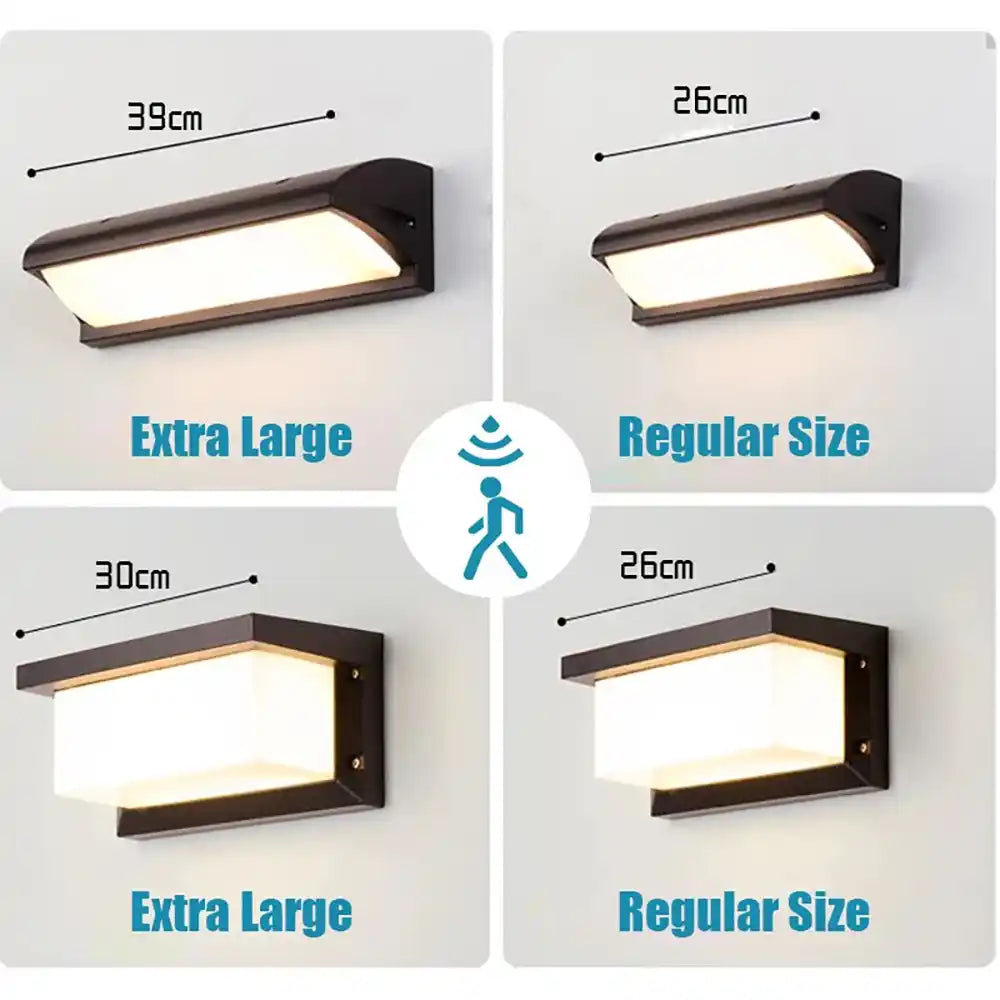
Extra Large LED Outdoor Wall Lights Waterproof Motion Sensor Outdoor Lighting
Weatherproof LEDs boost safety, lower operating costs, and maintain performance in harsh conditions. They protect electrical components from rain, dust, and temperature swings while delivering consistent light quality and reduced maintenance.
Key business impacts:
- Energy savings and predictable operating costs — LEDs use far less energy than legacy HID and incandescent sources.
- Improved safety and crime deterrence due to better uniformity and color rendering.
- Lower labor and replacement costs from long lifetimes and sealed housings.
Data point: the U.S. Department of Energy outlines that LED technology can cut lighting energy use substantially compared with older technologies and highlights lifecycle benefits for commercial applications (DOE — LED Lighting).
Major fixture types for storefronts, walkways, and parking areas
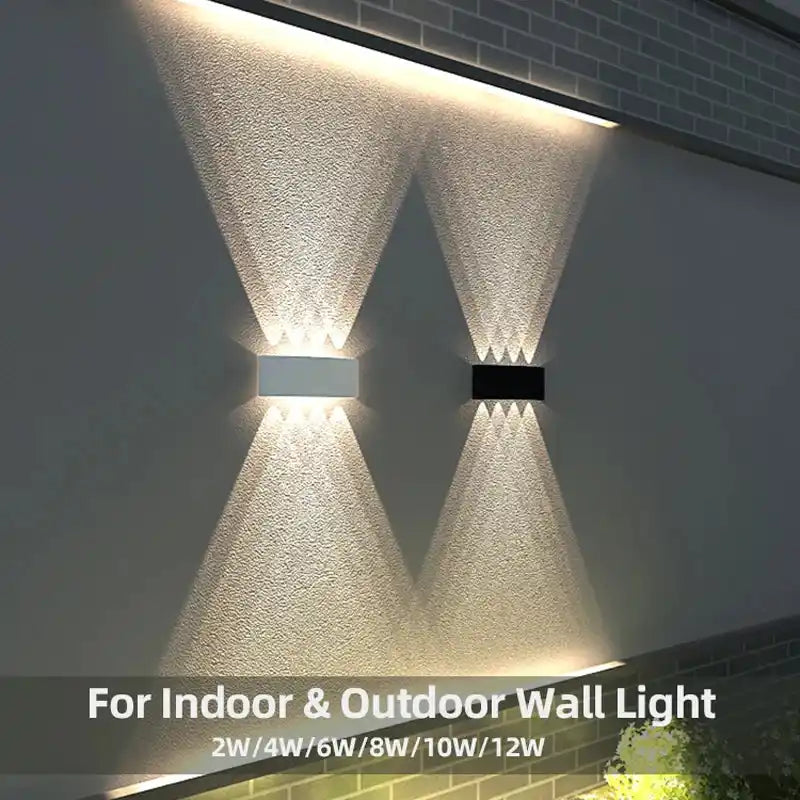
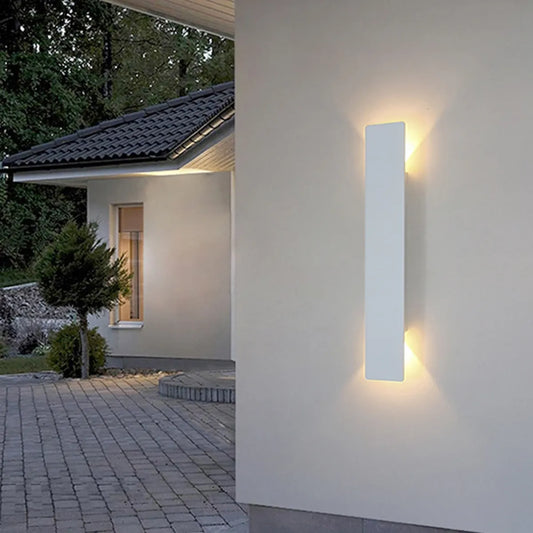
2/12W Waterproof LED Outdoor Wall Lights Aluminum Garden Porch Wall Sconce
This section summarizes which fixture families best serve storefronts, pedestrian paths, and parking lots, and why each is chosen.
Storefront wall packs
Compact, wall-mounted fixtures that illuminate entrances and signage with controlled distribution.
- Best for: building facades, entryways, merchandising windows.
- Look for: Type II/III optics for wide horizontal spread, full cutoff options to reduce glare.
Canopy and soffit-mounted fixtures
Flush-mounted lights ideal for covered walkways, ATM vestibules, and entry canopies.
- Best for: under-canopy uniform illumination and security.
- Look for: IP65+ rating and polycarbonate diffusers for impact resistance.
Pathway bollards and low-level posts
Bollards provide guidance lighting and visual appeal without excessive glare.
- Best for: pedestrian pathways, landscaping edges, ADA-compliant routes.
- Look for: vandal-resistant construction and warm CCT (2700–3000K) for comfortable pedestrian spaces.
Shoebox/area lights for parking lots
Shoebox luminaires (aka area/parking lot lights) provide long throw, high-efficiency illumination for wide parking zones.
- Best for: surface parking lots, loading areas, larger property perimeters.
- Look for: adjustable aims, DLC qualification, and BUG (Backlight-Uplight-Glare) ratings to limit skyglow.
Technical specifications to prioritize when selecting fixtures
Prioritize IP rating, lumens, CCT, CRI, BUG, and certification to ensure performance, compliance, and longevity.
Short checklist (quick-buy guide):
- IP rating: IP65 minimum for most outdoor use; IP66/IP67 near direct spray or flooding.
- Lumens and efficacy: aim for 100–140 lm/W for best value; lumen output sized to space.
- Color: 3000–4000K for commercial exteriors; 2700–3000K for pedestrian-focused areas.
- CRI: ≥70 for general exterior; ≥80 where color rendering matters (signage, retail windows).
- Certifications: DLC (DesignLights Consortium) for rebate eligibility; UL wet-location listing.
Standards & guidance: roadway and area lighting practices and uniformity recommendations are described by the Federal Highway Administration; use these as design baselines for safety and visibility (FHWA — Roadway Lighting).
Top recommended fixtures and product categories (brand-neutral)
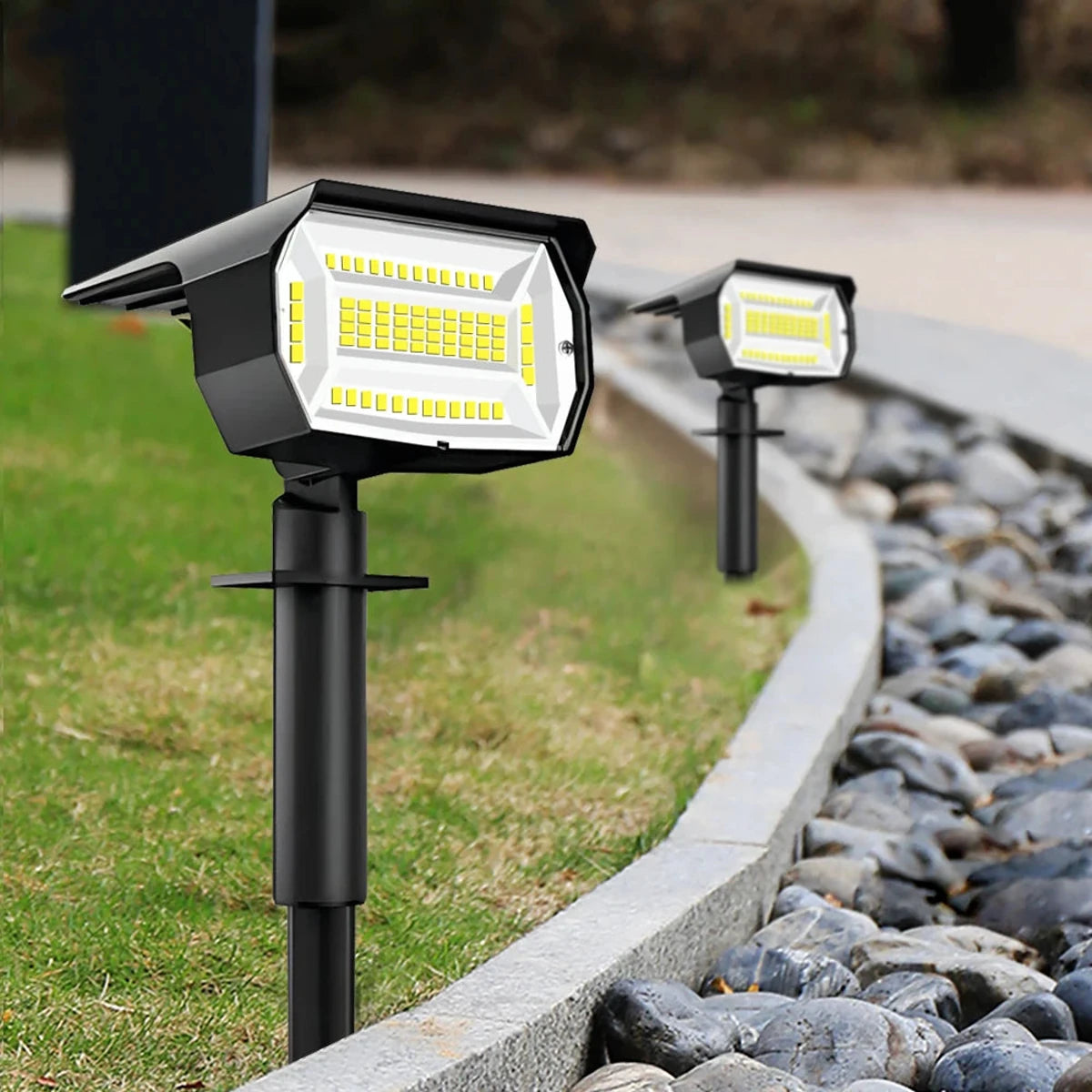
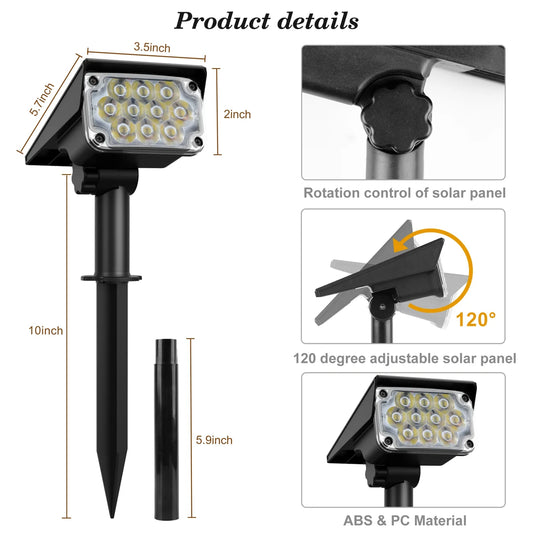
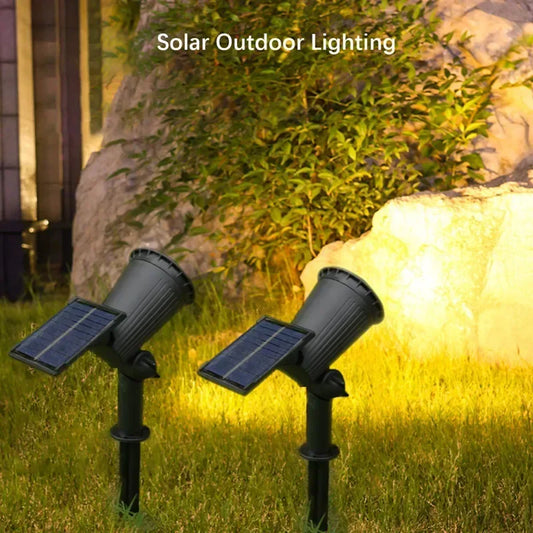
Outdoor 72/68 LEDs Solar Landscape Spotlight Waterproof 3 Modes Solar Garden Lights
Focus on categories with proven field performance and weatherproof construction rather than specific brand models.
| Fixture Type | Typical Use | Suggested IP/BUG | Typical Lumens | Key Benefit |
|---|---|---|---|---|
| Full-cutoff Wall Pack | Storefront, entrances | IP65 / B1-U1-G1 | 2,000–6,000 lm | Low glare, focused facade lighting |
| Canopy Recessed/Surface | Under-canopy walkways, fueling canopies | IP65 / B2-U0-G1 | 1,500–8,000 lm | Uniform under-canopy illumination |
| Bollard/Pathway Post | Pedestrian paths, patio borders | IP65 / B0-U0-G1 | 300–1,200 lm | Comfortable, low-glare guidance lighting |
| Shoebox / Area Light | Parking lots, large yards | IP66 / B2-U3-G2 | 8,000–40,000 lm | High efficacy and long reach |
| Integrated Flood / Landscape | Accent, signage uplighting | IP65 / B1-U0-G1 | 1,000–6,000 lm | Directional accent with good optics |
Buying tips for small businesses
- Choose modular or replaceable driver/LED modules to simplify future repairs.
- Confirm vandal-resistant options for high-traffic or exposed sites.
- Request BUG ratings and photometric files (IES) before purchase to verify distribution.
Controls, sensors, and network options to maximize savings and performance
Controls dramatically increase savings and allow adaptive lighting for safety and compliance.
Common control strategies:
- Photocells/dusk-to-dawn: Basic automatic on/off tied to ambient light.
- Occupancy/motion sensors: Dim to low level and ramp up when activity detected (excellent for low-traffic hours).
- Scheduling and dimming: Time-based profiles and 1–10V or DALI dimming to reduce lumen output at night.
- Wireless networked controls: Remote monitoring, scheduling, and per-fixture adjustments via cellular or mesh networks for larger sites.
Benefits of controls:
- Lower energy bills through hours-of-use reduction and dimming.
- Extended LED life as drivers operate at lower average current.
- Improved security by full-bright activation on detection versus all-night full output.
Sizing, layout, and metrics: how to design a compliant lighting plan
Correct sizing and placement ensure safety, visual comfort, and code compliance while avoiding over-lighting and waste.
Key metrics to design by
- Average horizontal illuminance (lux or fc): parking lots often 2–10 fc average depending on classification.
- Uniformity ratio (avg:min): aim for ≤4:1 in parking areas to avoid deep shadows.
- Lumen maintenance (L70): select fixtures with ≥50,000-hour L70 for long-term consistency.
Quick layout rules
- Storefronts: wall packs spaced 20–40 ft apart depending on mounting height and optical type.
- Walkways: bollards or low posts every 8–15 ft for continuous guidance; Supplement with low-glare wall lights.
- Parking lots: pole heights 15–30 ft with spacing roughly 1–2 times mounting height; verify with photometric simulations.
Tip: Always request an IES photometric layout from suppliers for your exact property dimensions. This eliminates guesswork and ensures required lux and uniformity targets are met.
Costs, energy savings, and ROI example
LED upgrades typically pay back via energy and maintenance savings within 2–5 years for many small commercial projects.
Example ROI — conservative calculation:
- Existing: 400W HPS (actual input ~450W with ballast) × 12 hours/day × 365 = 1,971 kWh/yr per fixture.
- Replacement: 150W LED × 12 hours/day × 365 = 657 kWh/yr per fixture.
- Energy saved: 1,314 kWh/yr per fixture. At $0.13/kWh → $171/yr saved.
- Maintenance saved: fewer lamp/ballast replacements, estimated $50–$150/yr depending on access costs.
- Payback: if installed cost after rebate is $400 per fixture → simple payback ≈ 2–3 years.
Note: Many utilities offer rebates for DLC-qualified fixtures, shortening payback. Check local programs and confirm DLC listing when budgeting.
Maintenance, warranties, codes, and real-world limitations
Plan for maintenance access, warranty terms, and local ordinances; consider environmental limitations like salt spray or extreme cold.
Maintenance and warranty
- Target fixtures with at least a 5-year warranty on the fixture and 3–5 years on drivers; longer warranties indicate manufacturer confidence.
- Design for access: tilt brackets, removable lens retainers, and modular components simplify future servicing.
Codes, Dark-Sky, and municipal requirements
- Many municipalities require full-cutoff or dark-sky-friendly fixtures; confirm local code before ordering.
- BUG ratings and full cutoff optics reduce light trespass and skyglow—often required in commercial districts.
Limitations and environmental considerations
- Glare: High CCT and poorly aimed fixtures can create glare—select optics for tasks and pedestrian comfort.
- Saltwater/coastal sites: Choose corrosion-resistant housings (marine-grade coatings) and higher IP ratings.
- Cold starts: Look for drivers rated for low-temp starting if the site regularly drops below −20°C.
🌟 "Switched our storefront to LED wall packs and installed photocells — power bills dropped and foot-traffic after dusk noticeably increased." — Local business owner
Practical next steps and procurement checklist
Use this compact checklist to move from evaluation to installation with confidence.
- Survey the site: photograph existing poles, mounting heights, and obstructions; measure areas in plan view.
- Define performance goals: safety lux, uniformity, color temperature, and maintenance window targets.
- Request photometric layouts and IES files from 2–3 vendors and compare using the same criteria.
- Confirm DLC and UL listings, warranty terms, and available utility rebates.
- Plan controls: photocell + scheduling; consider networked controls for multi-site management.
- Hire qualified electrical contractor and obtain permits; verify wet-location and conduit ratings during installation.
For more technical design guidance, refer to U.S. DOE resources on exterior lighting practices and the FHWA roadway lighting manual linked earlier.
FAQs
Can I retrofit existing pole or canopy fixtures with LED kits?
Yes — many LED retrofit kits fit common housings and can reduce installation cost. However, verify thermal management, driver compatibility, wet-location ratings, and that the retrofit maintains required optics and BUG ratings. In some cases, full-luminaire replacements are more durable and easier to warranty.
What IP rating do I need for coastal or high-pressure-wash areas?
For general outdoor use, IP65 is a good baseline. For direct spray, high-pressure washing, or coastal salt exposure, choose IP66–IP67 and corrosion-resistant finishes. Also specify marine-grade hardware and longer warranties for coastlines.
Are warmer color temperatures better for storefronts?
3000–3500K is a common compromise for storefronts: it renders merchandise well without appearing too harsh. Cooler 4000K is acceptable for security-focused zones where higher perceived brightness and color contrast are useful; check local ordinances for limits on CCT.
How do I estimate how many lumens my walkway needs?
Walkways typically target 1–5 foot-candles (10–50 lux) depending on pedestrian traffic and risk level. Use bollards or low-level fixtures spaced to achieve a uniform distribution; request photometric files from vendors tailored to your walkway width and tree/obstruction layout.
Will motion sensors annoy customers when lights dim and brighten?
Properly configured systems use gradual dim levels (e.g., 20–30% during low-traffic hours) and short-activation delays to avoid abrupt changes. Test settings during installation and choose occupancy sensors tuned for outdoor detection zones to minimize nuisance triggers.
Where can I find rebates for commercial LED installations?
Utility rebate programs vary by region and often require DLC-qualified fixtures and pre-approval. Start with your local utility’s business incentives page and check the DesignLights Consortium product list for rebate-eligible models.
Related Articles:
- 6 Tips to Choose the Best Solar Flood Light
- Boost Home Security with Motion Sensor Lights
- Lighting Knowledge: Tips & Basics
- Solar String Lights: Tips for Long-Lasting Use
- Ultimate Guide to Solar Spot Lights
- Top 5 Solar Pathway Lights for Your Garden in 2025
- Outdoor Hanging Lights Ideas
- Outdoor Lighting Buying Guide
- The 5 Best Outdoor Solar Lights: Brighten Up Your Space
- How to Choose Outdoor Wall Lights














 />
/>
 />
/>
 />
/>
 />
/>
 />
/>