

Solar and Low-Voltage LED Christmas Lights: Off-Grid Options for Trees and Remote Displays
Table of Contents
- Why choose solar and low-voltage LED Christmas lights?
- Types of solar and low-voltage LED systems for trees and remote displays
- Key components and equipment checklist
- Sizing solar panels and batteries for seasonal lighting
- Installing low-voltage LED lights on trees and remote locations
- Wiring, controllers, and safety: best practices
- Performance, runtime examples, and cost estimates
- Weather, maintenance, durability, and limitations
- Case studies and practical setups
- Buying checklist and recommended next steps
- FAQs
Why choose solar and low-voltage LED Christmas lights?
 Solar and low-voltage LED lighting combines low running cost, safety, and off-grid capability—ideal for trees and remote displays where mains power is impractical or costly to install.
Solar photovoltaic systems with efficient LEDs let you run attractive seasonal lighting with minimal utility impact. They reduce fire risk and often require less physical infrastructure than full-voltage holiday installations. The rest of this article explains types, sizing, installation steps, metrics, limitations, and real-world examples so you can plan a reliable off-grid display.
✨ Embrace energy-efficient, reliable lighting that enhances your holiday display. Choose Lumaz for a smarter, brighter experience.
Types of solar and low-voltage LED systems for trees and remote displays

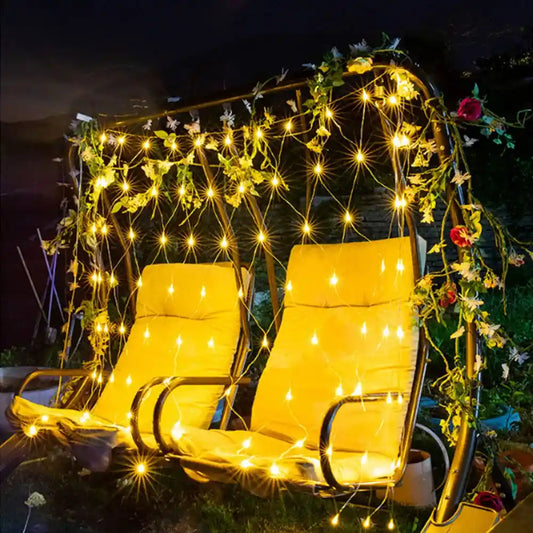
LED Solar String Light Outdoor Fairy String Lights Waterproof
Understand the three practical system types—standalone solar-powered LED strings, low-voltage DC wired networks, and hybrid solar + low-voltage combinations.
- Solar-powered LED strings (integrated): Small solar panel, internal battery, and controller built into a single unit. Best for single trees or small stakes.
- Modular solar + external battery packs: Separate panel, charge controller, and battery, powering 12V/24V LED strings or strips. Scales for larger displays and longer runtimes.
- Low-voltage wired LED networks (mains-supplied transformer or battery): Use a central low-voltage transformer (12V/24V) or DC battery bank to feed multiple runs of LED rope lights or strings—good for multi-tree installations close to each other.
Choosing depends on scale, weather exposure, and access to sunlight. Small solar units are plug-and-play but limited in runtime; modular systems are more work but vastly more capable.
Key components and equipment checklist
A concise list of the parts you’ll need, from panels to connectors and safety gear.
- Solar panel (mono or polycrystalline, wattage sized to load)
- Charge controller (MPPT preferred for efficiency in small systems)
- Battery (sealed AGM or lithium LiFePO4 recommended for cold and cycling)
- Low-voltage LED strings, rope lights, or strip lights (12V or 24V rated)
- Weatherproof enclosures, fuse or breaker, inline connectors, and UV-rated cable
- Mounts for the solar panel (ground stake, pole, or tree-mounted)
- Timer or light sensor controller and remote-switching capability
- Multimeter, cable clips, heat-shrink, and silicone sealant
Sizing solar panels and batteries for seasonal lighting
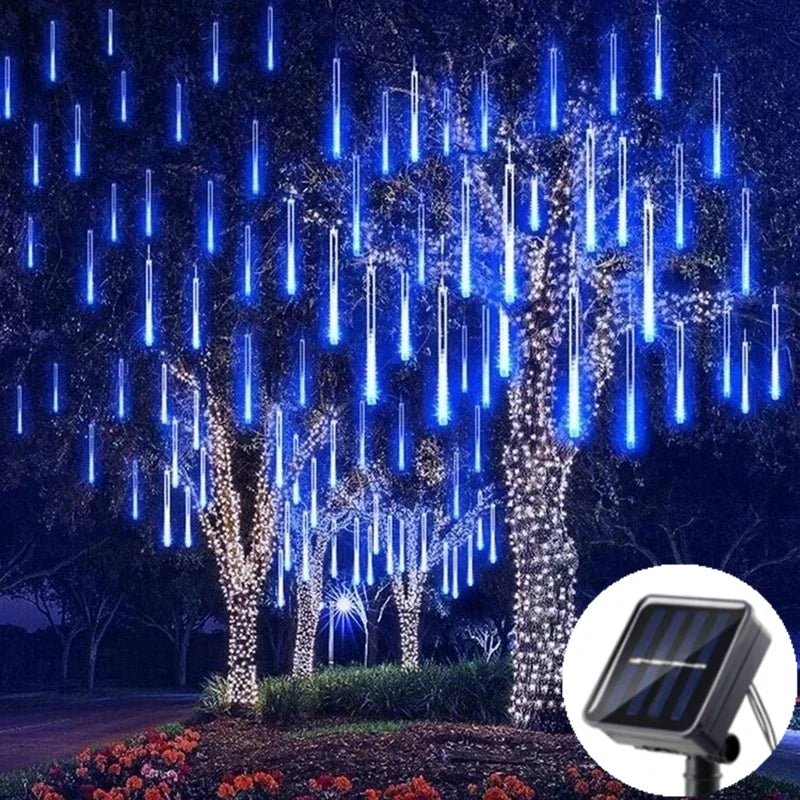
Solar LED Meteor Shower Rain Lights Outdoor String Lights Waterproof Christmas Decoration
Use daily energy (Wh) -> panel wattage -> battery amp-hours to size systems reliably for your display.
Follow this simple calculation sequence to size a small off-grid holiday system:
- Estimate load: sum the wattage of all LED strings (typical 100-LED string ≈ 3–7 W; LED rope lights ≈ 4–10 W per meter depending on density).
- Multiply by nightly hours to get Wh/day. Example: 10 W total × 6 hours = 60 Wh/day.
- Divide by average peak sun hours (PSH) for your location. Use NREL PVWatts or local solar maps for PSH (example: 4 peak sun hours/day) — NREL PVWatts.
- Account for system losses (battery, controller, wiring), multiply result by ~1.3–1.5.
- Battery sizing: choose battery capacity for required autonomy (1–3 nights recommended). Convert Wh to Ah at system voltage: Ah = Wh / V.
Example: 60 Wh/day ÷ 4 sun-hours = 15 W panel; add 30% losses → ~20 W panel. Battery for 2 nights autonomy: 60 Wh/day × 2 = 120 Wh → at 12 V ≈ 10 Ah usable. With depth-of-discharge limits (50% for lead-acid), choose 20 Ah lead-acid or 10–12 Ah LiFePO4.
For reliable design, always default to slightly oversized panels/batteries in winter or heavy cloud areas. The U.S. Department of Energy has useful basics on PV performance and losses.
Installing low-voltage LED lights on trees and remote locations
Follow a safety-first, stepwise installation: plan layout, secure solar array, run low-voltage cabling, and protect connections.
- Plan layout: map each tree/display, record run lengths, and cluster lights to minimize voltage drop.
- Mount solar panel: choose south-facing, unobstructed location; angle for winter sun (latitude ± 15° adjustment).
- Install battery and controller in a vented, weather-rated enclosure near the display but protected from direct rain/snow.
- Run low-voltage cable using UV-rated outdoor wiring; keep runs under recommended lengths or upsize wire gauge to reduce voltage drop.
- Use waterproof connectors, fuses, and a dedicated disconnect switch; test under full load before finalizing.
Practical tips:
- Use zip ties with rubber-lined clips to secure light cables to branches—avoid tight cinching that can girdle living branches.
- If wrapping trunks, anchor the beginning and end; heat-shrink and silicone seal any splices.
- For remote displays, route cables along the ground in conduit or protected raceways to limit wildlife damage.
Wiring, controllers, and safety: best practices
Protect your system with proper fusing, corrosion-resistant connections, and a charge controller sized to the panel and battery.
- Charge controllers: MPPT controllers increase energy harvest, especially in cold or low-light conditions; PWM controllers are cheaper but less efficient for mismatched voltages.
- Fusing and circuit protection: Install inline fuses sized to the conductor and load; place at battery positive terminal and near panel where appropriate.
- Voltage drop: Keep voltage drop <3% where possible—use thicker gauge wire for longer runs (12–10 AWG for long runs at 12V).
- Grounding and lightning: While small PV systems are lower risk, adhere to local code for grounding and surge protection—consider lightning arrestors if the site is exposed.
- Safety source: The Department of Energy and the National Renewable Energy Laboratory provide sound guidance on solar and battery safety—refer to installers or electricians when in doubt.
Performance, runtime examples, and cost estimates
Compare sample setups from single-tree minis to a multi-tree remote display, with estimated panel, battery, and cost ranges.
|
System Type |
Typical Load |
Panel Size |
Battery |
Night Runtime |
Approx. Installed Cost |
|---|---|---|---|---|---|
|
Small tree (integrated solar lights) |
5–10 W (built-in) |
1×5–10 W panel |
Small sealed battery (≤5 Ah) |
4–8 hours |
$25–$80 |
|
Medium display (modular, single tree) |
10–30 W LED strings |
20–50 W panel |
12 V, 10–30 Ah (AGM or Li) |
6–10 hours (1–2 nights autonomy) |
$250–$700 |
|
Remote multi-tree (professional DIY) |
50–200 W total |
100–400 W array |
12/24 V bank, 50–200 Ah |
6–12 hours (multi-night with oversizing) |
$1,200–$5,000+ |
Notes: Costs depend on battery chemistry (LiFePO4 higher upfront, lower lifetime cost) and installation complexity. LEDs drastically reduce energy compared to incandescent décor—Energy.gov documents LED energy savings and longevity benefits (Energy Saver: LED Lighting).
Weather, maintenance, durability, and limitations
Cold, shading, and snow affect solar output and battery performance; plan for maintenance and realistic limits.
- Cold-weather performance: Lithium batteries hold up better in cold than lead-acid; battery capacity changes with temperature—expect reduced runtime in deep cold (see DOE temperature effects guidance).
- Snow and shading: Keep panels angled to shed snow; temporary snow cover will dramatically reduce harvest—either tilt to maximize self-clearing or site panels where snow accumulation is low.
- UV and moisture: Use UV-resistant cable and IP65+ rated LEDs for outdoor use; protect controllers and batteries in enclosures with drainage.
- Wildlife and vandalism: Secure low-voltage wiring and battery enclosures off the ground or locked to reduce tampering and animal damage.
Limitations: small integrated solar novelty lights are attractive but unreliable in heavy tree canopy or prolonged cloudy conditions. For critical displays, size up panels and batteries or consider hybrid mains backup.
🌟 "We used a 50W panel and 30Ah Li battery to run three trees for five hours nightly—no extension cords, no tripped breakers, and it survived a week of cloudy weather." — Community holiday display organizer
Case studies and practical setups
Two real-world examples showing component choices, performance, and lessons learned.
Case A — Single backyard maple (DIY beginner)
System chosen: integrated solar LED string kit (5–10 W). Outcome: quick install, lights run 4–6 hours most nights, cost under $100. Lesson: works best where the canopy is pruned and panel gets unobstructed afternoon sun.
Case B — Neighborhood remote display (community project)
System chosen: 200 W solar array, MPPT controller, 12 V 100 Ah LiFePO4 battery, multiple 12V LED rope and string runs. Outcome: ran 8 hours nightly for 6 weeks with occasional cloudy days; system sized for 2 nights autonomy. Lesson: professional mounting and theft-resistant enclosures increased reliability and reduced maintenance.
Both projects used MPPT controllers and fused DC circuits. The larger project engaged a volunteer electrician for code compliance and grounding—the extra step avoided potential hazards.
Buying checklist and recommended next steps
A practical checklist and a three-step action plan to get from idea to working display.
- Determine total wattage of lights and desired nightly hours.
- Use local peak sun-hours (NREL) to size panels and batteries; oversize by 20–30% for winter reliability.
- Choose MPPT controller and appropriate battery chemistry (LiFePO4 recommended for frequent cycling and cold).
- Buy outdoor-rated LEDs and weatherproof connectors; choose low-voltage (12/24V) systems for safety.
- Plan fusing, surge protection, and a secure battery enclosure; consult local electrical codes for permanent installations.
Three-step action plan:
- Audit your lighting load (list each string/rope and its wattage) and create a simple sketch of display locations.
- Run a sizing calculation (Wh/day → panel W → battery Ah) using NREL PVWatts for peak sun-hours: pvwatts.nrel.gov.
- Buy and bench-test components before installing outdoors; verify charge controller settings and load behavior at dusk.
FAQs
Can I run LED Christmas strings directly from a solar panel?
Not directly. You must use a charge controller and battery between the panel and lights to regulate voltage and store energy for nighttime use. Direct connection will result in unstable brightness and possible damage.
How many hours will a 100 Ah battery run my 50 W display?
Estimate Wh: 50 W × 6 hours = 300 Wh/day. A 12 V 100 Ah battery holds 1200 Wh nominal; usable energy depends on chemistry—about 600 Wh if using lead-acid (50% DoD) or ~1000 Wh for LiFePO4 (80–90% DoD). So LiFePO4 could run ~16–20 hours; lead-acid ~10–12 hours (theoretical). Factor inefficiencies and aging.
Are solar-powered LED lights safe on live trees?
Yes, low-voltage LED lights are much safer than mains-voltage strings. Still, avoid stapling or nailing into the tree—use straps or clips—and keep battery enclosures clear of soil moisture and animal access.
What maintenance does a seasonal solar system need?
Monthly checks: panel cleaning (remove dust/snow), inspect connections for corrosion, test battery voltage, and verify controller logs. Replace consumables (fuses, worn connectors) as needed.
Is it worth using LiFePO4 batteries for a holiday display?
Yes, if you expect frequent cycling, cold-weather use, or want minimal maintenance. LiFePO4 has higher upfront cost but longer life, better cold performance, and deeper usable capacity than sealed lead-acid.
Do I need permits for a larger off-grid holiday display?
Local codes vary. Temporary battery-powered displays are usually permitted without special approval, but larger, permanent installations or wiring near public rights-of-way may require inspection or permits—check with local building authorities.
Conclusion: Solar and low-voltage LED Christmas lights provide a compelling off-grid solution for trees and remote displays. With proper sizing, weatherproofing, and safety practices—supported by MPPT controllers and appropriate batteries—you can achieve attractive, reliable, low-cost seasonal lighting that minimizes fire risk and electrical complexity. For technical planning, use NREL tools and Department of Energy resources as authoritative references to size and optimize your system.
Related Articles:
- The Complete Christmas Lights Buying Guide
- Which Christmas Lights Are Best?
- When Is the Best Time to Hang Christmas Lights?
- How to Choose and Use Christmas Light Clips?
- Fairy Lights: Guide to Creating Magical Spaces
- Solar String Lights: Everything You Need to Know
- How to Store Holiday Decorations Quickly and Efficiently














 />
/>
 />
/>
 />
/>
 />
/>
 />
/>