

How to Choose Christmas Lights: Length, Color Temperature, IP Rating, and Smart Features
Table of Contents
- How to choose Christmas lights: quick overview
- Measure length and calculate power needs
- Understand color temperature and color options
- IP rating and outdoor durability explained
- LED vs incandescent: efficiency, brightness, and lifespan
- Smart features, controllers, and connectivity options
- Safety, certifications, and installation best practices
- Practical buying checklist: connectors, bulb types, and placement
- Cost, energy use, lifespan, and ROI
- Final buying checklist and next steps
- Frequently asked questions (FAQs)
How to choose Christmas lights: quick overview
Start by matching lighting length, color temperature, IP rating, and smart features to your site and goals. This guide breaks each factor into practical steps so you buy the right lights, save energy, and avoid safety issues.
Measure length and calculate power needs
Measure run length, count bulbs, and calculate wattage to avoid too-short strings or overloaded circuits. Simple formulas and examples prevent surprises during installation.
Before buying, measure the full route (roofline, railing, tree circumference) and add 10–20% for corners, slack, and connectors.
- Measure horizontal runs and vertical drops separately; add allowance for clips and corners.
- Count bulbs per string and note wattage per string from the product label.
- Plan how many strings per circuit: continuous loads should not exceed 80% of circuit rating (15A circuit → ~1,440 W at 120 V).
How to calculate expected power draw (quick formula)
Use: total watts = (watts per string) × (number of strings). Convert to kW to estimate operating cost:
kW = total watts / 1,000; cost per hour = kW × electricity price ($/kWh).
Example: 10 LED strings at 6 W each → 60 W (0.06 kW). At $0.15/kWh, cost per 24-hour day = 0.06 × 24 × 0.15 ≈ $0.22.
Understand color temperature and color options
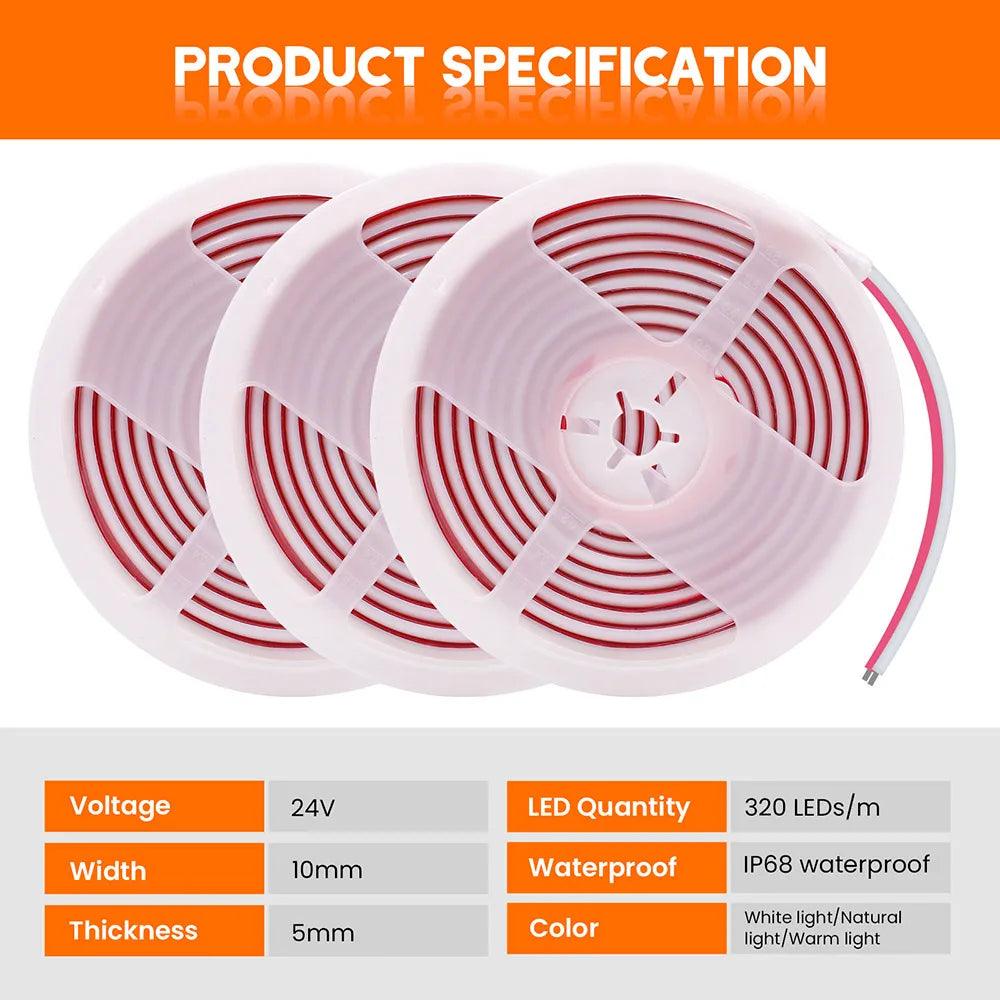
24V IP68 Waterproof COB LED Strip Lights Flexible Tape 320LEDs Bright Liner Lighting RA90
Color temperature (Kelvin) determines warm vs cool appearance; RGB and tunable white let you change tones. Pick based on style, location, and visual comfort.
- Warm white (2,700–3,000 K): traditional, cozy, good for warm wood tones and homes.
- Neutral white (3,500–4,000 K): clearer, modern look—good for displaying decorations.
- Cool white (>4,000 K): crisp, daylight-like; can look harsh on warm-colored houses.
Brightness and color accuracy
Compare lumens (brightness) and CRI (color rendering index). For decorative strings, 4–50 lumens per bulb is common; higher lumens help show ornaments.
Choose CRI ≥ 80 if you want accurate color rendering (important if lights highlight sales displays or décor).
IP rating and outdoor durability explained
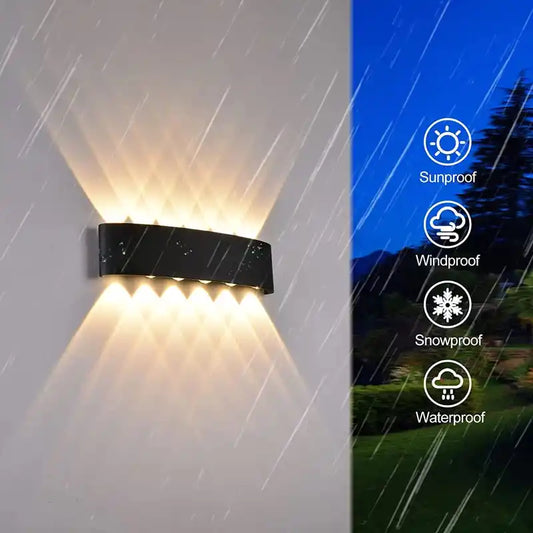
IP (Ingress Protection) codes tell you whether lights resist dust and water. Choose the right IP rating for exposed areas like rooflines or sheltered porches.
IPxy: x = solid-particle protection (0–6); y = liquid protection (0–9).
- IP20: indoor use only — no moisture protection.
- IP44: splash-resistant — acceptable for many outdoor placements (under eaves, protected areas).
- IP65/67: dust-tight and water-jet/immersion resistant — best for exposed rooflines, gutters, or yard fixtures.
Recommendation: For roofline and exposed installations, choose IP65 or higher; for sheltered porches IP44 is often sufficient.
LED vs incandescent: efficiency, brightness, and lifespan
LEDs use far less energy, run cooler, and last longer; incandescent lights are brighter per bulb but much less efficient. Choose by budget, look, and energy goals.
| Type | Typical watts per 50-bulb string | Lumens per bulb | Lifespan | Typical outdoor rating | Notes |
|---|---|---|---|---|---|
| Mini LED (incandescent-size) | 4–10 W | 2–20 lm | 20,000–50,000 hrs | IP44–IP65 | Energy-efficient, cool to touch, many colors. |
| C7/C9 LED (large bulbs) | 10–40 W | 15–100 lm | 15,000–40,000 hrs | IP44–IP65 | Bold, classic look with modern efficiency. |
| Incandescent mini | 35–80 W | 10–60 lm | 1,000–2,000 hrs | Often IP20/indoor | Warmer glow but high heat and energy use. |
| Rope lights / LED rope | 8–30 W per 16 ft | Varies | 10,000–30,000 hrs | IP65 common | Good for outlining edges, flexible mounting. |
| Addressable RGB (pixel) LED | 10–100+ W (depends on length & density) | Variable; per pixel brightness | 20,000–50,000 hrs | IP65 common for outdoor models | Dynamic effects, higher power draw and control complexity. |
Why energy matters
LEDs generally save 60–90% energy compared with incandescent strings; this adds up on long displays. The U.S. Department of Energy explains LED benefits and savings in residential lighting applications.
Source: energy.gov — LED lighting
💡 For superior efficiency, brilliant brightness, and a remarkably long lifespan, the choice is clear. Choose Lumaz LED technology for a smarter, brighter home.
Smart features, controllers, and connectivity options
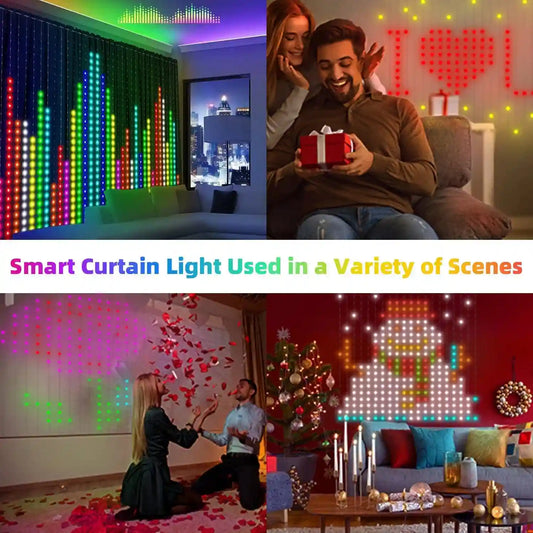
Smart lights offer scheduling, color control, and dramatic animations. Choose platforms and protocols that match your skill level and privacy preferences.
- Connectivity: Wi‑Fi (direct to internet), Bluetooth (local), Zigbee/Z‑Wave (hub-based), proprietary RF (controller-based).
- Control features: grouping, scenes, scheduling, sunrise/sunset timers, energy monitoring.
- Addressable vs non-addressable: addressable (pixel) LEDs let you animate each pixel; non-addressable change whole strings or zones.
What to look for in smart lights
- Local control option (no cloud) to avoid dependency on vendor servers.
- Compatibility with your assistant (Alexa, Google, HomeKit) if voice control is required.
- Security and firmware updates—prefer vendors with regular patches.
- Power monitoring if you want to track energy use and detect faults.
Safety, certifications, and installation best practices

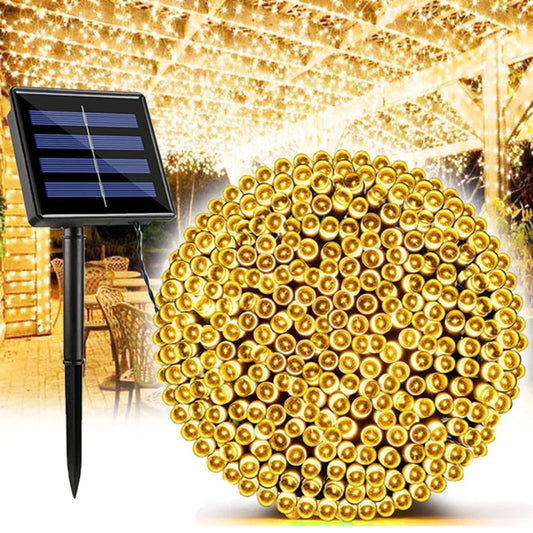
1/2/4PCS Led Crystal Globe Lights Solar String Lights Outdoor with 8 Modes Waterproof
Prioritize UL/ETL-listed products, outdoor-rated extension cords, and protected outlets. Safe installation reduces fire risk and prevents damage to property and lights.
🎄 "Switched to outdoor-rated LEDs and a GFCI outlet — no more tripping breakers and much lower power bills." — A homeowner from a community lighting forum
Key safety measures:
- Use GFCI-protected outlets for all outdoor lighting circuits.
- Follow listing marks: UL, ETL, or equivalent indicate third-party safety testing.
- Avoid running cords through windows or pinching under doors; use weatherproof boxes for outdoor connections.
- Don’t exceed the manufacturer’s maximum strings-per-connector recommendation.
- Inspect wires annually for cracked insulation and replace damaged strands.
For holiday-related fire and electrical safety guidance, consult the U.S. Consumer Product Safety Commission’s holiday safety resources.
Source: cpsc.gov — Christmas tree and lights safety
Practical buying checklist: connectors, bulb types, and placement
Choose bulb and connector types that match your mounting style and power plan. Plan clips, supports, and cord routing before purchase.
- String connector type: male/female end-to-end connections for daisy-chaining; verify weather seals on outdoor connectors.
- Bulb style: mini, C7/C9, globe, net, icicle, rope—pick for visual effect and mounting ease.
- Mounting hardware: plastic roof clips for shingles, gutter clips for gutters, zip ties for railings (avoid metal nails).
- Extension cords: outdoor-rated (SJTW or SJT) with adequate gauge for run length and load.
Placement tips for best effect
- Roofline: choose larger bulbs (C9) or rope lights for visibility from the street.
- Shrubs/trees: use mini LEDs or net lights to wrap foliage with minimal wiring.
- Pathways: low-voltage rope lights or stake-based fixtures improve safety and curb appeal.
- Windows: icicle lights or simple string lights mounted inside the frame create clean lines.
Cost, energy use, lifespan, and ROI
Factor upfront cost against energy savings and lifespan to calculate return on investment. LEDs often pay back in 1–3 seasons depending on scale and run hours.
Estimate annual energy cost: multiply kW by annual hours of use and local $/kWh. LEDs lower energy and replacement costs substantially.
- Typical LED seasonal runtime: 4–8 hours/day over 60 days → 240–480 hours.
- Example ROI: replacing one 50-bulb incandescent string (40 W) with an LED equivalent (6 W) saves ~34 W. Over 480 hours at $0.15/kWh, savings ≈ 0.034 kW × 480 × $0.15 ≈ $2.45 per string per season; larger displays scale savings.
- Also consider replacement frequency: LEDs last 10–25× longer than incandescent, reducing labor and replacement costs.
Limitations and realistic expectations
Addressable pixel displays require more power and technical setup. Cheap LEDs may have poor color consistency or shorter lifespans. Prioritize trusted brands and documented specs.
Final buying checklist and next steps
Use this concise checklist to finalize your purchase and installation plan. It keeps choices targeted and reduces wasted spend.
- Measure all runs and add 10–20% slack.
- Decide on look: warm vs cool white or full RGB/tunable color.
- Choose LED for energy savings unless incandescent aesthetics are essential.
- Pick IP rating based on exposure: IP44 for sheltered outdoors, IP65+ for exposed areas.
- Select smart features with local-control option if privacy or reliability matters.
- Verify UL/ETL listing and buy outdoor-rated cords and GFCI protection.
- Plan circuit loads—keep continuous loads ≤80% of circuit capacity.
Frequently asked questions (FAQs)
Q: How many light strings can I safely connect together?
A: Follow the manufacturer's recommendation printed on the product. If unavailable, calculate total watts and keep continuous load below 80% of circuit capacity (15A × 120V → ~1,440 W). For example, if each string uses 40 W, you could run up to ~36 strings theoretically, but manufacturers often limit daisy-chaining to 3–10 strings for safety.
Q: Is warm white or cool white better for house rooflines?
A: Warm white (2,700–3,000 K) is traditional and blends well with warm brick, wood, or yellow lighting. Cool white (>4,000 K) reads brighter from a distance and pairs well with modern facades. Consider viewing distance and the home’s color palette.
Q: Do smart lights use more energy than non-smart LEDs?
A: Core LED energy use is the same per lumen whether smart or not. Smart features add small standby or control-module power draw; typically a few tenths of a watt per device. The convenience and scheduling often enable net energy reductions compared with always-on timers.
Q: What IP rating do I need for lights on a snow-exposed roof?
A: Prefer IP65 or IP67 for areas exposed to wind-driven rain, snow, or melting ice since these ratings offer water-jet resistance or temporary immersion protection and are dust-tight.
Q: Can I leave LED Christmas lights plugged in overnight?
A: Yes—LEDs run cool compared with incandescent bulbs and are designed for long operating hours. Still, use GFCI-protected outlets, keep plugs off the ground in wet locations, and follow manufacturer maximum run recommendations.
Q: How do I store lights to extend lifespan?
A: Remove bulbs that are damaged, coil strings loosely around a reel or cardboard, keep connectors dry, and store in a cool, dry place away from rodents. Label lengths and locations for next season to reduce mistakes.
Related Articles:
- The Complete Christmas Lights Buying Guide
- String Lights: Guide to Brightening Your Space
- Fairy Lights: Guide to Creating Magical Spaces
- How to Hang Icicle Lights: Perfect Installation Tips and Tricks
- When Is the Best Time to Hang Christmas Lights?
- Christmas Light Color Choosing Guide
- Tips for Using Incandescent Christmas Lights
- Which Christmas Lights Are Best














 />
/>
 />
/>
 />
/>
 />
/>
 />
/>