

String Lights vs Net Lights vs Icicle Lights vs Rope Lights: Which LED Type Is Right for Christmas?
Table of Contents
- Quick snapshot: Which LED type fits your home?
- How these LED types differ at a glance
- String lights: flexible, versatile, and widely used
- Net lights: fast coverage for shrubs and facades
- Icicle lights: roofline and eave accents that mimic icicles
- Rope lights: rigid, linear lighting for clean lines and safety
- Key technical factors to compare (brightness, power, IP, and color)
- Energy use, operating cost, and lifespan — real numbers
- Installation and mounting: tools, anchors, and a quick plan
- Safety, weatherproofing, and code considerations
- Troubleshooting and maintenance for longer life
- Aesthetics and layering: design recipes for rooms and exteriors
- Smart features, connectivity, and control options
- How to decide: a step-by-step selection checklist
- Cost-benefit summary and final recommendation
- Further resources and credible references
- Frequently asked questions
Quick snapshot: Which LED type fits your home?
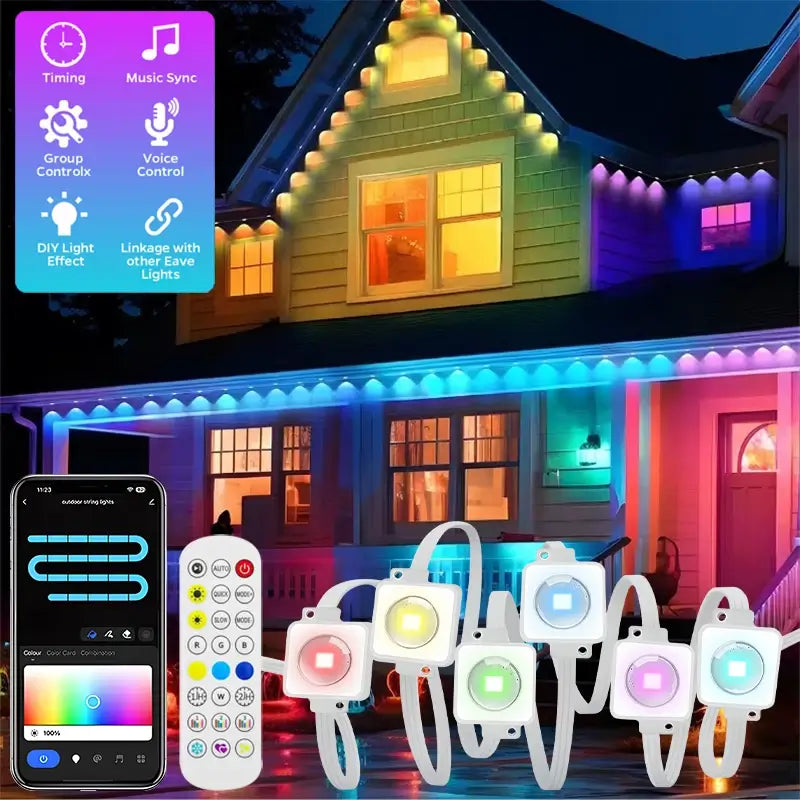 Choose a light type by location, purpose, and visual goal: string lights for flexible accents, net lights for shrubs, icicle lights for rooflines, and rope lights for clean linear effects.
How these LED types differ at a glance
Each LED style has unique form, mounting method, and visual effect — the right choice balances brightness, weatherproofing, and installation complexity.
Basic distinctions:
- String lights: individual bulbs on a flexible cord; highly customizable.
- Net lights: pre-spaced grid for fast shrub/hedge coverage.
- Icicle lights: staggered vertical drops for rooflines and eaves.
- Rope lights: LEDs sealed inside a tube for linear, rigid runs.
String lights: flexible, versatile, and widely used

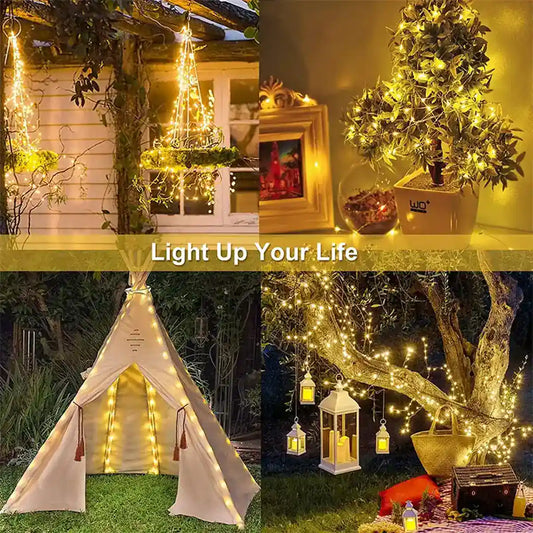
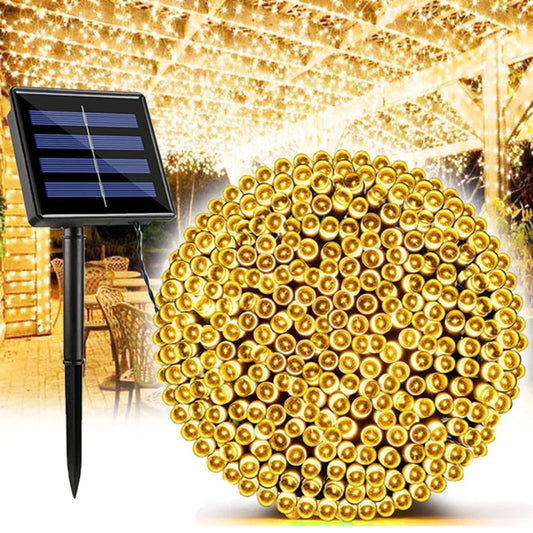
LED Solar String Light Outdoor Fairy String Lights Waterproof
String lights are best for wrapping, draping, and outlining because they're flexible, come in many lengths, and attach to nearly any surface.
Typical specs and options
- Lengths: 5–100+ feet; common 25', 50', 100'.
- Bulb spacing: 2", 4", 6", 12" (mini vs C7/C9 style).
- Wattage: LED strings commonly 3–20 W for 25–100 bulbs.
- Color temps: warm white (2700K–3000K), cool white (4000K–6000K), RGB color-changing.
- Ratings: indoor-only, damp-rated (porch), or wet-rated (direct exposure).
Pros
- Highly customizable length and spacing.
- Easy to replace or repair a single bulb/socket (on many LED sets).
- Available in smart/app-controlled options for scenes and timers.
Cons and limitations
- Can tangle and require more time to install than pre-shaped options.
- Lower-end models may lack waterproof endcaps; check IP rating.
Best uses
- Wrap trees, railings, columns, pergolas, and interior mantels.
- Hanging café or bistro scenes (use string lights rated for outdoor use and with solid mounting points).
Net lights: fast coverage for shrubs and facades
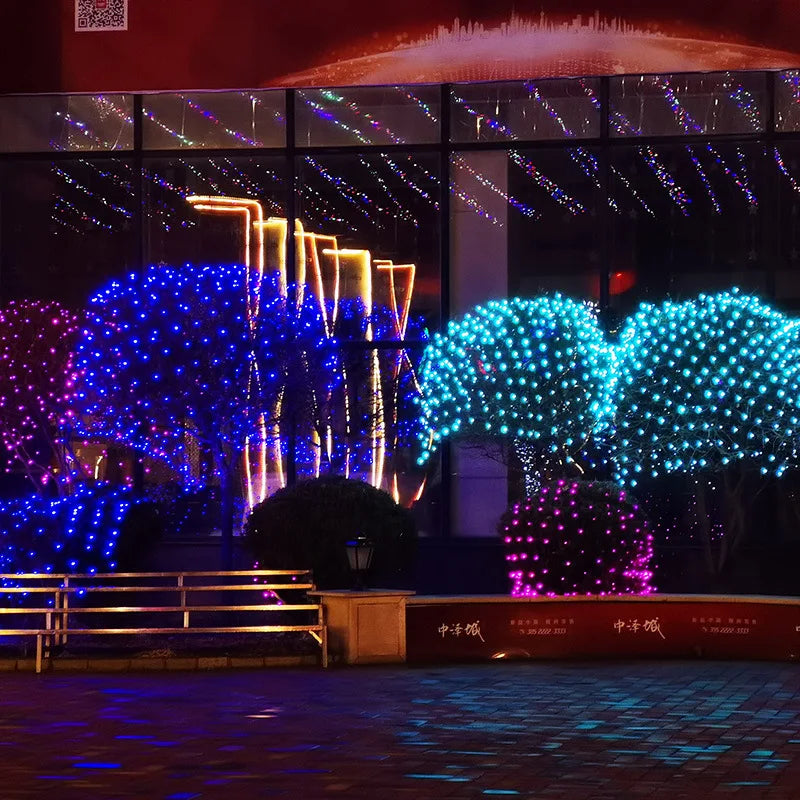
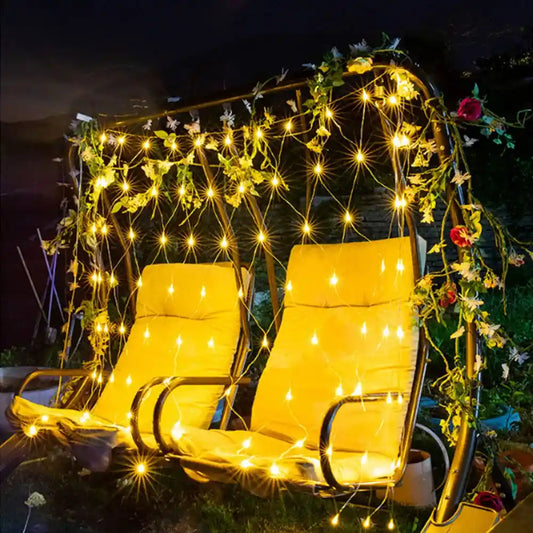
LED Net Mesh String Lights Waterproof Outdoor Christmas Lights
Net lights are pre-arranged grids that make covering hedges, bushes, and flat facades fast and uniform with minimal effort.
Typical specs and options
- Common grids: 3x3 ft, 4x6 ft, 6x8 ft, etc.
- Wattage: roughly 5–40 W depending on grid size and LED type.
- Connection: plug-to-plug sections or fixed-end plugs for chaining.
Pros
- Quick to drape over shrubs: consistent coverage and spacing.
- Less fiddly than individual string-wrapping.
- Often comes in warm white and multicolor options.
Cons and limitations
- Limited flexibility for irregular shapes; may need trimming or overlap.
- Replacement of individual LEDs can be tricky on sealed nets.
Best uses
- Wrapping bushes, low hedges, and air-conditioner covers.
- Quick commercial displays where uniform look matters.
Icicle lights: roofline and eave accents that mimic icicles
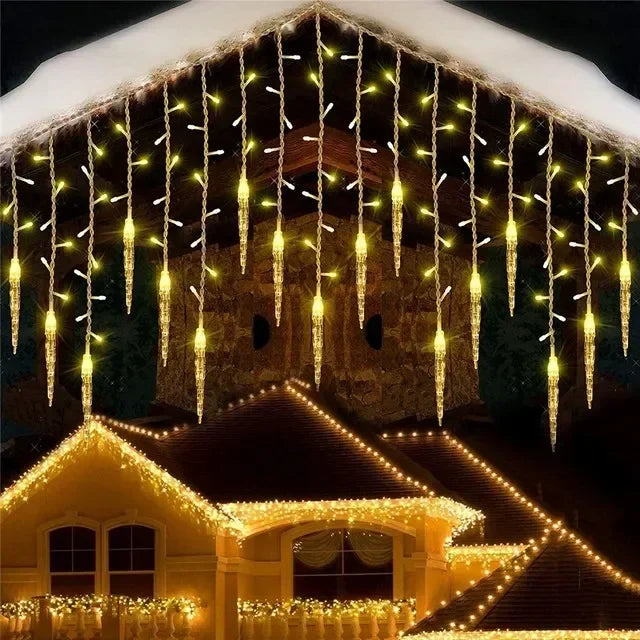
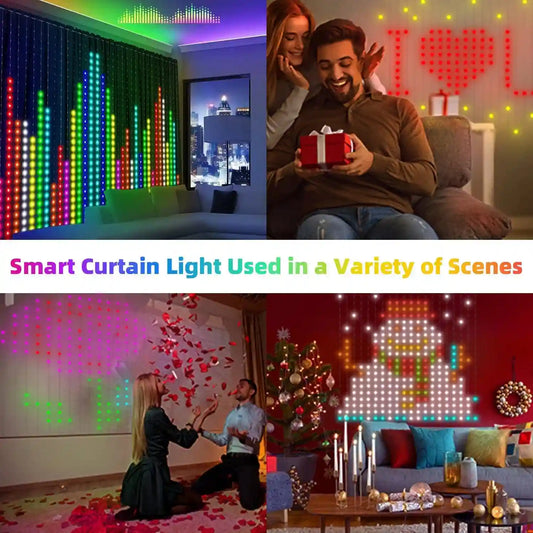
8Mode LED Curtain Icicle String Lights Waterfall Christmas Lights For Street Eaves Patio
Icicle lights hang in vertical strands of varying lengths, giving a classic roofline silhouette and motion-friendly sparkle.
Typical specs and options
- Drop lengths: commonly 6", 12", 18", up to 36"; mixed-length sets mimic natural icicles.
- Spacing: vertical strands spaced 3"–12" along a horizontal header.
- Wattage: LED icicle sets often 5–30 W depending on run length.
Pros
- Traditional holiday look that emphasizes architecture.
- Can create motion or twinkle effects with synchronized controllers.
Cons and limitations
- Requires secure mounting points along gutters and eaves.
- Long exposed drops may be vulnerable to heavy ice/wind unless designed for exterior loads.
Best uses
- Rooflines, porches, eaves, and second-story windows where vertical emphasis is desired.
Rope lights: rigid, linear lighting for clean lines and safety
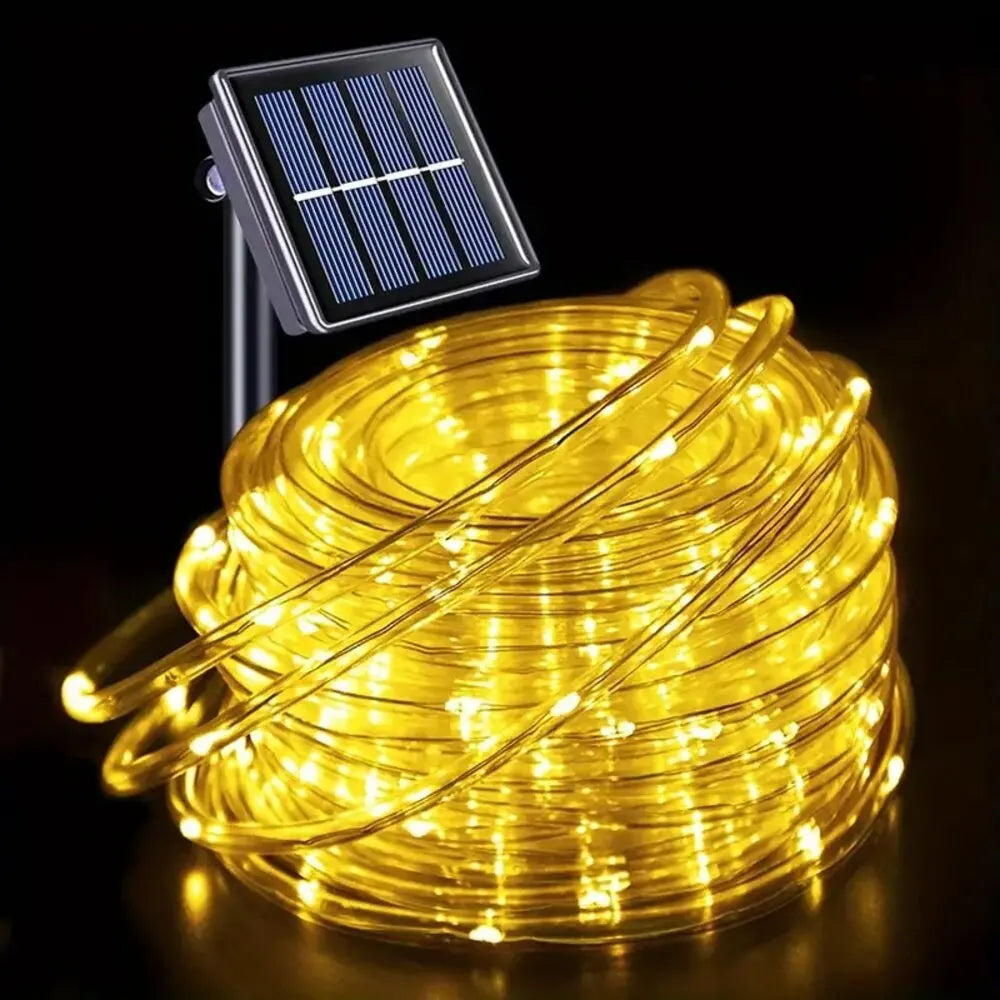
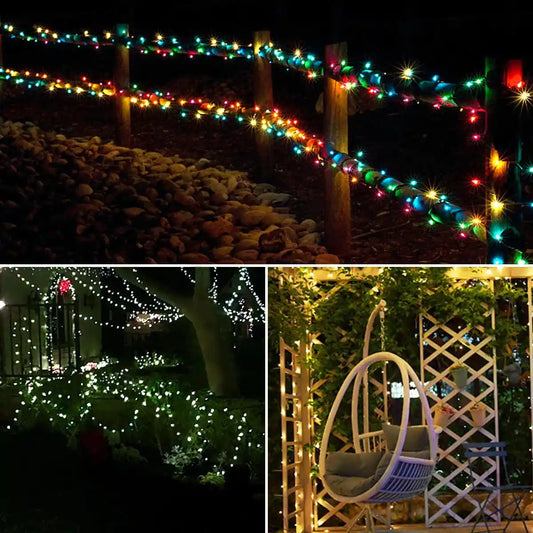
Solar Outdoor Tube Rope Lights, LED Fairy String Lights For Garden Christmas Decoration
Rope lights house LEDs inside a sealed clear or diffused tube—great for outlining pathways, steps, and architectural lines with minimal visible hardware.
Typical specs and options
- Profiles: circular tube (8–10 mm) or flat edge-mount channels.
- Lengths: sold in 16', 50', or by the foot; often cuttable at marked intervals.
- Wattage: roughly 3–10 W per 16 ft depending on LED density.
- IP ratings: many rope lights are wet-rated when properly sealed.
Pros
- Produces a continuous line of light—no visible bulbs.
- Durable and often weather-sealed for long exterior runs.
- Simple mounting with clips or channels; low-profile look.
Cons and limitations
- Less “sparkle” than individual LEDs; lower perceived brightness per foot.
- Replacement or repair of damaged segments can be harder than replacing a string.
Best uses
- Under stair treads, along decks, soffits, inside coves, and sign outlines.
Key technical factors to compare (brightness, power, IP, and color)
Compare lumens, wattage, IP (ingress protection), and color temperature to match your performance and weather needs.
Important metrics defined:
- Lumens = perceived brightness. Higher lumens = brighter light for same wattage.
- Watts = power draw; with LEDs, lower watts achieve same lumens as incandescents.
- IP rating = protection against dust and water. IP65+ recommended for fully exposed outdoor runs.
- Color temperature (Kelvin): warm (2700K–3000K) vs cool (>4000K) affects ambiance.
Comparison table: typical values by LED type
| Light Type | Typical Wattage (per 50 ft) | Typical Lumens (per ft) | Common IP Rating | Best For | Typical Cost Range (set) |
|---|---|---|---|---|---|
| String Lights | 5–15 W | 10–40 lm/ft | IP44–IP65 | Trees, wrap, patio | $15–$80 |
| Net Lights | 5–35 W | 15–35 lm/ft | IP44–IP65 | Shrubs, uniform coverage | $20–$120 |
| Icicle Lights | 5–25 W | 20–50 lm/ft (header) | IP44–IP65 | Rooflines, eaves | $20–$100 |
| Rope Lights | 5–40 W | 5–20 lm/ft | IP65–IP67 | Linear accents, steps | $10–$150 (by length) |
Energy use, operating cost, and lifespan — real numbers
LEDs use far less energy than incandescents; that saves money and reduces heat. Use wattage and hours to estimate cost.
Key guidance: LEDs can use up to 75–80% less energy than incandescent lights and last much longer, according to the U.S. Department of Energy.
Example calculations (assume $0.13 per kWh):
- LED string (50 ft) = 10 W. Running 6 hours/day for 30 days = 10 W × 180 hours = 1.8 kWh → cost ≈ $0.23 per month.
- Incandescent string (50 ft) = 40 W. Same use = 40 W × 180 hours = 7.2 kWh → cost ≈ $0.94 per month.
- Annual seasonal cost (LED) ≈ $2.75; incandescent ≈ $11.70. Savings scale with number of sets and hours used.
For national guidance on energy-efficient lighting, see the U.S. Department of Energy: energy.gov — LED Lighting.
💡 Save significantly with Lumaz LEDs. Our advanced tech offers superior energy efficiency, slashing operating costs while providing a remarkably long lifespan for lasting value.
Installation and mounting: tools, anchors, and a quick plan
Install safely: match mounting hardware to surface and choose rated connectors and extension cords for outdoor use.
Tools and supplies you'll likely need
- Weatherproof extension cords and outdoor-rated timers.
- Mounting clips (plastic roofline clips, gutter hooks, adhesive clips for smooth surfaces).
- Staple-free fasteners or cable ties for net lights and rope channels for rope lights.
- Drill, ladder, rubber gloves, and silicone sealant (for cut rope ends).
Step-by-step quick install checklist
- Plan layout: measure length and mark anchor points.
- Confirm IP rating and outdoor/damp/wet suitability.
- Set up grounding, GFCI-protected outlets, or use a GFCI adapter.
- Attach lighting using clips at recommended intervals (typically every 12–18").
- Test runs before finalizing and seal any cut rope-light ends with end caps/sealant.
Mounting tips by type
- String lights: use bulb clips or screw-in hooks; avoid piercing the cord.
- Net lights: drape over foliage and secure corners with stakes or cable ties.
- Icicle lights: use gutter clips or screw-in gutter hooks along the header wire.
- Rope lights: mount in aluminum channel for heat dissipation and neat looks; end seal each cut point.
Safety, weatherproofing, and code considerations
Follow rating labels, use outdoor-rated cords, and keep connections off the ground to reduce shock or fire risk.
Key safety requirements:
- Use lights and extension cords rated for outdoor/wet use when exposed to rain or snow.
- Plug outdoor decorations into GFCI-protected outlets; use timers or smart plugs rated for outdoor use.
- Inspect cords annually for cracking, exposed wires, or damaged plugs—replace if any issue.
For formal safety guidance on decorative lights and preventing holiday-related hazards, consult the U.S. Consumer Product Safety Commission: cpsc.gov — Holiday Lighting Safety.
Local codes and HOA rules
- Check municipal codes for wiring or electrical restrictions for large displays.
- Review HOA rules about lighting color, hours, and intensity to avoid disputes.
Troubleshooting and maintenance for longer life
Troubleshoot flickers, sections out, or dimming with a methodical approach: check power, connectors, and individual LEDs.
Common problems and quick fixes
- No power: confirm outlet GFCI hasn't tripped and test with a known-good appliance.
- Section out: on wired sets, a failed resistor/LED often isolates a section—swap with a spare set to test.
- Dimming: check for poor connections, excessive voltage drop from too-long runs or undersized wiring.
Seasonal maintenance checklist
- Before storage: clean, dry, and coil sets without tight knots.
- Store in a cool, dry place—avoid attic heat that can degrade plastic and solder joints.
- Replace cracked light covers, seal cut rope-light ends, and tighten any loose connectors before re-installation.
Aesthetics and layering: design recipes for rooms and exteriors
Combine light types to add depth: rope lights for base lines, strings for texture, and icicles for architectural emphasis.
Design ideas by area
- Patio/café look: warm-white string lights overhead + rope lights under railings.
- Front yard: net lights on shrubs + icicle lights on roofline for symmetry.
- Deck and steps: rope lights under deck skirts + step riser rope for safety and style.
Color and temperature choices
- Warm white (2700K–3000K): cozy, classic holiday look; blends with traditional décor.
- Cool white (4000K+): modern, crisp, and better for security lighting.
- RGB/multicolor: use for dynamic displays; avoid overuse on historic properties unless permitted.
Layering strategy
- Start with architectural lines (rope or string) to define space.
- Add focal points (trees, entryway) with net or wrapped string lights.
- Finish with accents (icicles, spot LEDs) for depth and sparkle.
Smart features, connectivity, and control options
Smart LEDs add scheduling, color control, and grouping—ideal for convenience and energy management.
- Wi‑Fi/Bluetooth sets: control via app, integrate with voice assistants.
- Proprietary controllers (for large displays): support synchronized effects across many strands.
- Timers and photocells: simple energy savings by scheduling lights to turn off automatically.
Tip: choose controllers rated for outdoor use and match load limits to your total wattage.
How to decide: a step-by-step selection checklist
Answer six practical questions to pick the best LED lighting type for your project.
- What's the mounting surface? (Shrub, roofline, railing, walkway.)
- How much run length do you need? (Measure twice; add 10% slack.)
- Do you need a continuous line or visible bulbs?
- Is the area fully exposed to weather? (Pick IP65+ for wet exposure.)
- Do you want smart control, color effects, or a fixed-warm look?
- What’s your budget for purchase and long-term running cost?
Decision quick guide:
- If you want speed and uniform bush coverage → choose net lights.
- If you want architectural vertical accents → choose icicle lights.
- If you want flexible, romantic draping → choose string lights.
- If you want low-profile, durable linear lines → choose rope lights.
🎄 "Switched our old incandescent roofline to warm LED icicle lights last winter—installation was faster than I expected and our electric bill barely moved." — Amelia, neighborhood display organizer
Cost-benefit summary and final recommendation
Investing in LED nets, strings, icicles, or rope lights reduces energy use and maintenance; choose by placement and desired visual effect.
Final recommendations:
- Prioritize IP ratings and GFCI protection for any outdoor setup.
- Match form factor to the surface for easier installation and better aesthetics.
- Consider smart sets for convenience if you’ll run many hours nightly.
Further resources and credible references
For more on LED energy savings and safe use of decorative lighting, consult:
- U.S. Department of Energy — LED lighting basics and savings: https://www.energy.gov/energysaver/led-lighting
- U.S. Consumer Product Safety Commission — Holiday lighting safety guides: https://www.cpsc.gov/safety-education/safety-guides/home/holiday-safety
Frequently asked questions
Are LED lights safe to leave on all night?
Yes, LEDs run much cooler and are safer than incandescents, but always use lights rated for continuous use and plug outdoor sets into GFCI outlets or timers for extra safety.
Can I connect multiple LED strings together?
Most LED sets allow chaining, but follow the manufacturer’s recommended maximum chain length to avoid voltage drop and overheating. Smart and high-wattage displays often require separate circuits.
What IP rating do I need for lights exposed to snow and rain?
Choose IP65 or higher for direct exposure to rain and snow. IP44 is typically fine for sheltered porches or damp locations but not for direct weather exposure.
How do I store lights to avoid damage?
Clean and dry lights before coiling loosely on a reel or around a flat board. Avoid sharp bends in rope lights and store in a cool, dry place away from heavy items that could crush wires.
Can rope lights be cut to length?
Yes—many rope light products are cuttable at marked intervals. Always cut only at manufacturer-designated points and reseal ends with the supplied end caps and silicone to maintain the IP rating.
Should I prefer warm or cool white for outdoor lighting?
Warm white (2700K–3000K) creates a welcoming, traditional atmosphere and complements warm-colored exteriors; cool white (4000K+) reads cleaner and is often chosen for modern architecture and security lighting.
Related articles:














 />
/>
 />
/>
 />
/>
 />
/>
 />
/>