

How to Choose Bedroom Lights Based on Room Size, Ceiling Height, and Bed Placement
Table of Contents
- Introduction: Why Space Determines Bedroom Lighting Choices
- 1. Bedroom Size as a Non-Negotiable Lighting Constraint
- 2. Ceiling Height and Perceived Comfort
- 3. Bed Placement as the True Reference Point
- 4. How Spatial Variables Interact in Bedroom Lighting Decisions
- 5. Spatial Decision Mistakes That Lead to Poor Bedroom Lighting
- 6. When Spatial Constraints Limit Your Lighting Options
- FAQ
- Conclusion: Let Spatial Logic Guide Lighting Decisions
Introduction: Why Space Determines Bedroom Lighting Choices
Bedroom lighting choices are shaped by space first and fixtures second. Treat room size, ceiling height, and bed placement as inputs, and the “right” lights become easier to identify.
This is a decision guide, not an installation tutorial. It focuses on what your space allows and why some lighting feels uncomfortable from the bed at night.
Light is not just visual; it influences alertness and timing. NIGMS explains how light exposure helps regulate circadian rhythms (nigms.nih.gov).
Bedroom Size as a Non-Negotiable Lighting Constraint
Room size is a hard boundary, not a style preference. It determines how quickly light fills the space, how “busy” fixtures feel, and how forgiving the room is when a light source is too bright or poorly controlled.
Small Bedrooms: Preventing Overlighting and Visual Compression
In small bedrooms, lighting failures often come from overcompensation: adding brightness or fixtures to “fix” a room that already reflects light strongly and has short viewing distances.
Small spaces amplify three effects:
- Short throw distance: light reaches walls and your eyes quickly, so intensity feels higher than expected.
- High reflection feedback: light bounces back faster from nearby surfaces, increasing perceived brightness and glare.
- Fixture dominance: a large or visually complex fixture takes up a larger percentage of the room’s visual field.
Decision rule: in a small bedroom, if the room feels “flatter” or more cramped after adding light, you likely increased uniform brightness without improving usable light where you need it. The symptom is not darkness; it is visual compression from too much unstructured light.
Decision check: from the bed, can you see the bulb or a hotspot? If yes, small rooms magnify the discomfort.
In a small bedroom, it's important to control light placement to avoid overwhelming the space with unstructured brightness. The Wood Touch-Control LED Wall Light, with its 360° rotatable design and three adjustable brightness levels, allows you to direct light exactly where you need it, providing focused illumination without the discomfort of visible hotspots or glare.

Medium Bedrooms: When Multiple Lighting Approaches Become Viable
Medium bedrooms create the highest decision complexity because multiple approaches can work, and trade-offs matter more than absolutes.
Use these judgment dimensions to keep the decision grounded in space:
- Control distance: how far you are from switches or dimmers when you are in bed.
- View angles from bed: whether light sources are visible at seated and lying angles.
- Surface reflectance: light walls, mirrors, and glossy furniture multiply brightness and highlight glare.
- Furniture density: more furniture creates shadows and “dark pockets,” changing how even light feels.
Decision rule: if you cannot name the primary job of each light source (general navigation, reading, dressing, mood), a medium bedroom is where “nice fixtures” start to compete and cause annoyance, even when the room looks bright enough.
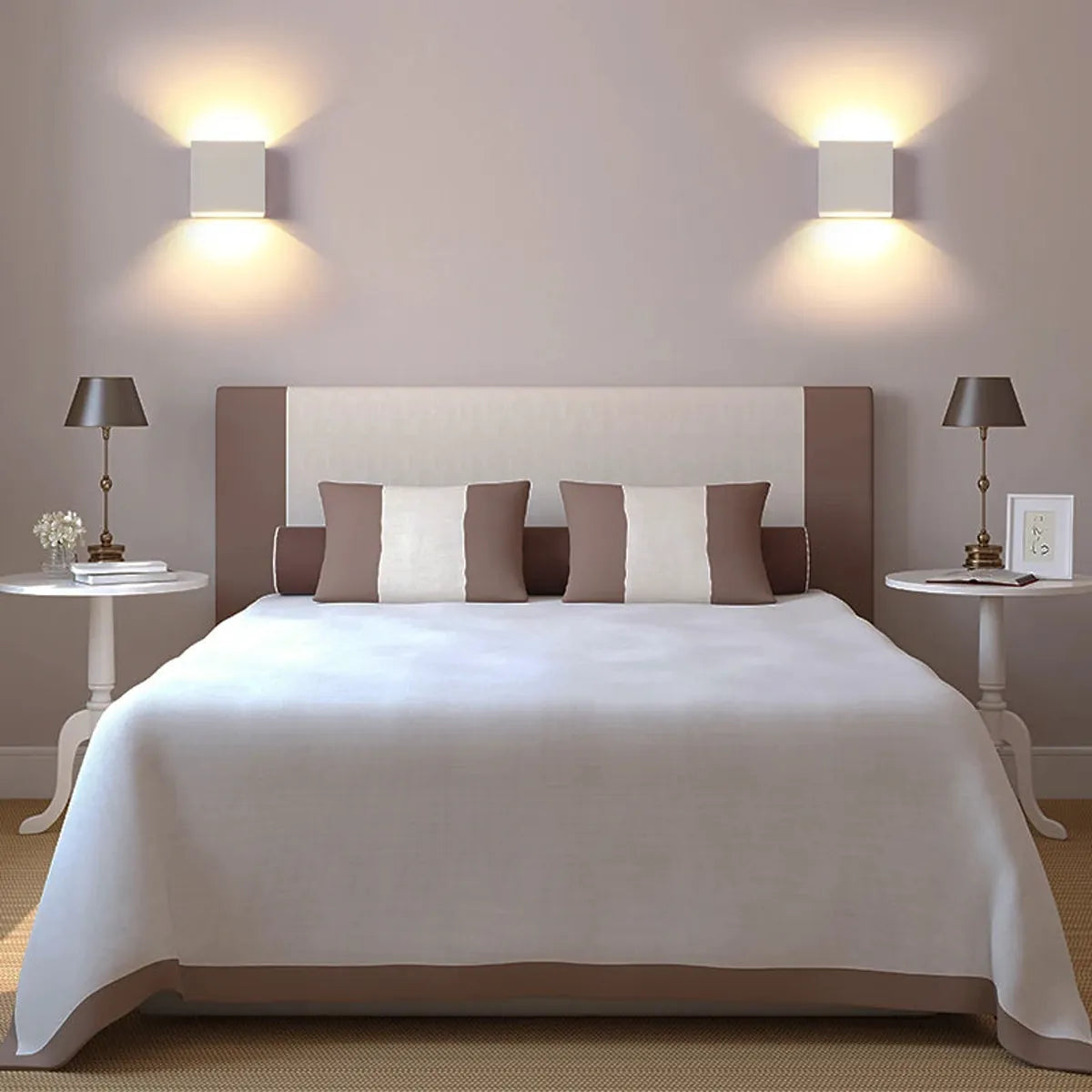
In medium-sized bedrooms, it's important to clearly define the function of each light source to avoid clutter and ensure each zone is properly lit. The Modern Minimalist Square LED Wall Light offers a sleek solution with its up-down lighting design, providing focused illumination for reading or creating mood lighting, all while complementing your room's minimalist aesthetic with its durable aluminum body.
Large Bedrooms: Why Single-Source Lighting Breaks Down
Large bedrooms make single-source lighting fail because the coverage path becomes too long. What feels “adequate” near the source can feel dim or uneven at the bed, seating, or closet.
The core problem is not simply “you need more lumens.” It is that one source struggles to deliver comfortable light to multiple zones without creating hotspots, shadows, or harsh contrast. As distance increases, light falloff and obstruction from furniture become more noticeable.
Decision rule: if the room has more than one functional zone (bed + seating, bed + vanity, bed + large closet wall), treat it as a multi-zone space. A single centered source tends to overlight the center and under-serve the zones people actually use.
Large rooms reward “zone thinking” and punish one-size-fits-all brightness.
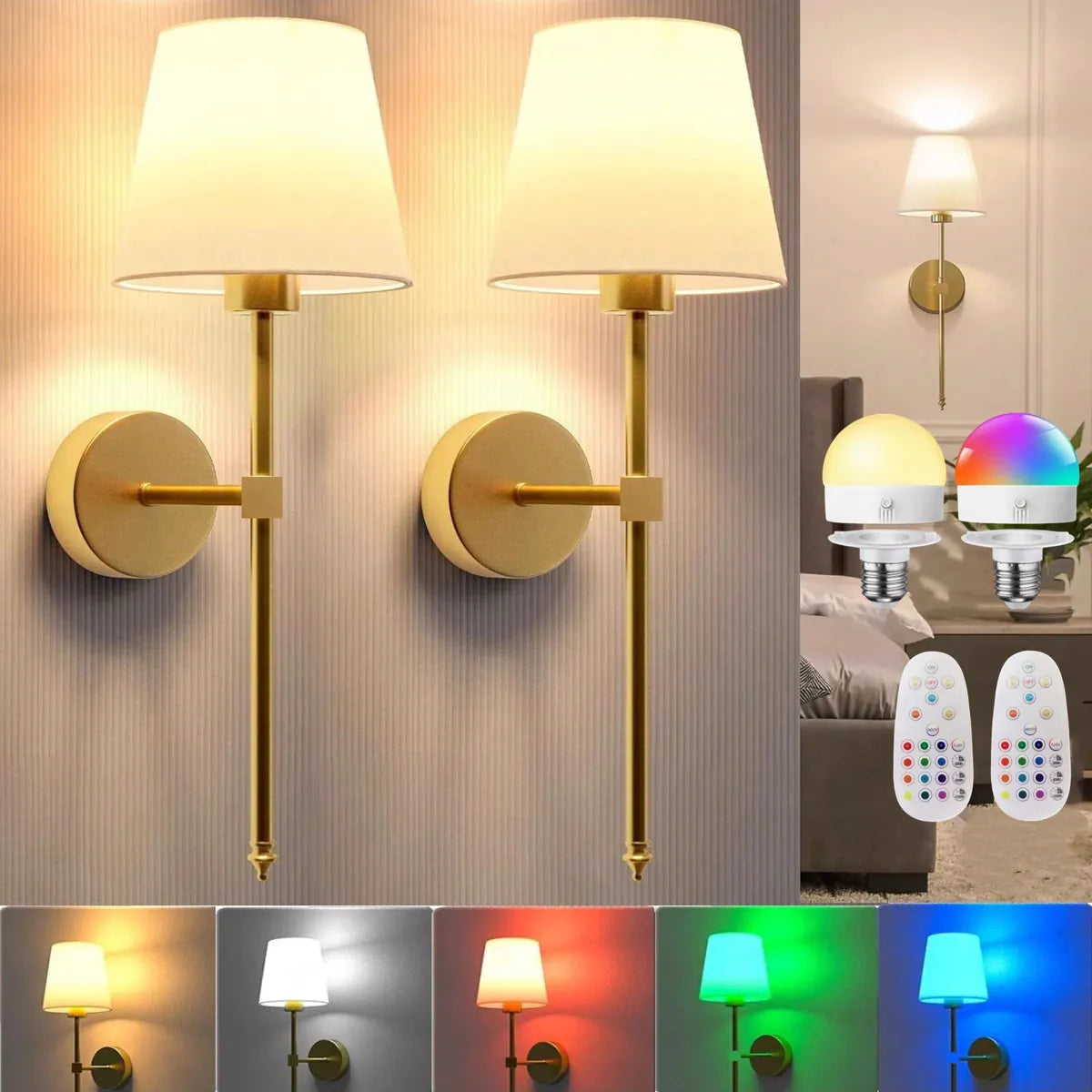
In large bedrooms with multiple zones, a single light source often results in uneven lighting and under-served areas. The 3-Color & RGB LED Wall Lamp, with its rechargeable design, remote dimming, and detachable E27 bulb, allows you to customize the lighting for each zone—whether it’s bright lighting for reading by the bed or softer tones for the seating area—ensuring your space is evenly lit and functional.
Ceiling Height and Perceived Comfort
Ceiling height affects comfort through perceived pressure, glare geometry, and how light spreads before it reaches eye level. The same fixture can feel soft and calm in one room and harsh in another because height changes what you see from the bed.
Low Ceilings: Spatial Pressure and Glare Risk
Low ceilings increase discomfort when light sources sit closer to your sightline and when reflected light bounces back into the bed zone.
Common low-ceiling failure modes are spatial, not technical:
- Visible source: bulbs or bright LEDs become directly visible from bed angles.
- Ceiling “hot spot”: the ceiling becomes a bright plane, which can feel like pressure overhead.
- Shadow exaggeration: strong downlight creates harsh facial shadows near mirrors and closets.
Decision rule: in a low-ceiling bedroom, a “bright but comfortable” choice usually means the luminous element is hidden from the bed view and light is distributed rather than concentrated. If a fixture relies on direct line-of-sight brightness, low ceilings make that feel aggressive.
Standard Ceilings: Why Height Stops Being the Primary Variable
With standard ceiling height, the ceiling stops dominating the decision. Other variables—especially bed placement and room proportion—start to control whether light feels usable and calm.
Standard height removes one major constraint, which exposes the next one: where the bed sits relative to the room’s visual and functional centers.
Decision rule: if your ceiling height is neutral, prioritize decisions around sightlines (what you see from bed) and zones (what you do where). Height becomes a secondary modifier, not the driver.
High Ceilings: Scale Mismatch and Light Falloff
High ceilings create discomfort less through brightness and more through reach: light has farther to travel, and the parts of the room you use can feel underlit even when the ceiling plane looks bright.
Common effects include:
- Scale mismatch: fixtures can look small and feel ineffective because they occupy little visual area relative to the volume.
- Light falloff in use zones: you may see light at the ceiling but not get comfortable illumination where your eyes work (bedside, closet, reading chair).
- Contrast imbalance: bright upper volume with dim lower zones makes the room feel unsettled.
Decision rule: if a high-ceiling bedroom feels “dramatic but not restful,” it is often because the light is visually present but functionally distant. The problem is where the light arrives, not whether the fixture is technically capable.
For energy context, the U.S. Department of Energy provides general guidance on LED efficiency and how lighting choices impact energy use (energy.gov).
Bed Placement as the True Reference Point
Bed placement is the decision anchor because the bedroom’s most important behaviors happen at the bed: reading, relaxing, winding down, and nighttime navigation. Lighting success is largely “does it work from the bed?” rather than “does it look centered in the room?”
Bed-Centered Lighting Logic
From a decision perspective, the bed is the reference origin. That means evaluating lighting by how it performs at bed angles, bed distances, and bed routines.
Use a bed-centered checklist to stress-test any lighting plan before you commit:
- Line of sight: can you see the bright element from lying down?
- Reading zone: does light reach the page without shining into eyes or waking a partner?
- Control: can you change brightness without getting up?
- Night movement: can you move safely without turning on a “daytime” mode?
- Reflection traps: do mirrors or glossy furniture bounce light into bed sightlines?
Decision rule: if a choice fails any two items above, it will feel wrong quickly, even if it looks good in photos.
🗣️ Community note: “Our ceiling light looked perfect in the middle of the room, but from the bed it felt like staring into a headlight. We didn’t need more light—we needed the light to stop aiming at us.”
Bed Position vs. Ceiling-Centered Thinking
“The light goes in the center of the room” is a ceiling-centered habit. It often fails in bedrooms because the visual center of the room is not the same as the functional center of the room.
Ceiling-centered thinking fails for predictable spatial reasons:
- Bed offset: in many bedrooms, the bed is not centered due to doors, windows, closets, or circulation.
- Functional asymmetry: one side of the bed may have different routines (reading, baby monitor, phone charging).
- Zone competition: closets and dressers want different light behavior than the bed zone.
Decision rule: if your bed is not centered, a centered ceiling light is a compromise by default. It may still be acceptable, but it should not be treated as “correct.” The correct reference is use, not symmetry.
Shared Sleeping Spaces and Lighting Conflict
In shared bedrooms, lighting conflicts come from behavior mismatches: one person reads, one sleeps; one wakes earlier; one needs brighter dressing light. This conflict is not a “bad fixture” problem—it is a system reference problem.
Instead of choosing “the perfect light,” evaluate whether your lighting can separate needs without forcing a shared compromise. A shared bedroom usually needs at least two independent comfort ranges: one for sleep and one for activity.
Decision rule: when two people share a bed, prioritize decisions that preserve independence (control, directionality, and visibility from each side). If one person cannot meet their routine without changing the other person’s environment, you will perceive the lighting as “wrong” even if it is technically adequate.
💡 Lumaz tip: In bedrooms, comfort is a control problem more than a brightness problem. If a light cannot be adjusted easily from the bed, it will get used less—or used at the wrong intensity—no matter how “good” it is.
How Spatial Variables Interact in Bedroom Lighting Decisions
Bedroom lighting outcomes come from variable interaction, not single-factor selection. Room size, ceiling height, and bed placement behave like weighted inputs; one may dominate, but the others still shift the result.
When One Variable Dominates the Decision
Some combinations make one variable so influential that it overrides the others. Recognizing dominance helps you avoid “fixing” the wrong problem.
| Space Combination | Dominant Variable | What Usually Goes Wrong | Decision Focus |
|---|---|---|---|
| Small room + high ceiling | Room size | Overlighting at eye level despite large volume | Reduce visible brightness and glare at the bed |
| Large room + low ceiling | Ceiling height | Pressure + glare when trying to cover long distances | Keep comfort while acknowledging multi-zone use |
| Medium room + bed offset | Bed placement | Centered lighting misses the use zones | Evaluate from bed angles, not room symmetry |
| Any size + shared bed routines | Bed placement (behavior) | One person’s light becomes the other’s disruption | Preserve independent comfort ranges |
Decision rule: if you can clearly name the dominant variable, you can also predict the most likely failure mode. That prediction is the point of a decision model—preventing the “why is this still uncomfortable?” loop.
Why Changing One Element Alters the Entire Lighting Outcome
Spatial variables are coupled. Changing bed placement, adding a tall dresser, or swapping a dark rug for a light one changes reflection paths, sightlines, and how bright the room feels at the bed.
Use a simple interaction test when evaluating any change:
- View test: stand where your eyes are when seated in bed and scan for direct glare and mirror glare.
- Zone test: identify the three most used zones (bed, closet/dresser, doorway path) and check whether each feels supported.
- Contrast test: look for extreme bright/dark transitions; bedrooms feel calmer with controlled contrast.
Decision rule: if a change improves one zone but makes another zone feel harsher, you are seeing coupling in action. The goal is not maximal brightness everywhere; it is compatibility between zones anchored to bed comfort.
Spatial Decision Mistakes That Lead to Poor Bedroom Lighting
Most bedroom lighting mistakes are decision mistakes, not installation mistakes. They happen when you treat spatial constraints as fixture problems and chase brightness or style instead of comfort outcomes from the bed.
Here are the highest-impact judgment errors:
- Treating a space problem as a product problem: buying a new fixture to solve glare, reflection, or bed offset.
- Ignoring the bed-to-light relationship: evaluating lights from the doorway instead of from the bed.
- Replacing spatial judgment with a brightness number: assuming a lumen target guarantees comfort regardless of sightlines and reflection.
Decision rule: if you describe the problem only with a number (“it’s not bright enough”) but cannot describe where the light fails (“the closet is dim” or “the bed zone glares”), you are likely measuring the wrong thing.
When the “real” complaint is glare, poor control, or a shadowed zone, treat it as a space-and-behavior mismatch first and a fixture choice second.
When Spatial Constraints Limit Your Lighting Options
Some bedrooms naturally eliminate certain lighting choices, and recognizing that early saves time and money. A good decision is often the ability to say “that option is incompatible with my space,” not the ability to force a favorite fixture to work.
Use these incompatibility signals as a filter:
- Low ceiling + visible-source fixtures: high glare risk from bed angles.
- Small room + visually dominant fixtures: high chance of visual compression and harshness.
- Bed under a strong central hotspot: comfort problems during rest modes even if the room is bright.
- Shared bed routines without independent control: persistent conflict regardless of fixture quality.
Decision rule: when your space triggers two or more incompatibility signals, narrow your options before you compare styles. Style selection is the last step; spatial feasibility is the first.
FAQ
How do I know if my bedroom is being overlit?
Overlighting usually shows up as discomfort rather than visibility problems: glare from bed, a “washed out” look, or a room that feels smaller and harsher after adding light. If you avoid using certain lights at night, the space is likely telling you the brightness distribution is wrong.
What is the most common reason a centered ceiling light feels wrong?
Centered lights optimize for symmetry, not use. If the bed is offset or your main routines happen away from the room center, a centered hotspot can be bright in the wrong place and uncomfortable from the bed.
Why do high ceilings sometimes feel less cozy even with bright lights?
High ceilings increase volume and distance, so light can be visually present up high while not arriving where you live—at bed height, in reading zones, and along nighttime paths. The room can look bright but feel functionally distant.
In shared bedrooms, what creates the biggest lighting conflict?
Behavior mismatches: one person reading while the other sleeps, different wake times, or different comfort preferences. Without independent control and directionality, any “one setting for both” will feel like a compromise.
Conclusion: Let Spatial Logic Guide Lighting Decisions
Bedroom lights are not simply “chosen.” In practice, they are filtered by space: room size sets boundaries, ceiling height shapes comfort, and bed placement defines what lighting success feels like in daily life.
When you start with spatial logic—especially bed-centered evaluation—you reduce trial-and-error and end up with lighting that supports rest, reading, and nighttime comfort without fighting your room’s geometry.
Further Reading
Explore the full guide for this topic: Bedroom Lights: The Complete Guide to Choosing the Right Lighting for Every Bedroom
Related Articles
- Table Lamps vs. Wall Sconces for Bedroom Lighting: Which is Better?
- Warm White LED Lights vs. Cool White LED Lights for Bedroom
- Dimmable Bedroom Lights vs. Non-Dimmable Lights: Benefits and Drawbacks
- Smart Bedroom Lights vs. Traditional Bedroom Lights: Pros, Cons & Expert Tips
- Battery-Powered vs. Wired Bedroom Lighting: 9 Key Differences
- Hanging Lights Buying Guide: Perfect Sizes & Installation Tips















 />
/>
 />
/>
 />
/>
 />
/>
 />
/>