

Smart Bulbs vs. Integrated LED Fixtures for Bedrooms: Pros, Cons, and Best Use Cases
Table of Contents
- Quick answer: what to choose for most bedrooms
- What is a smart bulb?
- What is an integrated LED fixture?
- Bedroom light quality: glare, dimming, flicker, and color
- Sleep and circadian considerations (what matters, what doesn’t)
- Installation, maintenance, and total cost of ownership
- Smart home control, reliability, and security
- Decision matrix: best use cases by bedroom scenario
- Smart bulbs vs integrated fixtures: quick comparison table
- FAQs
- Conclusion
Quick answer: what to choose for most bedrooms
For most bedrooms, the best result is a hybrid: integrated fixtures for clean, low-glare overhead light, and smart bulbs in bedside lamps for scenes and routines. If you want only one approach, use these rules of thumb:
- Choose smart bulbs if you rent, want reversibility, care most about scenes (warm evening, reading, night light), or you like upgrading over time.
- Choose integrated LED fixtures if you want the cleanest ceiling look, better optical control (less glare), longer service intervals, or you are already remodeling.
- Avoid buying on “features” alone: in bedrooms, low-end dimming stability, glare control, and warm evening settings matter more than RGB effects.
What is a smart bulb?
Smart bulbs are retrofit LED lamps with built-in control electronics. They fit standard sockets (E26/E27, GU10, etc.) and add software features without changing the fixture.
What people actually use in bedrooms
- Tunable white (warm to cool) and dim-to-warm for wind-down comfort.
- Scenes like Evening, Read, and Night Path with one-tap control.
- Schedules that automatically lower brightness and warmth at night.
Bedroom-specific downside you should plan for
Smart bulbs need constant power to stay controllable. If someone turns the wall switch off, the bulb goes “offline.” In bedrooms, that can turn into daily frustration unless you design around it (using smart controls, scenes, or dedicated lamp circuits).
What is an integrated LED fixture?
Integrated LED fixtures combine the LED light source and the fixture into one product. Instead of replacing a bulb, you install a complete unit (recessed downlight, flush mount, wall sconce, panel) with an LED module and a driver.
Why homeowners choose them for bedrooms
- Optics and glare control: the fixture can be engineered to hide bright emitters and shape the beam.
- Thermal design: better heat management can support longer life and steadier output.
- Aesthetics: slimmer profiles and more “built-in” ceiling results.
Serviceability is the real question
When an integrated fixture fails, the culprit is often the driver. Before buying, check whether the driver is replaceable, the warranty length, and whether the model is still likely to be available years later.
Bedroom light quality: glare, dimming, flicker, and color
Bedrooms punish bad lighting because you spend time looking toward the ceiling from a pillow angle. “Bright enough” is not the goal; comfortable light is.
Glare control (the #1 bedroom difference)
- Smart bulbs depend on your existing shades and reflectors. A clear bulb in an exposed socket can look harsh even when dimmed.
- Integrated fixtures can use recessed optics, diffusers, and shielding for lower glare and a calmer ceiling.
Low-end dimming and flicker
- Smart bulbs usually dim smoothly through their own electronics, but performance varies by model and control method.
- Integrated fixtures can be excellent when the LED module and driver are well-matched, but poor driver quality can create flicker or unstable low levels.
Color quality: don’t stop at CRI
If you care how skin tones and fabrics look, use CRI as a baseline and also look for strong red rendering (often noted as R9) or additional color-quality reporting (TM-30) when available.
Heat in enclosed fixtures
Enclosed or poorly ventilated fixtures can shorten bulb life. If your bedroom has enclosed ceiling fixtures, confirm that the smart bulb is rated for enclosed use, or consider switching the fixture.
Sleep and circadian considerations (what matters, what doesn’t)
For most people, timing and intensity matter more than chasing a perfect “circadian bulb.” Light helps regulate circadian rhythms and melatonin timing (nigms.nih.gov). A controlled study found that ordinary room light before bedtime can suppress melatonin onset compared with dim light (pmc.ncbi.nlm.nih.gov).
Bedroom lighting rules that are easy to follow
- Dim earlier: lower brightness 1–2 hours before bed.
- Go warmer at night: use warm settings in the evening and for night navigation.
- Avoid harsh sources from bed: use shades, diffusion, and indirect light for comfort.
Smart bulbs make these changes easy in lamps and accent lights. Integrated fixtures work well when you choose models that dim smoothly and support warm settings (either warm-only, warm-dim, or tunable).
Installation, maintenance, and total cost of ownership
Cost is not just purchase price. In bedrooms, the hidden costs are repeated replacements, troubleshooting, and living with light you dislike.
Energy efficiency and longevity (what’s actually comparable)
Both are LED-based, so the differences are usually in driver quality, heat management, and optics. The U.S. Department of Energy notes that LEDs use at least 75% less energy and last much longer than incandescent lighting (energy.gov).
Practical cost checklist
- If you may move: smart bulbs are portable and reversible.
- If you want long service intervals: integrated fixtures can reduce replacement cadence, especially in hard-to-reach ceilings.
- If you hate downtime: prioritize products with strong warranties and clear replacement parts (drivers/modules).
Smart home control, reliability, and security
Bedroom lighting should work even when the Wi‑Fi is flaky. Reliability and a sane control plan matter more than the app UI.
Interoperability: what to check before you buy
- Matter compatibility if you want cross-platform flexibility.
- Local control options (hub/bridge, local schedules) if you want fewer cloud dependencies.
- Wall control behavior: confirm what happens when someone flips the switch off.
Security basics that reduce risk
- Keep device firmware updated and use strong account security (including 2FA if supported).
- Segment IoT devices on a guest network or VLAN when possible.
- Prefer vendors with transparent privacy and update policies.
Decision matrix: best use cases by bedroom scenario
| Bedroom scenario | Best default choice | Why it wins |
|---|---|---|
| Renter, no wiring changes | Smart bulbs (in lamps) | Fast, reversible, great for evening routines |
| Homeowner, wants clean ceiling look | Integrated fixtures | Better optics, lower glare, fewer visible parts |
| Remodeling or adding recessed downlights | Integrated fixtures | Optimized beam, thermal design, long service horizon |
| Needs scenes and color effects | Smart bulbs | Most flexible tuning and scene control |
| Wants maximum comfort from bed | Hybrid | Integrated overhead + smart bedside lamps is easiest to live with |
Smart bulbs vs integrated fixtures: quick comparison table
| Category | Smart bulbs | Integrated LED fixtures | What it means in a bedroom |
|---|---|---|---|
| Upgrade speed | Fast (swap bulbs) | Slower (install fixture) | Bulbs are best for quick comfort improvements |
| Glare control | Depends on the fixture/shade | Often better optics and shielding | Glare is the most common “why this feels harsh” problem |
| Low-end dimming | Usually good, varies by model | Excellent when driver is high quality | Low-level stability is what makes “evening mode” usable |
| Serviceability | Replace the bulb | Replace driver/module or fixture | Check warranty and parts availability for integrated fixtures |
| Portability | High | Low | Bulbs move with you; fixtures don’t |
| Best role | Lamps, accents, routines | Overhead ambient, built-in lighting | Hybrid layouts usually feel most natural |
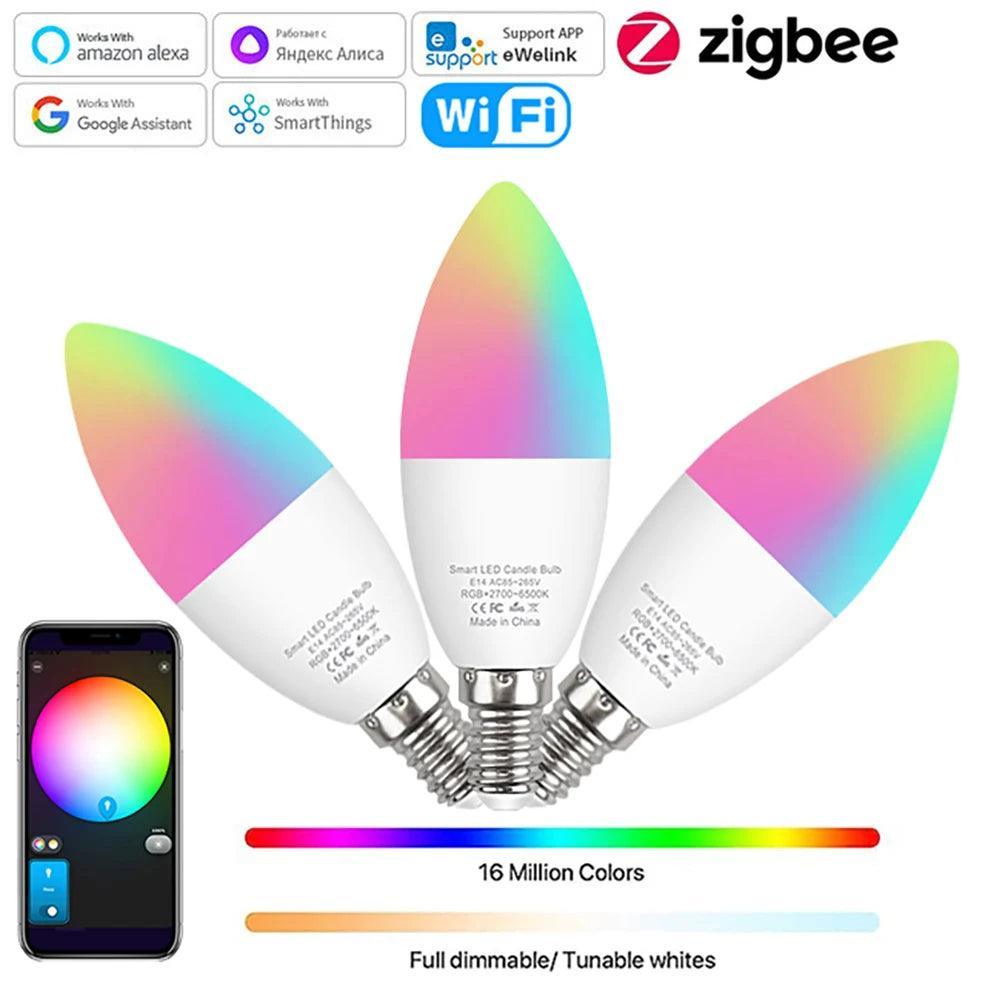
When comparing smart bulbs to integrated LED fixtures, smart bulbs offer flexibility and easy retrofitting, allowing you to update existing fixtures with advanced features. The Smart E14 LED Light Bulb is a perfect example, offering RGB and CCT dimming, app and voice control, and seamless WiFi/Zigbee integration, letting you customize your bedroom lighting without replacing entire fixtures.
FAQs
Will smart bulbs work in recessed cans and enclosed fixtures?
Many smart bulbs fit physically, but heat inside enclosed fixtures can shorten bulb life. Check whether the bulb is rated for enclosed fixtures and whether the housing has adequate ventilation.
Can I mix smart bulbs and integrated fixtures in the same bedroom?
Yes. A common approach is integrated fixtures for uniform ambient light and smart bulbs in lamps for scenes and routines. Keep color temperature consistent to avoid a mismatched look.
Do smart bulbs increase cybersecurity risk?
Any networked device can increase risk. Reduce exposure by updating firmware, using strong account security (including 2FA when available), and segmenting IoT devices on a separate network when possible.
How many lumens do I need for a bedroom?
It varies by room size and tasks, but many bedrooms land around 1,000–3,000 total lumens across layers. A practical approach is to layer light: one comfortable ambient source plus dedicated task lighting where you read or dress, and a low-level night path for safety.
Is tunable white lighting worth it?
If you want daytime clarity and a calmer evening routine, tunable white is often worth it. If you only care about wind-down comfort, warm-only lighting with good dimming can be enough.
What happens when an integrated fixture’s LED or driver fails?
Some fixtures allow driver or module replacement; others require replacing the whole unit. Before buying, check warranty terms and whether replacement parts are accessible.
Conclusion
Smart bulbs are the fastest way to add routines and flexible scenes, especially in bedside lamps. Integrated LED fixtures are the better choice when you want a clean ceiling, better glare control, and long-term hardware performance. If you want the most comfortable bedroom with the least friction, combine both: integrated overhead lighting for calm ambient light, plus smart bulbs in lamps for evening and night scenes.
Further Reading
Explore the full guide for this topic: Smart Bedroom Lighting Guide: Systems, Controls, and Real-Life Benefits

















 />
/>
 />
/>
 />
/>
 />
/>
 />
/>