

Top 10 Smart Garden Lights for Home Automation (App & Voice Control)
Table of Contents
- Why choose smart garden lights?
- How app and voice control change outdoor lighting
- Top 10 smart garden lights (app & voice control)
- Buying guide: key features to compare
- Install and setup: a practical checklist
- Energy, cost, and performance metrics
- Wildlife, safety, and regulation considerations
- Real-world case evidence and maintenance schedule
- Next steps: planning your smart garden lighting project
- Frequently asked questions (FAQs)
Why choose smart garden lights?
Smart garden lights add convenience, security, and energy savings while enabling schedules, scenes, and voice commands to control outdoor ambiance and safety.
Smart garden lights replace manual switches with app and voice control, letting you automate dusk-to-dawn schedules, sync lights with routines, and create dynamic color scenes for landscaping or parties. They combine LED efficiency with IoT convenience, improving safety, curb appeal, and night‑time usability.
💡 Elevate your outdoor space with reliable, stylish, and energy-efficient lighting. Discover smarter illumination with Lumaz.
How app and voice control change outdoor lighting
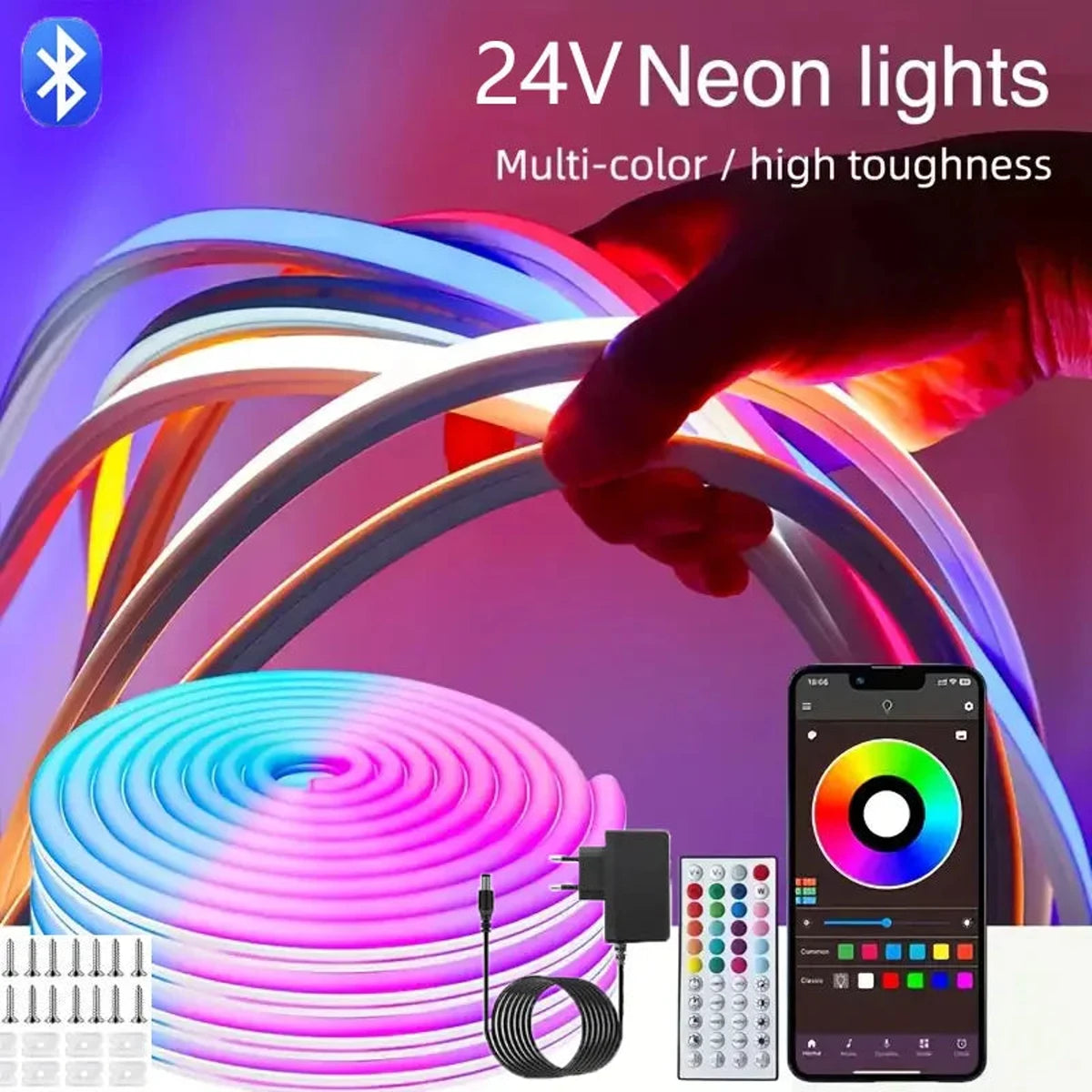
24V RGB LED Neon Rope Lights Color Change Music Sync App Control Waterproof Flexible
App and voice control enable remote operation, rules-based automation, geofencing, and integration with broader home automation systems.
Beyond on/off, smart control provides:
- Remote management: control lights from anywhere via smartphone apps.
- Voice control: hands-free commands through Alexa, Google Assistant, or Siri (HomeKit) for instant scenes.
- Automation: schedules, sunset/sunrise triggers, motion-based activation, and presence-based rules (geofencing).
- Integration: tie lights into security routines, lawn sprinklers, or holiday scenes via platforms like HomeKit, SmartThings, and IFTTT.
These capabilities reduce wasted energy and let you program context-aware behaviors—for example, dim path lights when guests arrive or flash floodlights during an alarm trigger.
Top 10 smart garden lights (app & voice control)
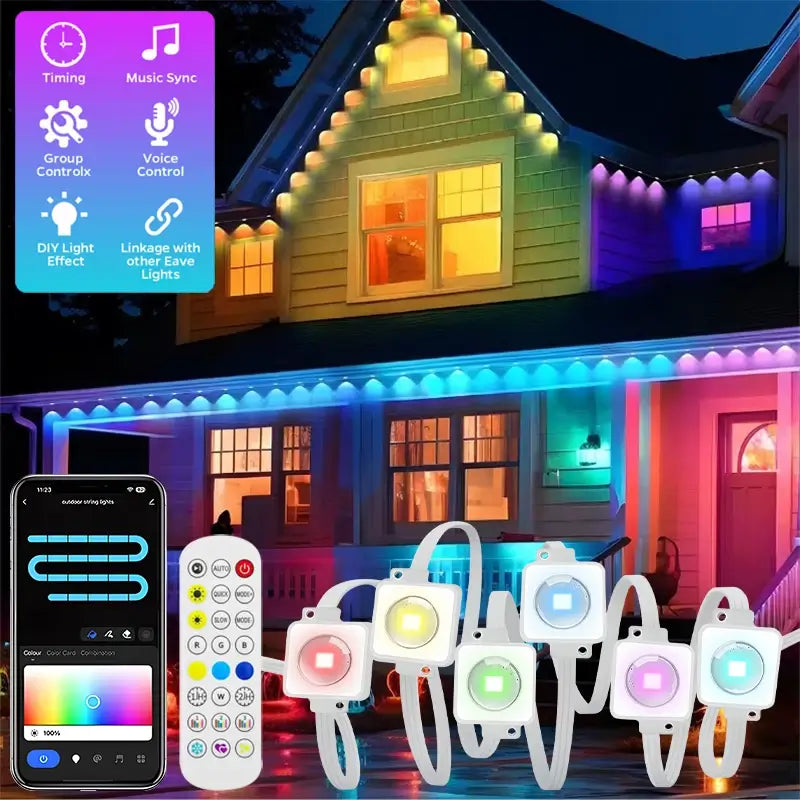
100FT 60 LED Permanent Outdoor Eaves LED Lights Waterproof RGB Christmas String Lights
Curated types and representative models that work with voice assistants and common smart hubs—choose based on location, power source, and desired control features.
Below are ten widely used smart garden light types with representative examples and primary features. Always verify the current model specifications before purchasing.
| Rank / Type | Representative Model | Controls | Power | Features | Approx. Price |
|---|---|---|---|---|---|
| 1. Outdoor spotlight | Philips Hue Lily | Hue app, Alexa, Google, HomeKit | Wired / Hue Bridge | RGB, scenes, high CRI | $$$ |
| 2. Smart floodlight | Sengled / Feit Electric Smart Flood | Manufacturer app, Alexa, Google | Hardwired | Bright white, motion/auto | $$ |
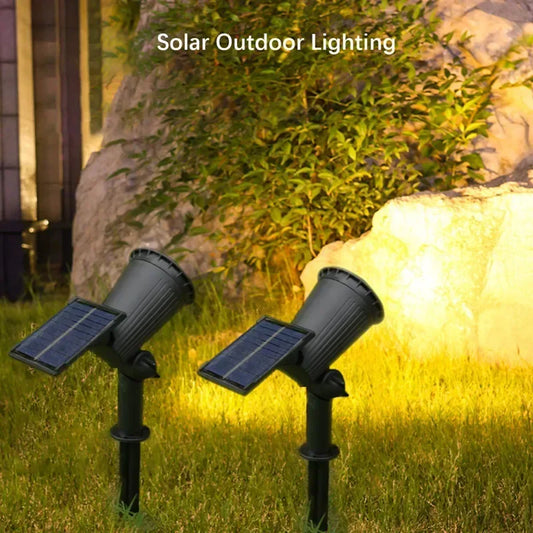
| 3. Solar pathlight (smart) | Ring Solar Pathlight | Ring app, Alexa | Solar | Wireless, rechargeable, motion | $–$$ |
| 4. RGB floodlight | Govee Outdoor RGBIC Floodlight | Govee app, Alexa, Google | Hardwired / pigtail | Color scenes, music sync | $ |
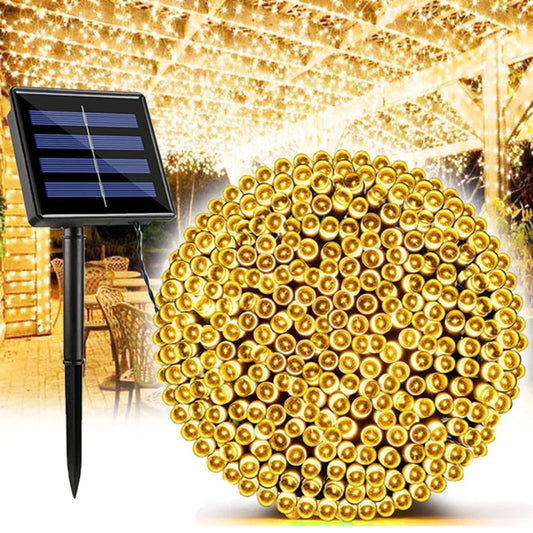
| 5. Smart string lights | Brightech / Govee Outdoor String | App, Alexa, Google | Plug-in / Solar | Warm to colored, outdoor-rated | $–$$ |
| 6. Deck/step lights | Feit Smart Deck Lights | App, voice via hub | Low-voltage / wired | Low-profile, pathway illumination | $$ |
| 7. Smart bollard/in-ground | Enbrighten Smart Bollard | App, Zigbee/Z‑Wave (hub) | Wired / low-voltage | Durable, landscape-grade | $$$ |
| 8. Floodlight camera combo | Eufy / Ring Floodlight Cam | Vendor app, Alexa | Hardwired | Integrated camera, motion alerts | $$$ |
| 9. LED outdoor strip | Philips Hue Outdoor Lightstrip | Hue app, voice | Plug-in | Flexible, RGB, weatherproof | $$$ |
| 10. Smart plug + existing lights | Any outdoor smart plug (Kasa, TP‑Link) | App, Alexa, Google | Plug-in | Instant smart control of legacy fixtures | $ |
Use the table to match location (path, spotlight, deck), power (solar vs. wired), and control (local hub vs. direct Wi‑Fi) to your needs. Price bands: $ = budget, $$ = mid-range, $$$ = premium.
Buying guide: key features to compare
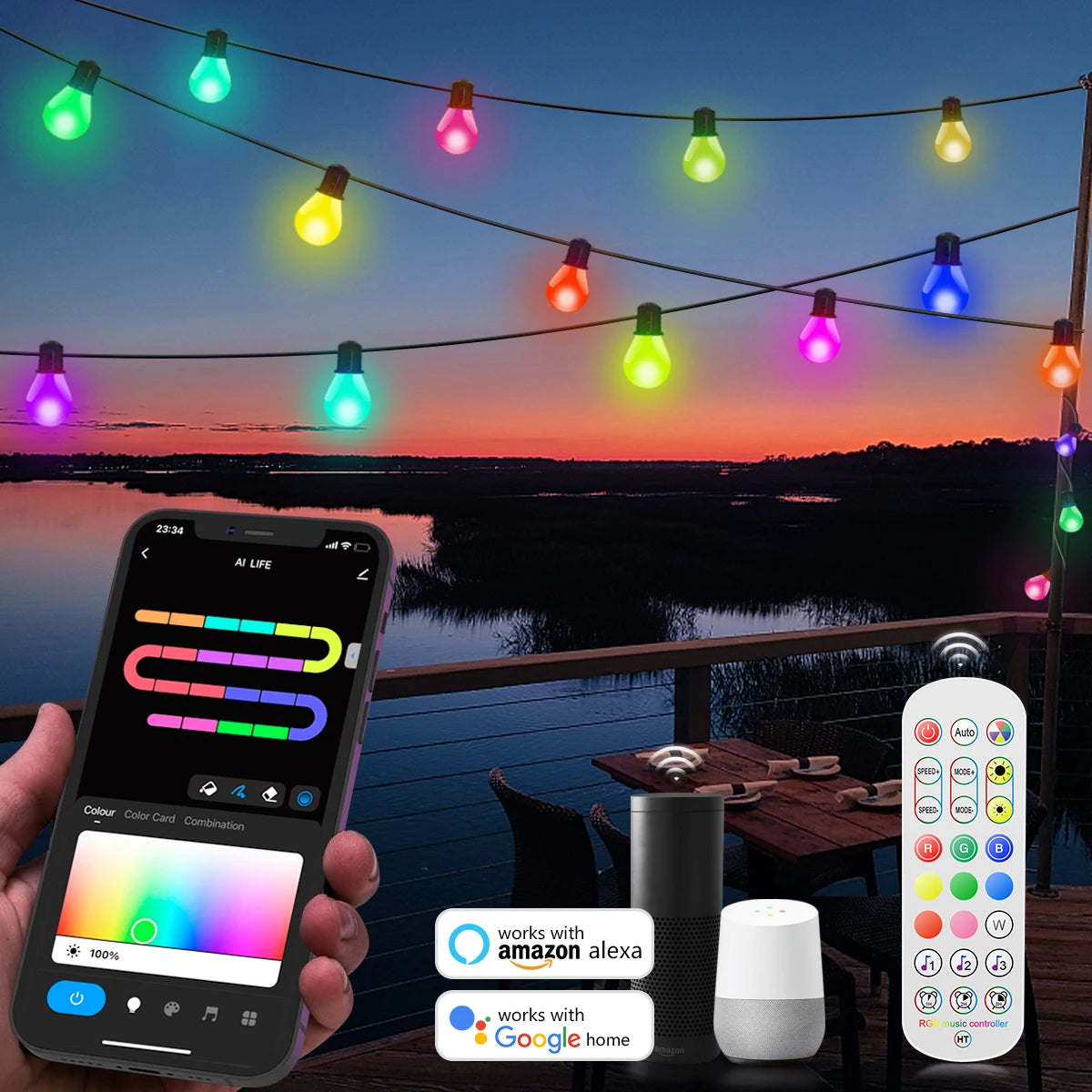
USB Smart G40 LED Bulb String Light 15M 25 Blubs Christmas Lights
Prioritize power source, connectivity, lumens, IP rating, compatibility, and smart features for reliable, safe outdoor automation.
- Power source: solar for easy installs; hardwired or low-voltage for long-term reliability.
- Connectivity: Wi‑Fi (no hub), Zigbee/Z‑Wave (requires hub), or proprietary bridges (Hue Bridge).
- Lumens vs. watts: check lumens for brightness; LEDs deliver high lumens per watt.
- IP rating: IP65+ for rain and dust protection; IP67 for occasional submersion.
- Voice & platform compatibility: Alexa, Google Assistant, Apple HomeKit—confirm before buying.
- Color capability: Warm white only vs. tunable white vs. full RGB/RGBW for color scenes.
- Motion & sensors: integrated motion can save energy and increase security.
Install and setup: a practical checklist
Follow a logical sequence—plan placement, check power, secure mounts, then configure network and automations.
- Plan locations: minimize glare, avoid pointing into neighbors’ windows, and consider wildlife impact (see below).
- Choose power: mark wiring routes for hardwired lights; place solar units in full sun.
- Confirm Wi‑Fi or hub coverage: outdoor lights need a strong connection—consider a mesh Wi‑Fi extender or outdoor access point.
- Mount hardware: follow IP and mounting recommendations; use silicone sealant for roof/wall penetrations.
- Register and update firmware: add to the vendor app, connect to home assistant if needed, and update firmware before automations.
- Create automation rules: set sunset/sunrise triggers, motion-based ramps, and vacation modes; test manually.
Tip: Use a smart plug (outdoor-rated) as a temporary test to evaluate placement and network reach before permanent installs.
Energy, cost, and performance metrics
Track lumens, wattage, energy use, and runtime to estimate costs and savings; LEDs and automation reduce energy use dramatically.
LED outdoor lights typically use 5–50 W per fixture while producing 300–4,000 lumens depending on type. Compare lumens rather than watts to judge brightness.
- Example calculation: A 10 W LED producing 1,000 lumens running 6 hours/night consumes 0.06 kWh per night ≈ 21.9 kWh/year. At $0.15/kWh, annual cost ≈ $3.29 per fixture.
- Automation savings: motion-based operation and adaptive dimming can reduce annual runtime by 50% or more versus dusk-to-dawn operation.
- Solar units: output depends on panel size and sun exposure—expect reduced brightness and runtime in shaded or winter conditions.
For authoritative guidance on LED efficiency and consumer choices, see the U.S. Department of Energy’s lighting resources: energy.gov—LED lighting guide.
Wildlife, safety, and regulation considerations
Outdoor lighting can affect wildlife and neighbors; choose warm color temps, shielded fixtures, and follow local ordinances to reduce impacts.
Artificial light at night (ALAN) impacts insects, birds, and sea turtle nesting. Mitigation includes lower correlated color temperatures (2700–3000K), full cutoff fixtures that minimize skyglow, and motion-activated usage.
- Use warm whites (≤3000K) and dimming to reduce insect attraction and behavioral disruption.
- Prefer shielded fixtures to direct light downward and reduce glare and light trespass.
- Check local ordinances: some communities restrict excessive outdoor lighting to protect dark-sky areas or wildlife.
Consider these reputable resources on light pollution and ecology: NOAA’s materials on coastal light impacts and guidance on reducing light pollution: noaa.gov—light pollution.
Real-world case evidence and maintenance schedule
Practical examples show savings and safety improvements; regular maintenance sustains lifespan and connectivity.
Case 1 — Residential retrofit: A homeowner replaced six legacy halogen landscape spots with RGB smart LED spots (bridge-controlled). Result: 70% energy reduction, simpler seasonal scenes, and integrated safety lighting triggered by security sensors.
Case 2 — Small business front: Replacing incandescent display lighting with smart floodlights reduced night-time operating energy and enabled central scheduling to match business hours, cutting utility bills and complaints.
💬 "Swapping to smart pathlights and scheduling them around our dog walks took guesswork out of the evenings. We cut energy bills and we get helpful activity alerts—all set with a single routine." — neighborhood homeowner
Maintenance checklist (quarterly/annual):
- Quarterly: clean lenses, inspect seals, verify firmware is current, test automations and sensors.
- Annually: check mounting hardware and wiring, replace failing solar batteries, and review scene schedules for seasonal changes.
Next steps: planning your smart garden lighting project
Decide goals, budget, and timeline; pilot a small area; scale and integrate with home automation platforms for best results.
- Define goals: security, ambiance, navigation, or entertainment.
- Set a budget: include hardware, mounting, hub/bridge, and possible electrician fees.
- Pilot: buy one or two fixtures to confirm placement, app behavior, and voice responses.
- Scale & integrate: expand using the same ecosystem or choose hubs for cross-vendor unification (e.g., Home Assistant, SmartThings).
For larger deployments or code compliance (e.g., altering electrical circuits), consult a licensed electrician and verify local building codes before hardwiring.
Quick compatibility cheat-sheet
Matching ecosystem compatibility prevents future headaches—choose devices that work with your preferred voice assistant and hub.
- Alexa-friendly: Broad vendor support; look for “Works with Alexa” branding.
- Google Assistant: Most major vendors support Google voice control.
- Apple HomeKit: More restrictive—confirm HomeKit support if iPhone/Siri voice control is essential.
- Hub-based (Zigbee/Z‑Wave): Best when you want many devices and local control; requires a compatible hub.
Frequently asked questions (FAQs)
Q1: Can I make existing outdoor lights smart without replacing fixtures?
A1: Yes. An outdoor-rated smart plug, smart switch (installed by an electrician), or an in-line smart controller lets you automate legacy fixtures. Ensure devices are IP-rated for outdoor use and comply with local codes.
Q2: Are solar smart lights reliable year-round?
A2: Solar reliability depends on sun exposure and battery quality. In winter or shaded yards, solar lights may have shorter runtimes—consider hybrid systems or wired fixtures for consistent performance.
Q3: Will bright garden lights disturb neighbors or wildlife?
A3: They can. Use warm color temps (≤3000K), shielded fixtures, and motion/dimming rules to reduce glare and ecological impact. Check local ordinances for light trespass restrictions.
Q4: Do smart outdoor lights work if Wi‑Fi goes down?
A4: Behavior depends on model. Hub-based systems and some local-control devices retain basic functions if the cloud is unreachable; cloud-dependent Wi‑Fi devices may lose advanced features. Choose local-control-capable products for reliability.
Q5: How much can I save by switching to LED smart garden lights?
A5: Savings vary. LEDs use 70–90% less energy than halogens/incandescents. With automation (motion activation, dimming), expect additional reductions in runtime—real-world savings often exceed 50% versus always-on legacy lighting.
Q6: Are there safety codes for outdoor smart lighting installation?
A6: Yes—electrical codes (NEC in the U.S.) govern wiring, GFCI protection for outdoor outlets, and proper sealing of penetrations. For hardwired installs consult a licensed electrician and local permitting authorities.














 />
/>
 />
/>
 />
/>
 />
/>
 />
/>