

Hardwired vs. Plug-In vs. Rechargeable Under Cabinet Lighting
Hardwired vs. Plug-In vs. Rechargeable: The Short Answer
Choose hardwired under-cabinet lighting for a permanent kitchen where a clean finish and long daily runtime matter most. Choose plug-in lighting when an outlet and a manageable cord route already exist. Choose rechargeable lighting when avoiding new wiring is more valuable than avoiding regular charging.
These are different ownership decisions, not three versions of the same installation. A light that is easy to mount can still be inconvenient if it must be recharged after every long cooking session. A hardwired system can look excellent after a remodel, but it is not the sensible first choice for a renter or a finished kitchen where opening walls would cost more than the dark area justifies.
Start with four facts: how often the lights will be on, whether power is already available, how visible a cable would be, and whether you can reach the fixture for maintenance. Then compare the fixtures that fit that power route.
Compare the Three Under-Cabinet Lighting Power Routes
| Factor | Hardwired | Plug-in | Rechargeable |
|---|---|---|---|
| Best fit | Permanent daily task lighting planned with the kitchen | Regular use where an outlet and cable route are available | Short visits, isolated zones, rentals, or finished rooms with no acceptable new wiring |
| Initial disruption | Highest; wiring and electrical work must be planned | Low when the outlet and route are close | Usually lowest; the light still needs secure mounting and charging access |
| Everyday task | Little routine power management | Keep the plug, adapter, and cable route accessible | Recharge the light or lights and monitor battery condition |
| Long cooking sessions | Strong fit | Strong fit | Often the least convenient fit |
| Moving the setup later | Least flexible | Possible within the cord and outlet reach | Easiest when the fixture is removable |
| Main visual trade-off | More work now for a cleaner finished result | A visible cable or adapter needs a hiding plan | No permanent cable, but charging and fixture access remain visible in the routine |
“Easy to install” and “easy to live with” are not the same test. A rechargeable bar may take minutes to mount but become a nuisance across six cabinet sections. A plug-in bar may need more cable planning but remain ready every evening. Choose the inconvenience your household can actually manage.
When Hardwired Under-Cabinet Lighting Fits
Hardwired lighting makes the most sense when the kitchen is being remodeled, the cabinet run is permanent, and the lights will serve a worktop for long or frequent sessions. The supply and switching can be planned with the rest of the room, so there is no adapter sitting in a cabinet and no plug to unplug accidentally.
Choose hardwired when
- the lighting will be used every day for cooking, cleanup, or another long task;
- you want the power route and control to disappear into the finished installation;
- the cabinet layout and wall finish are already being opened for authorized electrical work; or
- several fixtures would otherwise need separate charging or multiple visible adapters.
Check the trade-offs first
Hardwired is not a product feature that makes an installation safe by itself. The circuit, junction boxes, switches, clearances, and local requirements must suit the selected system. Use a qualified electrician for new line-voltage wiring or any connection you are not authorized and equipped to make. Keep drivers and connections accessible as the product instructions require; hiding a serviceable component behind permanent cabinetry creates a maintenance problem.
Hardwired also becomes a poor fit when the fixture location is still changing. Fix the cabinet layout, light position, and control plan before committing to a route that will be difficult to move.
When Plug-In Under-Cabinet Lighting Fits
Plug-in lighting is the middle path: it avoids new in-wall wiring while providing continuous power. It works well when an outlet is already inside or near the cabinet run and the cord can be routed without crossing a drawer, heat source, sink splash zone, or visible sightline.
Choose plug-in when
- the lights will stay on for long periods and charging would be inconvenient;
- an existing outlet can reach the run through a safe, tidy path;
- you want to replace or reposition the fixture without electrical work; or
- you can hide an adapter inside an accessible cabinet or behind a planned trim detail.
Plan the route, not just the fixture
Measure from the outlet to the first light, then account for every connecting lead, sensor, switch, and adapter. A slim bar does not make its power cord disappear. Do not assume that a multi-light kit is series-connectable: some kits use separate leads from one adapter, while others are designed for a specified linked configuration only.
For a straight run, a bar may be easiest to align. For separated cabinet sections or a corner, a strip or a kit designed for multiple runs may use the one outlet more flexibly. Choose the fixture after you know the route.
When Rechargeable Under-Cabinet Lighting Fits
Rechargeable lighting is the practical choice when the room is finished, the user cannot or does not want to add wiring, and the illuminated zone needs help for short or intermittent periods. Magnetic or otherwise removable fixtures can make charging manageable, but “wireless” does not remove the need for a reliable ownership routine.
Choose rechargeable when
- you are a renter or cannot alter the wall, cabinet, or electrical system;
- the light is for a pantry, isolated cabinet, short counter section, wardrobe, or occasional display;
- the fixture can be removed without a ladder or awkward disassembly; and
- you have a convenient place to charge it between uses.
Estimate the charging burden
Count the minutes the light will be on, not just the number of times the sensor triggers. Six short pantry visits use little light time. A 90-minute meal-preparation session is a different demand, especially when several bars or pucks run together at high brightness.
Motion and auto-off controls can prevent accidental all-day operation, but they do not make a rechargeable system equivalent to continuous power. If the light must be kept dim or the charge must be rationed to remain practical, select plug-in or hardwired power instead.
For a deeper daily-use check, see Battery-Operated Under Cabinet Lighting: Pros and Cons. If the room has no usable outlet at all, the No-Wiring Under Cabinet Lighting Solutions guide compares the wider power-route decision.
Choose the Power Route by Household Situation
| Your situation | Likely starting point | Why | Watch for |
|---|---|---|---|
| New kitchen or major remodel | Hardwired | Power and switching can be coordinated before surfaces are closed. | Confirm fixture access, driver location, and the final cabinet layout first. |
| Finished kitchen with a nearby outlet | Plug-in | Continuous power without opening the wall. | Plan the cord, adapter, and any interruption at a sink, range, window, or drawer. |
| Rental or no permission to alter wiring | Rechargeable | Low-disruption placement and easy removal. | Choose a fixture you can remove and recharge comfortably. |
| Long daily food preparation | Plug-in or hardwired | Continuous power avoids a charging task during the work you need to see. | A rechargeable option may still work for a short zone, but check actual on-time. |
| Pantry or cabinet visited briefly | Rechargeable with suitable automatic control | Short, intermittent use can make cordless convenience worthwhile. | Check trigger behavior, auto-off timing, and whether the light is easy to remove. |
| Several cabinet runs and no single nearby outlet | Compare a planned hardwired system with a rechargeable layout | The number of sections changes both wiring complexity and charging burden. | Do not multiply small cordless fixtures without planning who will charge them. |
Plan the Power and Cable Path Before Buying
- Mark the actual task zones. Decide whether you need a full prep run, one dark corner, a pantry shelf, or display light. Power choice depends on how long each zone will be used.
- Locate the real power point. Identify the outlet, proposed junction, or charging place. Do not plan from a theoretical point behind a fixed appliance.
- Trace every component. Include the plug, driver or adapter, switch or sensor, extension lead, and the path around cabinet gaps. Leave serviceable parts reachable.
- Check sightlines. Stand at the counter and from nearby seating. A cable, adapter, or surface-mounted fixture that is invisible while standing may be obvious from a seated position.
- Test the routine before permanent mounting. For rechargeable lights, remove and charge the fixture once. For plug-in systems, switch the lights from the position where you actually work. For hardwired work, confirm the final layout with the installer before the finish is closed.
For the separate installation sequence after the power route is chosen, use the under-cabinet lighting installation guide. It should not replace local electrical requirements or a qualified electrician where line-voltage work is involved.
Lumaz Examples by Power Route
These are fit examples, not a ranking of every under-cabinet light. The hardwired decision belongs to the installation plan; the two examples below show how plug-in and rechargeable choices change the daily routine. Check the exact length, plug type, color, and included parts for the variant you select.
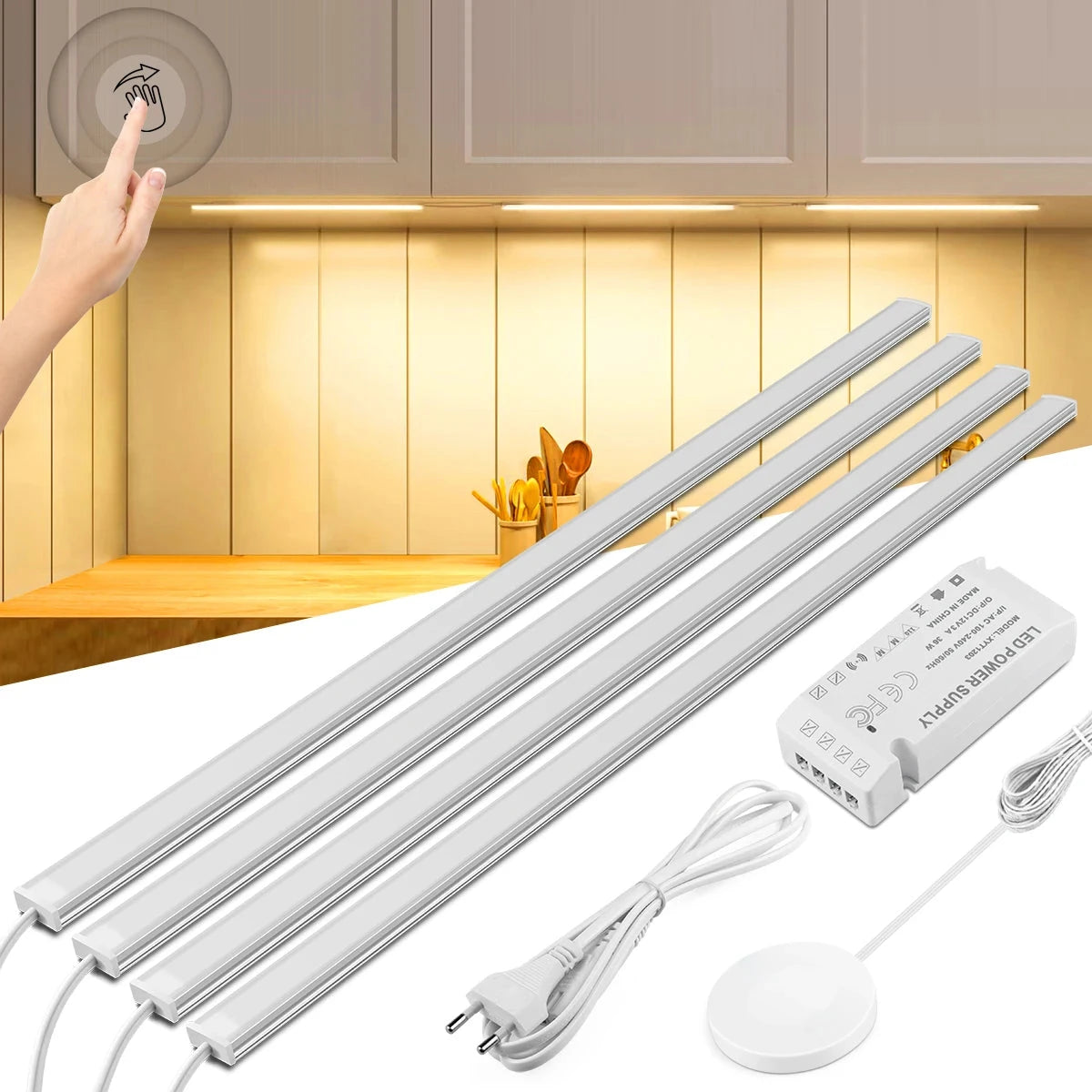
- 30, 40, and 50 cm options with a US or EU adapter configuration.
- Hand-sweep control and stepless touch dimming suit hands-busy worktops.
- Plan the adapter, sensor position, and cable route; the 7 mm body does not eliminate those parts.

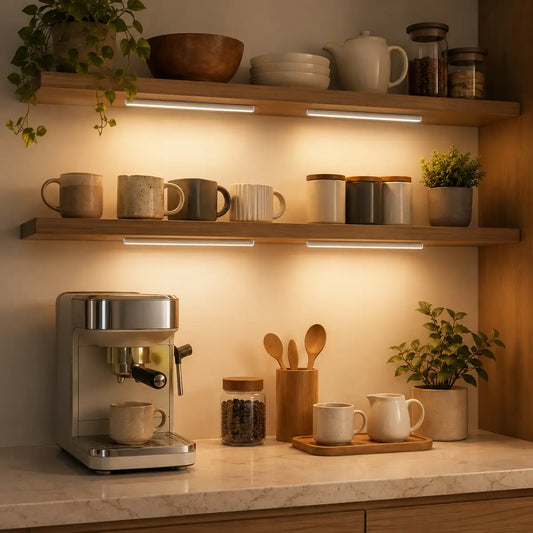
- 10 to 50 cm options with magnetic installation and USB Type-C charging.
- Always-on, night-motion, and all-day-motion modes let the control match the use pattern.
- Confirm the selected length, color temperature, removal path, and charging place before mounting.
Common Questions About Under-Cabinet Lighting Power
Is hardwired under-cabinet lighting better than plug-in?
It can be better for a permanent kitchen with long daily use and a planned electrical installation. Plug-in is often better when an outlet already exists, the wall should remain untouched, or the fixture may move later. The right choice depends on the room and the installation you are willing to maintain.
Is rechargeable under-cabinet lighting practical for a kitchen?
It is practical for short or intermittent zones when the fixture is easy to remove and charge. It is less convenient for a long prep run that stays on during cooking, especially when several lights must be charged separately.
Does plug-in mean the cable will be visible?
Not necessarily, but the cable and adapter still need a route. They may be hidden inside an accessible cabinet, behind suitable trim, or along a planned path. Check the whole route from outlet to fixture before ordering.
Can I convert a plug-in light to hardwired power?
Do not assume that a plug-in product can be converted safely. Use only the connection method and power supply specified for the exact model. New line-voltage connections should follow local requirements and be handled by a qualified electrician.
Bottom line: hardwired minimizes the recurring power task after a planned installation; plug-in minimizes new wiring while keeping continuous power; rechargeable minimizes installation disruption while adding a charging routine. Match that trade-off to how the space is actually used.

















 />
 />
 />
 />
 />