Inside Deep Cabinets & Pantries: Door- or Motion-Activated Lighting Solution
Deep Cabinet and Pantry Lighting Plan by Shelf Construction
Start with the shelf construction, not the sensor label. For one deep open bay or wire shelves with a clear light path, place the Lumaz 3-Color Switchable USB Rechargeable Motion Sensor Light Bar near the top-front edge and aim its light toward the rear labels. For solid shelves, put light below each active shelf with a powered Lumaz multi-bar system, or use one side-mounted Lumaz COB strip only when the shelf fronts share a clear vertical edge. Reserve a Lumaz PIR puck for one small compartment or retrieval point.
Best fit
- Deep food cabinets, pantry towers, appliance compartments, and divided storage where the rear contents disappear behind front rows.
- The shelf material and stored items can be inspected before deciding between one top source, a side line, or per-shelf light.
- The desired trigger can be defined as door position, a reaching hand, room approach, or deliberate manual control.
The plan changes when
- Opening and closing one door must define the light state exactly; use a purpose-built door-contact system.
- Tall packages, shelf lips, baskets, or face frames block either the beam or the sensor.
- Several high-use levels would make repeated charging more work than routing one powered system.
Lumaz planning principle: every opaque shelf creates a separate light zone; every clear opening creates a possible trigger path. Map those two conditions first, then choose the Lumaz bar, puck, strip, power source, and control that can serve the resulting zones.
Match Light Position and Trigger to the Shelf Construction
This matrix is the working plan. Classify each bay or shelf level separately; a tall pantry can contain more than one row from the table.
| Shelf construction | Light position | Trigger or control plan | Lumaz route | Re-plan when |
|---|---|---|---|---|
| One open deep bay with no intermediate shelf | Top-front underside, with light directed beyond the first row of packages | PIR motion when the reaching hand crosses the sensor naturally; deliberate on mode for longer organizing sessions | Rechargeable linear motion bar | A tall front row blocks the rear target or covers the sensor; move the source forward or divide the bay into two lit zones. |
| Wire or open shelves with a clear vertical sightline | Begin at the top-front edge; add a lower source only after a stocked test shows a remaining shadow zone | Use approach or reach-in motion only when the sensor can see the intended action without facing a busy room | One bar first, then add only where needed | Baskets, liners, or tall goods turn the apparently open shelf into an opaque obstruction. |
| Several solid shelves with an outlet and cable route | One bar below each frequently used shelf, placed toward the front so the beam reaches the rear | One powered controller can activate the shelf group; start with the shortest useful sensing distance | Powered Lumaz multi-bar plan | Cables cross hinges, moving drawers, food-contact areas, or an inaccessible adapter location. |
| Solid shelves with no practical per-shelf cable, but one clear front-side edge | One continuous strip down the front interior side, aimed across shelf fronts and labels | Keep the motion-control box near the opening where it can see the intended approach or reach | Side-mounted Lumaz motion COB strip | A face frame, baskets, door hardware, or stored items cover the side line; use removable bars on priority levels instead. |
| One small compartment, pull-out bin, or isolated corner | Upper-front corner centered over the item or handle being retrieved | PIR motion for short visits where a brief automatic cycle is useful | Rechargeable Lumaz PIR puck | The compartment is wide, the rear corners remain dark, or the user works there longer than the automatic cycle. |
If the pantry includes a worktop, coffee station, or food-preparation surface, plan that surface separately with the Kitchen Counter and Work-Zone Lighting Plan. Interior storage light should reveal shelves and labels; countertop task light should cover the user's hands and working surface.
Choose the Trigger from the Action You Want to Detect
Exact door state
Use a door-contact system
Choose this when one hinged door must switch the light on at opening and off at closing. Door position—not human movement—is the event that matters.
Brief retrieval
Let PIR see the reach
Place the sensor at the front of an open bay or compartment so the hand or body enters its field before stored goods block it. Keep it from aiming broadly into normal room traffic.
Several shelf levels
Trigger the group, light each zone
A powered multi-bar system can use one controller while each solid-shelf level receives its own light. The trigger may be shared even though the light positions are not.
Long organizing session
Provide deliberate control
Inventorying food or rearranging shelves can outlast a short automatic cycle. Choose a Lumaz model with an always-on, touch, app, or remote-control route rather than relying only on repeated movement.
Door-contact boundary: the Lumaz products mapped below use motion, microwave sensing, touch, app, remote, or always-on controls; the maintained product facts do not identify any of them as a mechanical or magnetic door-contact switch. Do not treat motion sensing as an exact substitute when the door itself must control the light.
Configure the Light for Each Storage Structure
Plan 1 · Open deep bay or wire shelves
Start with One Front-Mounted Linear Motion Bar
Recommended setup: choose a 20cm, 30cm, 40cm, or 50cm bar that fits the usable opening between hinges, shelf pins, and face frames. Temporarily place it near the top-front underside, keep the sensor exposed to the normal retrieval path, and test whether the beam reaches the smallest rear label after the cabinet is restocked.
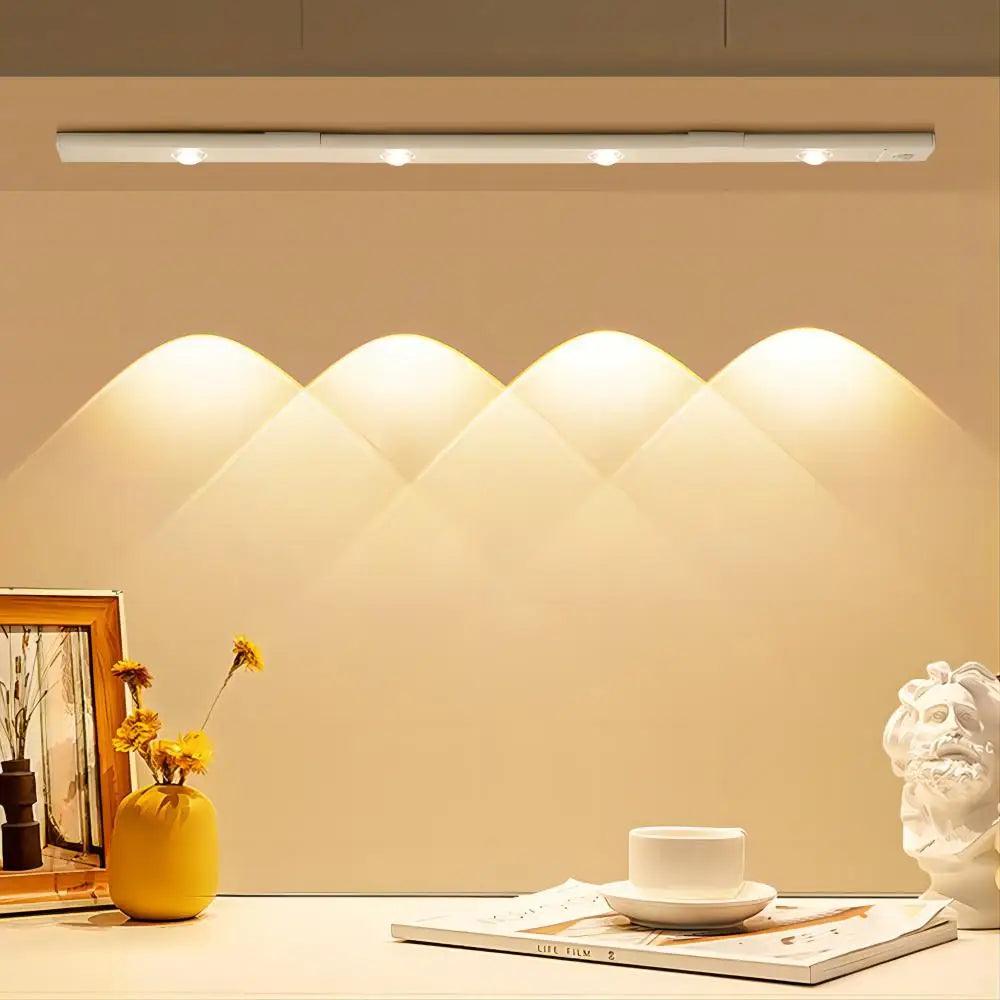
- Best fit: one deep food cabinet, appliance compartment, or wire-shelf bay with no practical power cable.
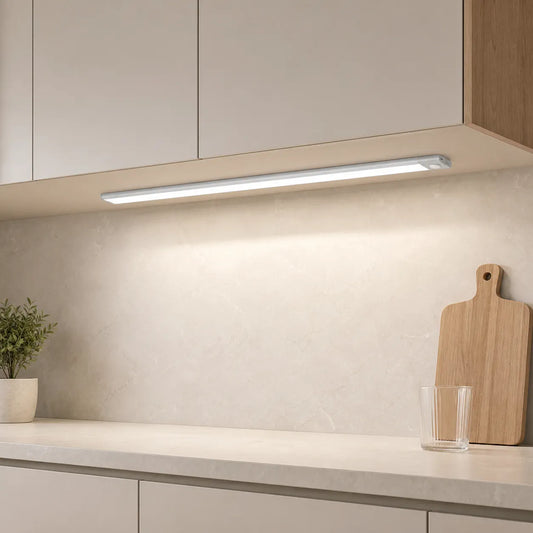
- Fixture facts: 20cm, 30cm, 40cm, and 50cm lengths; black or white housing; three selectable light colors; rechargeable battery.
- Why this model: the documented 120° motion range within 3m supports approach or reach-in activation, while 10%–100% touch dimming helps manage reflections from pale shelves and packaging.
- Not ideal when: an opaque shelf divides the light path, the sensor is hidden behind the face frame, or frequent daily use makes charging burdensome.
- Load the front row with the tallest packages normally stored there.
- Begin at the front edge; move the bar inward only enough to conceal the source or avoid door hardware.
- Open every door fully and reach for a rear item. Confirm that the hand enters the sensor field before it blocks the light.
- Add a second light only if a real lower or rear target remains dark; do not multiply fixtures from cabinet width alone.
Plan 2 · Several solid shelves
Place Light Below the Obstruction That Creates Each Shadow
Recommended setup: when an outlet and serviceable cable path exist, mount one powered Lumaz bar below every frequently used solid shelf and let the controller activate the group. Without a per-shelf cable route, use one vertical Lumaz COB strip only when the front-side edge remains clear across the levels; otherwise use removable bars on the priority shelves rather than asking one top light to pass through opaque boards.
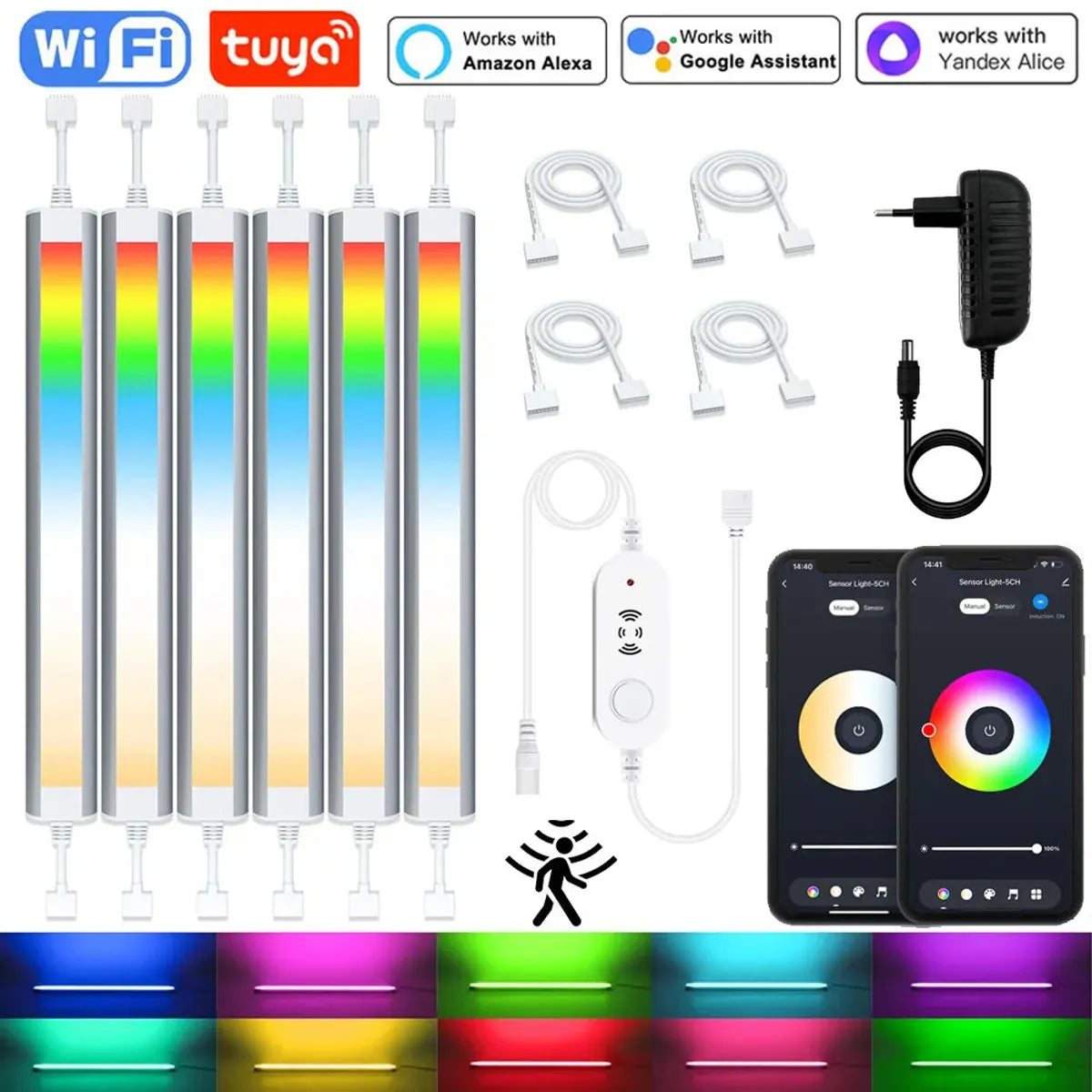
- Best fit: a high-use pantry with several opaque shelves, an outlet, and an accessible route for the adapter and connecting cables.
- System facts: 300 × 39 × 9mm bars, DC12V operation, multi-bar full-kit options, Tuya/Smart Life control, and 1m, 5m, or 10m sensing-distance settings.
- Why this model: separate bars put light below each solid shelf, while the shared powered controller avoids charging several individual fixtures.
- Not ideal when: a safe concealed cable route is unavailable, the adapter cannot remain accessible, or surrounding movement still triggers the shortest useful setting.
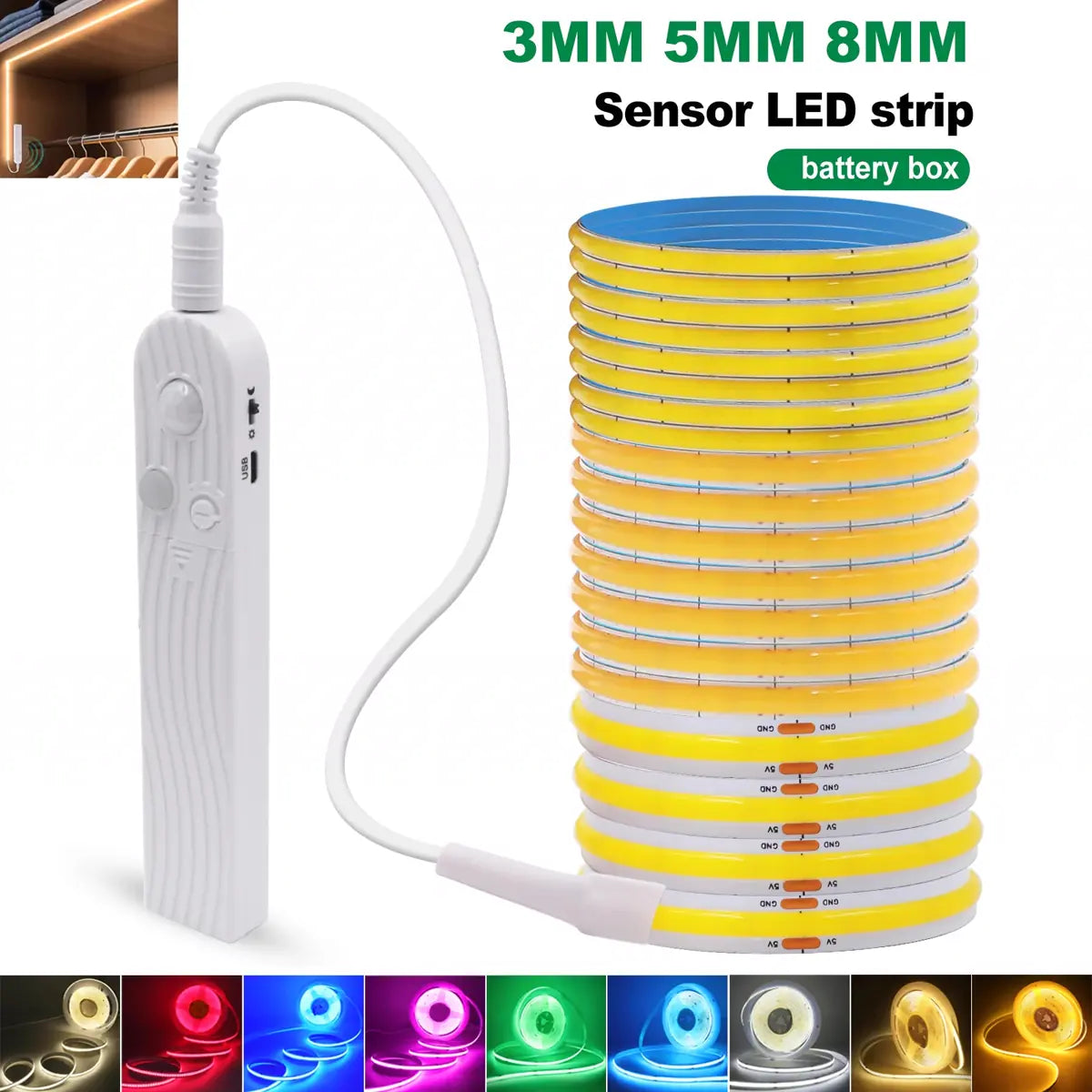
- Best fit: shelf fronts that share one unobstructed interior side and do not justify a separate powered or rechargeable fixture at every level.
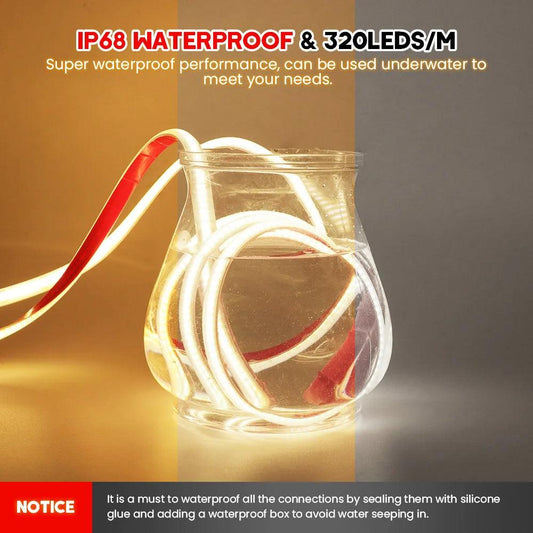
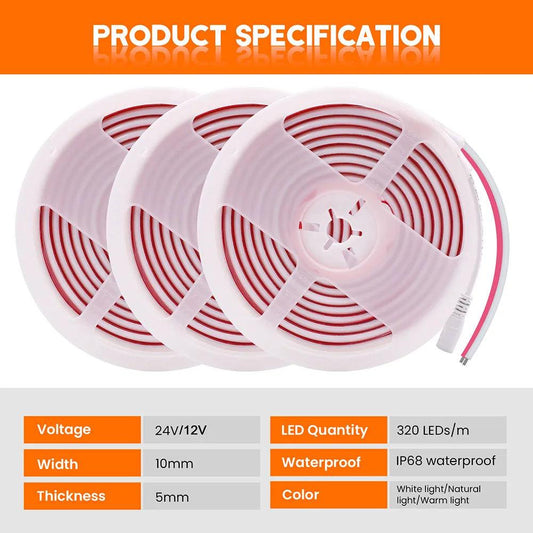
- Strip facts: 1m to 5m lengths, 3mm/5mm/8mm widths, 320 LEDs/m, 180° beam angle, cuttable construction, and four-AAA battery or USB power.
- Why this model: a continuous COB line can wash across several shelf fronts, and its separate motion-control box can remain near the opening rather than behind the stored goods.
- Not ideal when: a face frame, shelf lip, basket, hinge, or normal pantry load covers the side line; direct per-shelf light is then more dependable.
Choose powered bars when
Every active shelf needs direct light, the pantry is used throughout the day, and one serviceable power route is easier to maintain than several batteries.
Choose the side strip only when
The vertical source remains visible to the shelf fronts after baskets, bulk packages, door hardware, and the normal pantry load return. A clear empty cabinet is not enough proof.
Plan 3 · Small compartment or retrieval point
Use One Puck Close to the Item, Not at the Cabinet Center
Recommended setup: place one Lumaz PIR puck near the upper-front corner and center its light over the bin handle, spice group, pull-out, or appliance control that must be found. Keep the Fresnel lens exposed so a reaching hand enters the sensing field before blocking the LEDs.
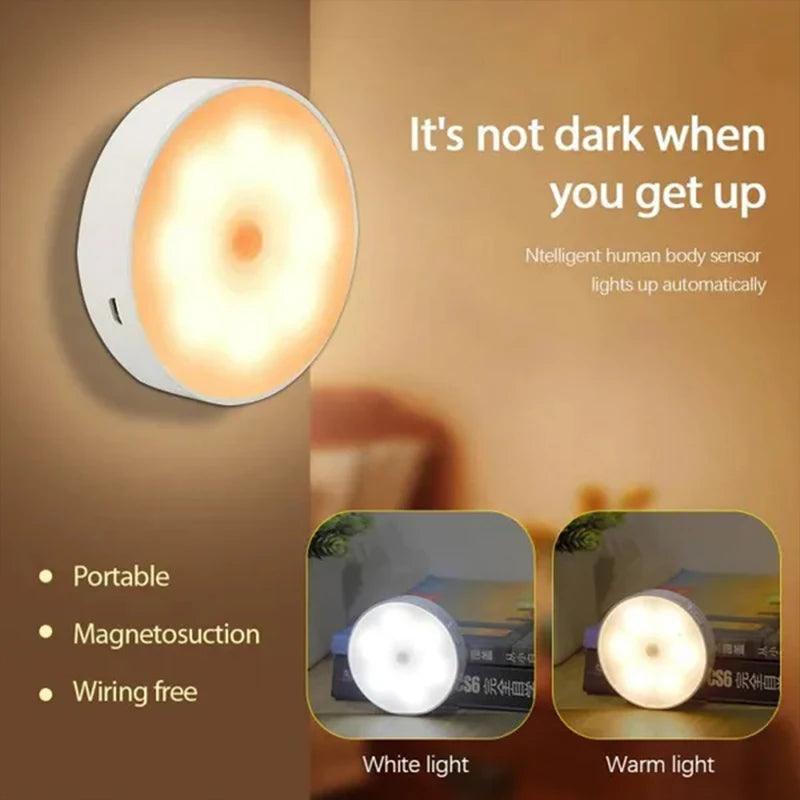
- Best fit: a spice shelf, pull-out bin, appliance control, or one dark corner used for brief retrieval.
- Sensor facts: infrared sensor with Fresnel lens, 120° sensing angle, listed 3–6m distance, and 25-second auto-off.
- Why this model: the 8.3 × 8.3 × 2cm magnetic rechargeable puck creates one local automatic pool without lighting unused shelf width.
- Not ideal when: the user reads labels or organizes the compartment for several minutes, or one pool still leaves the rear corners dark.
Test the 25-second cycle during the real retrieval task. If the light switches off before the user has finished reading labels or replacing a bin, use a Lumaz bar with deliberate always-on control instead of expecting repeated motion to compensate.
Build and Verify the Plan with the Pantry Stocked
- Label every light zone. Treat one open cavity as one zone, and every level below a solid shelf as a separate zone.
- Mark the retrieval target. Identify the rear label, bin handle, appliance control, or shelf area that must become visible—not merely the cabinet interior.
- Measure usable mounting space. Exclude hinges, shelf pins, door arms, face frames, removable baskets, and the direction needed to detach a rechargeable light.
- Write the intended trigger. Record door position, approach, reaching hand, or deliberate control. If the answer is door position, specify a real door-contact system.
- Return the normal load. Replace the tallest boxes, jars, baskets, and appliances before fixing the final position; empty-shelf testing hides the shadows that matter.
- Test household traffic. Walk past the closed and open pantry, then perform the normal retrieval action. Adjust the sensor position or sensing-distance setting until intended use activates reliably without routine passersby becoming the trigger.
- Check service access. Confirm that a rechargeable fixture can be removed, the controller remains reachable, and cables stay clear of hinges, moving hardware, loose food, heat, moisture, and pinch points.
If false triggers, missed reach-in detection, or control behavior becomes the main problem, use the motion-sensor and hand-wave control plan. If the shelf plan is sound but no acceptable power route exists, compare removable choices in the No-Wiring Under Cabinet Lighting Solutions page.
Questions That Determine Your Lighting Setup
Can one top light illuminate every pantry shelf?
Only when the pantry has a clear vertical light path, such as one open cavity or wire shelves without opaque liners, tall packages, or baskets blocking the beam. Every solid shelf creates another shadow zone; place a Lumaz bar below each important level or use a side COB strip only where one vertical edge stays clear.
Should I use a door sensor or a motion sensor?
Use a true door-contact system when the door must define on and off exactly. Use Lumaz motion control when an approaching person or reaching hand is the action to detect and the sensor can see that action without facing unrelated room traffic.
When is a vertical side strip better than one light per shelf?
Use the side strip only when the shelf fronts share one unobstructed vertical edge after the pantry is fully stocked. Choose per-shelf Lumaz bars when solid shelves, face frames, baskets, or door hardware interrupt that side light or when every level needs direct illumination.
Are rechargeable lights practical for several pantry levels?
They are practical for one or two priority levels or a lightly used cabinet. For several shelves used many times each day, a powered Lumaz multi-bar system usually creates a simpler maintenance plan when an outlet and safe cable route are available.
Continue with the Right Lumaz Path
Collection hub
Compare Lumaz Under Cabinet Lighting
Use the collection after classifying the shelves and trigger to compare current light-bar, puck, strip, power, size, and control options.
Next decision · Counter task zones
Plan Kitchen Counter and Work-Zone Lighting
Continue here when the pantry or cabinet also sits above a preparation, cleanup, coffee, or appliance surface that needs task coverage outside the storage interior.
Next decision · Lighting layers
Balance Task, Ambient, and Decorative Light
Continue here when an open pantry is visible from the room and the next decision is how bright storage light should relate to the surrounding kitchen and evening atmosphere.