Under Cabinet Lighting for Glossy & Reflective Countertops: Reduce Glare and Reflections
How to Reduce LED Reflections on a Glossy Countertop
First identify what you actually see: individual LED dots, one bright reflected line, or the fixture itself from a seated position. Try dimming and temporarily moving the existing light before replacing it. If a row of dots remains, a continuous COB strip is a better starting source. If a COB strip still appears as one sharp line, change its position or add diffusion. A mirror-like countertop will still reflect some light; the goal is a less distracting reflection without making the worktop too dark.
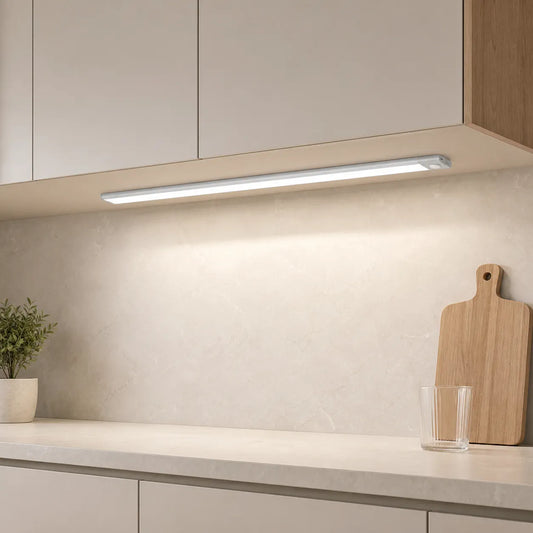
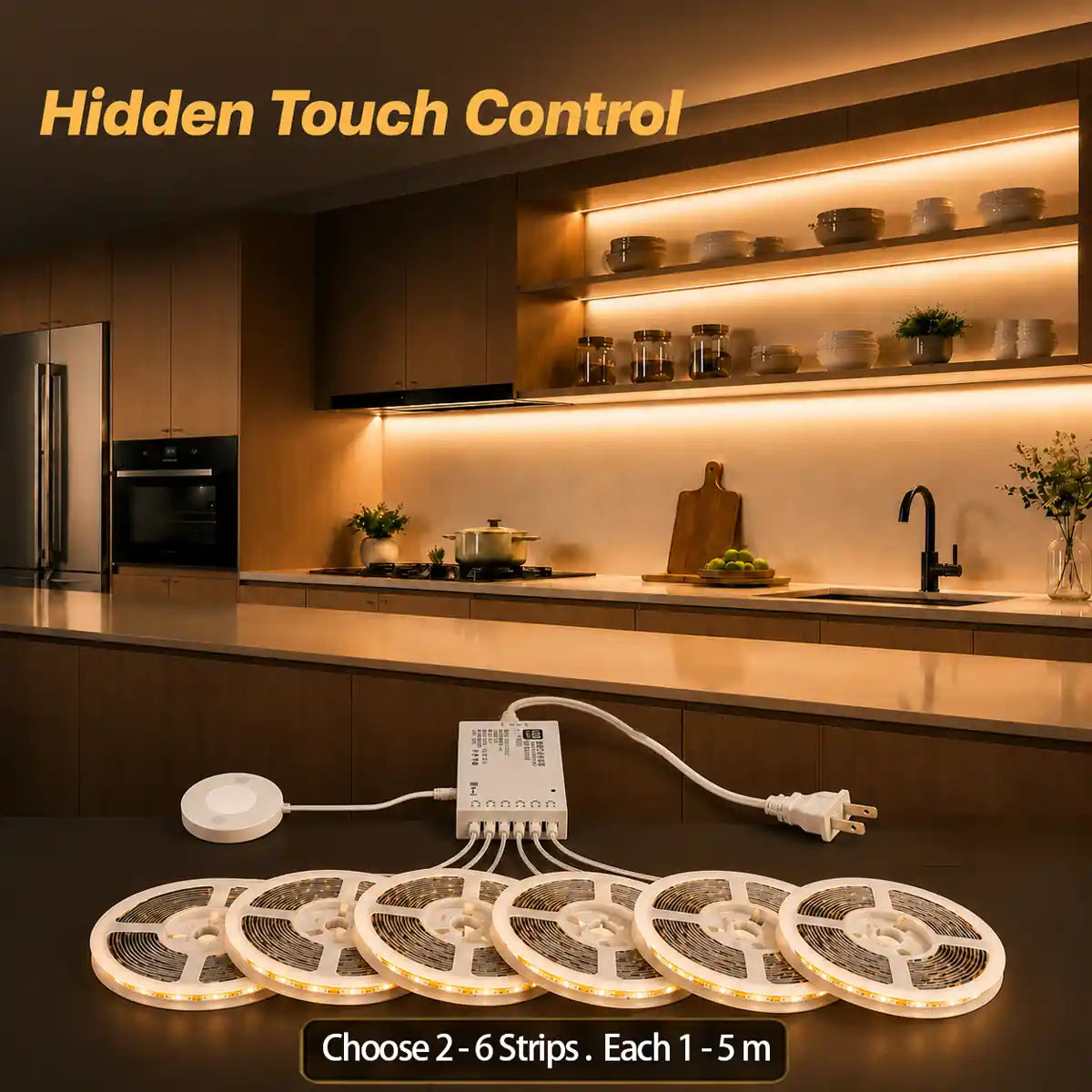
For a powered everyday prep counter with a hidden cable route, Lumaz's Hidden Touch Sensor COB LED Strip Light Kit is a practical first product to compare: its continuous COB line and stepless dimming address dotted reflections and brightness together. It cannot, by itself, erase a sharp mirrored line. Test its position from the places people stand and sit before final mounting.
Best fit
- A polished stone, glass, or high-gloss surface showing distinct LED dots.
- A daily prep zone that needs continuous, dimmable light.
- A fixture position that can be tested before final adhesion.
Choose differently when
- A continuous COB line still looks too sharp: try position and brightness, then compare a milky-tube source or compatible opal diffuser.
- A custom channel and low-voltage system are already planned: compare an angled 12V COB installation.
- No cable route exists: compare a dimmable rechargeable bar and its charging trade-off.
Before buying: check whether turning down or shifting the current light solves the problem. A new source matters most when the reflection is a pattern of individual LEDs; diffusion matters most when the remaining line is too sharp.
Identify the Reflection Before Choosing a Light
Reflected glare is a bright copy of the light on the countertop. Direct glare is the fixture you can see under the cabinet, often from a dining chair or another part of the room. They can occur together, but a diffuser or new strip will not fix every direct sightline; a cabinet lip, a different mounting position, or a light rail may be needed.
| What you see on the counter | First correction | Why it fits | Escalate when |
|---|---|---|---|
| A row of individual LED dots or repeated bright points | Dim or move the current light; if dots persist, compare a continuous COB source | COB changes the visible source from separated points to a continuous line. | The dots disappear but one sharp linear reflection remains. |
| One continuous bright line on black or mirror-like stone | Test a different position and lower brightness; then compare milky diffusion | Position can move the line away from a viewer; diffusion may make the remaining line look softer. | The line still enters the normal standing or seated sightline. |
| The reflection is acceptable standing but glaring from a dining chair or adjacent room | Reposition and test an angled channel; shield the fixture if it is directly visible | Direction and shielding change different problems, so test both from the seat in question. | No channel position avoids both reflection and direct fixture visibility. |
| The kitchen has no practical outlet or hidden cable route | Rechargeable dimmable bar | Magnetic mounting allows position and brightness to be revised without permanent wiring. | Daily long sessions make repeated charging less acceptable than adding a powered route. |
A glossy counter will still reflect light: the practical goal is a broad, low-contrast reflection outside the main viewing path—not an impossible promise of zero reflection from a mirror-like surface.
Four Configurations for Reflective Worktops
Configuration 1 · Visible LED dots on polished stone
Replace Point Sources with a Continuous Dimmable COB Line
Recommended setup: use one measured Lumaz COB run per uninterrupted counter section. Begin just behind the front underside lip, then test the strip in place before fixing it. Check that the front working edge is lit and that the source is not directly visible from nearby seats. Use dimming to reach a comfortable level after the position is right.
- Best fit: a frequently used polished-stone prep counter where individual diode reflections make a standard strip look dotted.
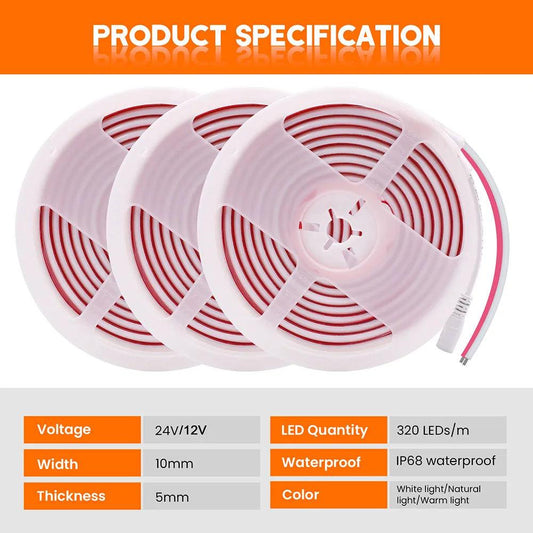
- Source facts: 320 LEDs/m COB, 8mm PCB, 1m to 5m lengths, cuttable every 2.5cm, and warm/neutral/white options.
- Why this model: the continuous COB source replaces separated LED points, while stepless dimming lets you reduce a too-bright reflection without adding a visible switch.
Best fit
A black granite or polished quartz counter shows a repeated dotted pattern when the light is on. The cook still needs even illumination across a cutting board, so replacing the source pattern is more useful than simply moving a low-density strip farther back.
Not ideal when
The countertop mirrors one sharp COB line even at moderate output. Choose the Lumaz milky-tube COB option or add a compatible opal diffuser channel, then retest the angle and brightness.
COB solves dots, not every reflection: a continuous strip can still appear as a continuous line on polished stone. Before final adhesion, check the reflected line from the usual cooking position and nearby seats.
Configuration 2 · A sharp continuous line remains
Broaden the Source with a Milky Diffusing Tube
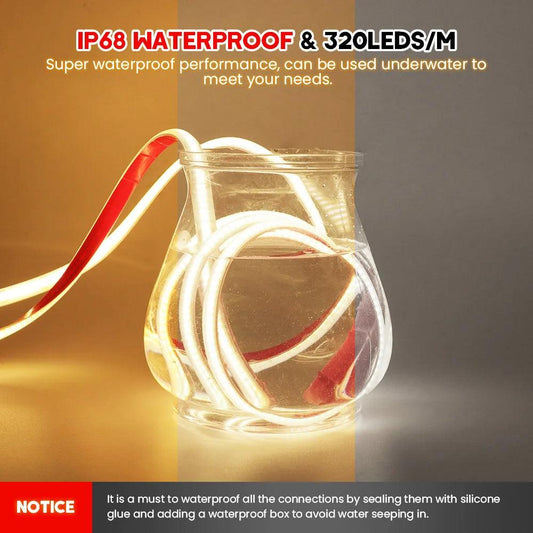
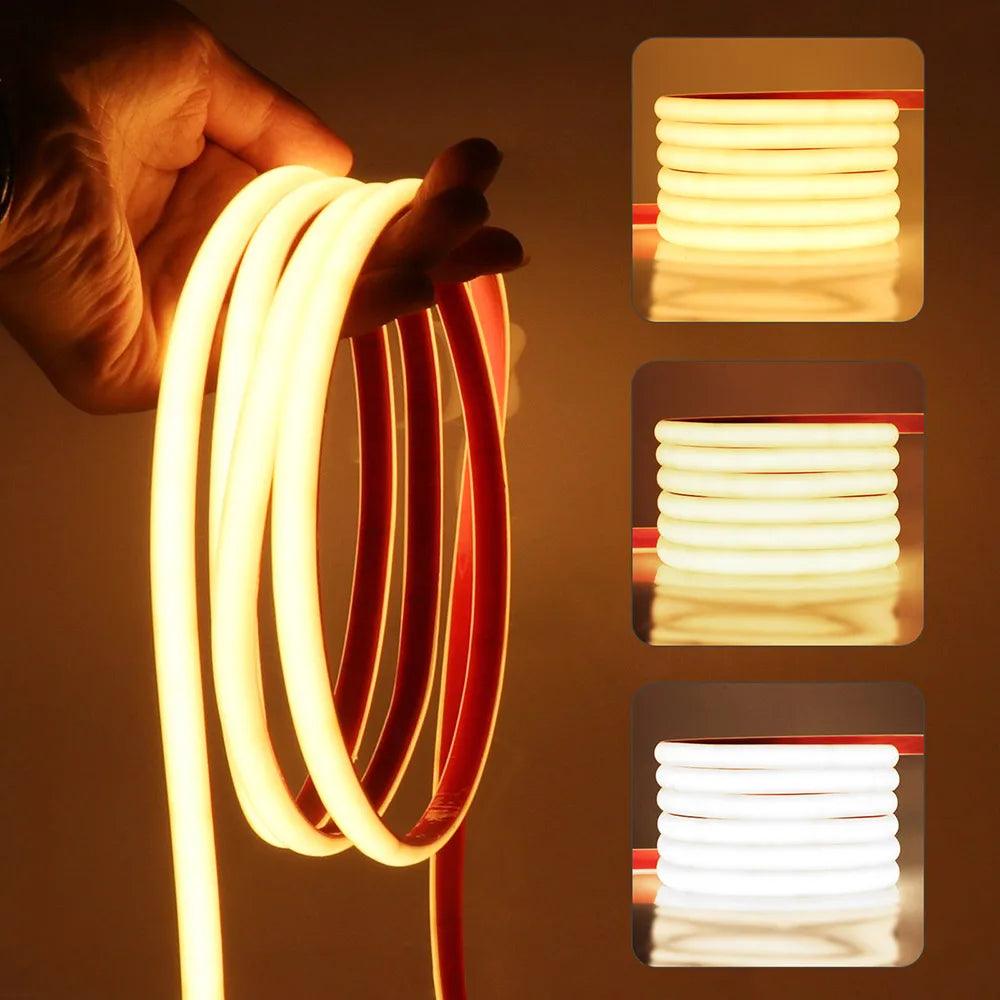
Recommended setup: compare the milky-tube variant of the Lumaz 24V COB strip if a continuous line still looks harsh after repositioning and dimming. Check that its roughly 10 mm body fits behind the cabinet lip, then plan a compatible 24V power and dimming system. The milky tube may soften the appearance of the line, but it cannot remove a mirror reflection.
- Best fit: highly polished black stone or glass-like surfaces where a bare COB line remains visually sharp.
- Source facts: milky or clear silicone tube, 320 LEDs/m, CRI above 90, 3000K or 6000K, 24V input, and 1m to 20m lengths.
- Why this model: the milky tube can soften the visible source while high-density COB avoids distinct LED dots; CRI above 90 supports natural-looking food and surface colors.
Best fit
A reflective island or long dark counter is viewed from several positions, and the main complaint is the hard mirrored line rather than insufficient task coverage.
Not ideal when
You want a complete plug-in kit. This product is a strip, not a finished under-cabinet system; select a compatible 24V power supply, dimmer, connectors, and mounting method. Choose the Lumaz Hidden Touch Sensor COB LED Strip Light Kit when a ready-to-use power and control package matters more than the milky tube.
Clear versus milky: choose milky when reflection softness is the goal. The clear-tube option protects the strip but does not provide the same visual diffusion decision.
Configuration 3 · Reflection enters a specific sightline
Test an Angled Channel for a Viewer-Specific Reflection
Recommended setup: pair the Lumaz 12V high-density COB strip with a compatible angled aluminum channel and opal diffuser when a custom system is already being planned. Begin near the front underside edge, then test more than one direction from the seat where the reflection is distracting. An inward angle may help one sightline and worsen another; there is no universal angle.
- Best fit: custom cabinetry where the channel angle, diffuser, driver, and dimmer can be selected together.
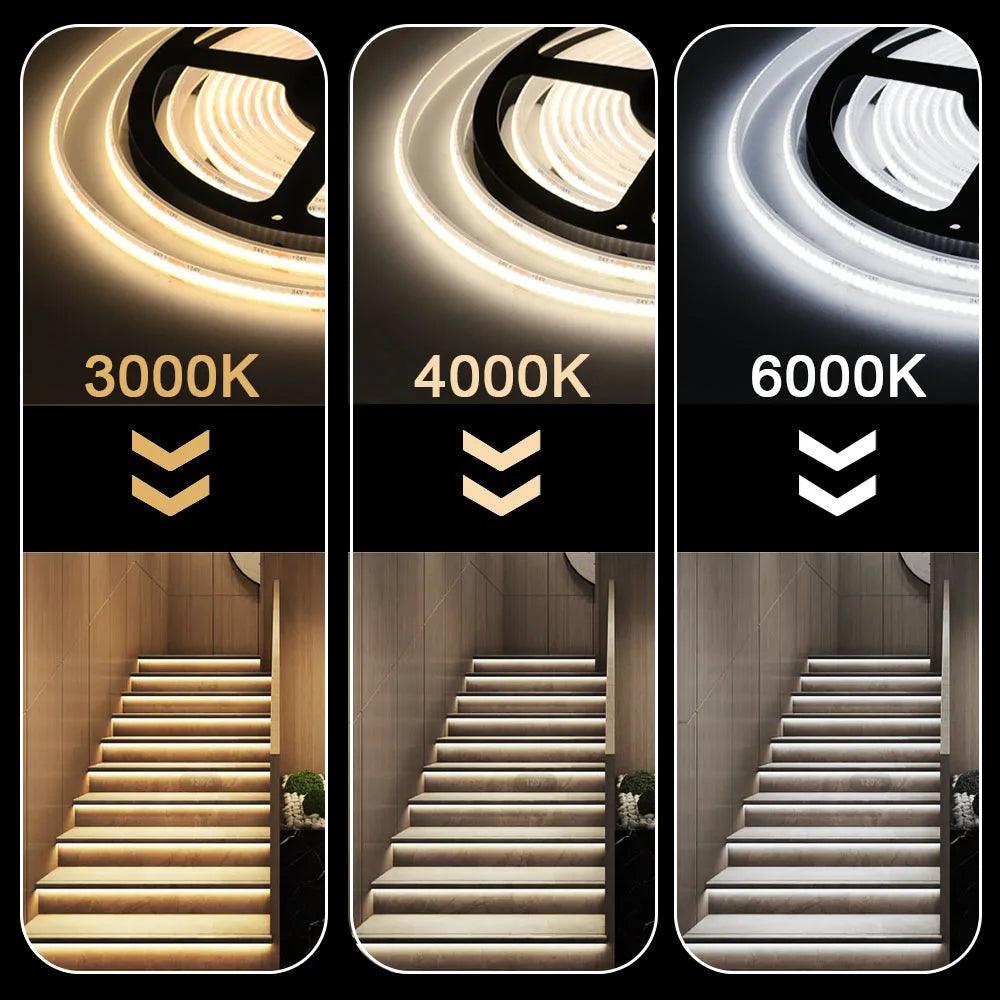
- Strip facts: DC12V, 320 LEDs/m, CRI above 90, 3000K/4000K/6000K, 9–10mm width, cuttable and dimmable construction.
- Why this model: the narrow high-density COB strip is a candidate for a purpose-built channel, while high CRI supports food and stone color; the channel position, not the strip alone, changes where the reflection appears.
Best fit
A polished island looks acceptable to the person cooking but produces a bright line for someone seated across the room. A temporary angled mock-up can target that exact viewer position before the channel is installed.
Not ideal when
No compatible 12V power, dimmer, channel, diffuser, or connector system has been selected. This Lumaz strip includes no power supply; choose the complete COB kit rather than improvising incompatible components.
Check channel depth as well as angle
A deeper channel lip can shield the LEDs from an oblique direct view, while a compatible opal cover can make the source look less sharp. But a deep recess may also narrow the useful light reaching the front of the counter. Check the strip width, diffuser fit, cable exit, and the channel and strip makers' mounting and heat guidance. The Lumaz item here is the strip; the channel, diffuser, power supply, and dimmer must be chosen as compatible separate components.
Test the angle without committing to it
- Temporarily tape a short channel or non-powered mock-up at the proposed front position.
- Place the real strip or a safe test light in the channel and begin at low brightness.
- Check the counter from the cook's position, adjacent seating, the room entrance, and any glossy backsplash reflection.
- Rotate or move the channel in small steps. Keep the position that reduces reflection without leaving the front cutting area dark or exposing the source directly.
- Confirm final channel width, diffuser fit, cable exit, and heat-management instructions before permanent mounting.
Configuration 4 · Rental or no concealed cable route
Use a Removable Bar and Tune Position Before Brightness
Recommended setup: place a Lumaz rechargeable bar at a short reflective work zone when no practical cable route exists. Test its position behind the front lip and lower its stepless dimming until the reflection is less distracting without leaving the task area dark. Use always-on mode for cooking so the motion timer does not interrupt the test. Its rigid body can still reflect as a bar, so view the result before treating it as a permanent answer.

- Best fit: a rental or finished kitchen where the fixture must be removable and the counter has one or two reflective work zones.
- Fixture facts: 10cm to 50cm lengths, 3000K/4000K/6000K, stepless dimming, magnetic installation, and always-on plus two motion modes.
- Why this model: magnetic mounting makes front-to-back testing reversible, while adjustable brightness and color allow the visual result to be tuned without opening cabinets for a powered route.
Best fit
A polished rental countertop shows a visible fixture reflection, but the user can move a magnetic bar several times and choose the least distracting position before committing the iron patch.
Not ideal when
A long daily worktop needs several bars at high output for hours. Charging becomes a larger compromise, and a rigid bar may still mirror as a bright shape; use a powered, diffused Lumaz COB configuration when a safe route becomes possible.
Test Position and Direction on Your Actual Counter
| Starting position | Likely benefit | Watch for | Adjustment |
|---|---|---|---|
| Just behind the front underside lip, facing down | Can reach the working edge while the lip screens the source. | A bright line can still mirror toward nearby seating. | Angle inward or move slightly rearward while protecting front-edge coverage. |
| Near the front edge, aimed inward for testing | May move the strongest reflected light away from one viewing position. | The backsplash may become too bright, and another viewing position may still catch glare. | Reduce the angle or brightness and check every normal sightline. |
| Centered beneath the cabinet | Balances front and rear task coverage on some counters. | The light can sit directly in a mirror-like reflection zone. | Shift toward the front and recess behind a lip. |
| Near the rear or backsplash | Creates a wall-wash effect and hides the fixture from direct view. | The backsplash becomes bright while the cutting edge stays dark; the reflection may face the room. | Move forward unless a back-panel glow is the actual goal. |
A five-step reflection test
- Recreate the real scene. Clean the surface as usual and return the cutting board, appliances, and other glossy objects that affect what you see.
- Try the current light first. Dim it, then temporarily shift it between front, middle, and rear positions if its mounting allows. A movable mock-up can help before purchasing a new fixture.
- Check the task. Put a cutting board where you normally work. The least reflective position is not useful if it leaves your hands or the front half of the counter in shadow.
- Check the viewers. Look while standing at the board, seated nearby, and entering the room. Repeat after dark, when a bright line can become more noticeable.
- Then choose the hardware. Persistent dots call for a continuous source; a hard line may call for diffusion; a viewer-specific reflection may need a different position or angle.
Color-temperature check: warm light may look visually softer and neutral light is a practical task starting point, but neither removes glare by itself. Position, apparent source size, and brightness have the larger effect on reflected intensity.
Questions That Change the Solution
Will COB strip remove every reflection from granite?
No. COB changes repeated LED dots into a continuous source, but polished granite can still mirror that source as a line. Try position and brightness first; compare the Lumaz dimmable COB kit when separated points are the main problem.
Should under-cabinet lights go at the front or back over glossy counters?
Start just behind the front lip because it reaches the active work edge and allows an inward angle. Rear mounting can over-light the backsplash while leaving the front worktop dim. Test both because cabinet depth, viewer height, and surface polish change the reflection path.
Will an angled channel always reduce glare?
No. An angle can move a reflected line away from one person and toward another. Test several positions from the actual standing and seated views. If the fixture itself is visible, also check whether a cabinet lip or deeper compatible channel shields it.
Is a diffuser still useful with COB?
It can be. If a continuous COB line remains too sharp after moving and dimming it, the milky-tube Lumaz 24V COB option or a compatible opal channel may soften the source's appearance. Neither guarantees that a mirror-like surface stops reflecting it.
Continue with the Right Lumaz Path
Collection hub
Compare Lumaz Under Cabinet Lighting
Use the collection after choosing COB, stronger diffusion, an angled custom system, or rechargeable operation to compare current lengths, controls, and power variants.
Next decision · Task coverage
Fix Dark Countertop Work Zones
Continue here when reflections are controlled but the cutting board, sink edge, or appliance zone still falls into a body-cast shadow.
Next decision · No wiring
Plan a No-Wiring Under Cabinet Setup
Continue here when the preferred diffused or angled powered layout cannot reach an outlet and removable rechargeable products become the main constraint.