Under Cabinet Lighting for L-Shaped Kitchens: Corners, Gaps & Separate Runs
Best Overall Layout for a Powered L-Shaped Kitchen
Best overall for an L-shaped kitchen with an outlet and a planned cable route: the Lumaz Through-Wood Touch Sensor COB LED Strip Light Kit. Treat each straight cabinet leg as a measured strip run, stop and restart at sharp corners or cabinet interruptions, and return the runs to the centralized power hub. The kit's 2-, 4-, 5-, and 6-strip choices and 2.5cm cutting intervals make it better suited to irregular cabinet geometry than forcing one rigid fixture across the whole kitchen.
Best fit
- Two perpendicular countertop legs meet at an inside corner.
- A range hood, sink, dishwasher, window, or tall cabinet divides the upper cabinets.
- Continuous power and a concealed route back to one accessible hub are available.
Choose a different configuration when
- Each straight cabinet section closely matches a 30cm, 40cm, or 50cm rigid light bar.
- No acceptable crossover cable route exists; use an independent rechargeable bar per section.
- A custom 12V installation requires installer-selected power, wire, and verified compatible connectors.
Lumaz solution principle: cabinet layout determines the electrical groups before it determines the fixture count. Divide the kitchen at sharp corners and physical gaps, decide which sections can share power without visible cable, and only then match each group to a cuttable strip or an individual light bar.
Decide Where Each Lighting Run Starts and Stops
| Cabinet condition | Recommended run strategy | Why it fits | Choose differently when |
|---|---|---|---|
| L-shaped cabinets with two straight legs and a sharp inside corner | One cuttable COB strip run per leg | A separate run on each leg avoids twisting a strip around a tight corner and allows both lengths to be measured accurately. | The two legs cannot return to one concealed hub without an exposed wire. |
| Two or more straight cabinet sections separated by a short gap | One powered light bar per section | Rigid bars keep each illuminated section visually clean when the kit cable can be hidden across the gap. | The sections need custom lengths or the gap is too long for a practical concealed route. |
| Cabinet sections split by a range hood, sink window, dishwasher, doorway, or tall appliance | Independent rechargeable group after the break | No visible crossover cable is needed, so a distant section can operate as its own task zone. | The section is used for long daily sessions and routine charging would be inconvenient. |
| Long custom route where an installer will specify the 12V power supply and wiring | Cuttable 12V two-pin COB strip | The strip supports precise custom lengths and can be divided around corners and discontinuities. | A complete plug-and-play kit is preferred or connector compatibility cannot be verified. |
| No upper cabinet or safe mounting surface above part of the counter | End the under-cabinet run at the last cabinet | A wire or lit strip should not bridge open air simply to preserve visual continuity. | A separate wall, shelf, or ceiling task-lighting plan is added for the uncovered zone. |
Four Configurations for Corners and Separate Cabinet Runs
Configuration 1 · Powered L-shaped cabinets
Use a Separate Cut-to-Fit COB Run on Each Leg of the L
Recommended setup: measure each straight cabinet leg from its own start point to the inside corner, ending each strip at a documented cut point before the turn. Begin a second strip on the perpendicular leg and route both runs back to the centralized hub. Use additional strip outputs for cabinet sections beyond a hood or other break only when their cables can reach the same hub without remaining visible.
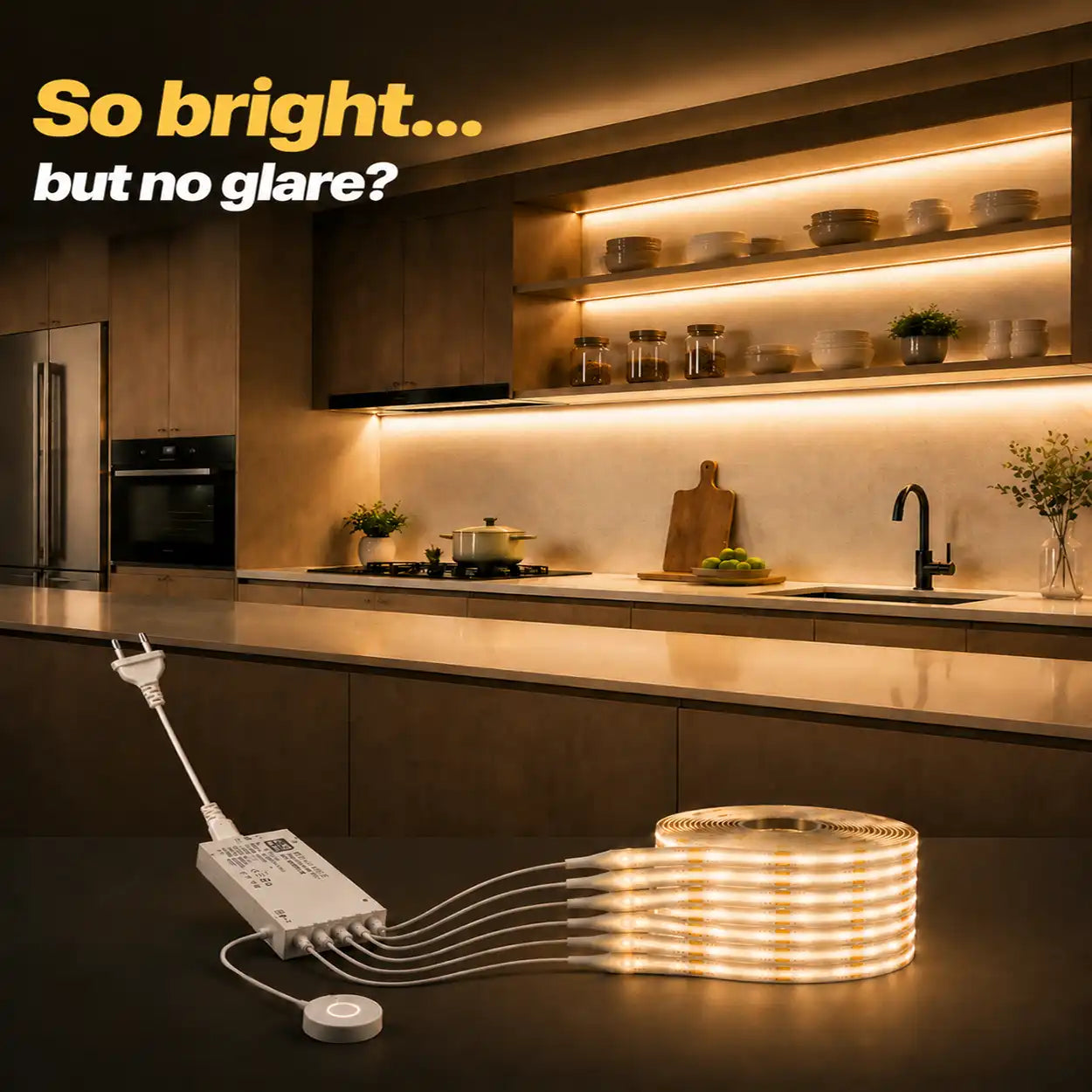
- Best fit: two or more measured cabinet runs that can return to one powered hub.
- Layout facts: 1m/2m/3m/5m lengths, 2-/4-/5-/6-strip choices, and cutting points every 2.5cm.
- Why this model: multiple strip options, centralized power, 320 LEDs/m COB light, and stepless dimming support coordinated but separately measured runs around an L-shaped layout.
Best fit
A remodel or finished kitchen where two L-shaped legs, a coffee station, and a short cabinet beyond the hood can all reach one concealed, serviceable power location.
Not ideal when
The cable path between cabinet groups would cross a window, sink, exposed wall, or hot appliance zone. Use an independent Lumaz rechargeable bar for the separated group instead of preserving one electrical group at the cost of visible wiring.
Build the multi-run layout
- Label the two L-shaped legs A and B, then label any section beyond a hood or tall cabinet C rather than treating the kitchen as one perimeter.
- Measure the usable underside of each section independently and subtract space needed for trim, hinges, and the final cable turn.
- End both corner strips before the cabinet undersides change direction. A small deliberate pause at the inside corner is better than a twisted strip or a bright overlapping knot.
- Dry-fit every strip and cable back to the hub before exposing adhesive or cutting at the documented 2.5cm intervals.
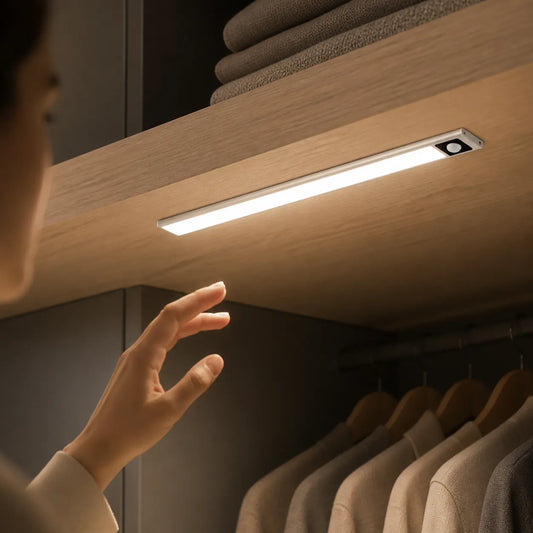
- Place the through-wood control point on a compatible non-metallic panel within its documented 25mm sensing range and test it before final mounting.
Main trade-off: one powered kit gives the most coordinated daily operation, but every included run still needs a practical route back to the centralized hub. More strip outputs do not solve an exposed or inaccessible cable path.
Configuration 2 · Straight sections with concealed cable access
Give Each Straight Cabinet Section Its Own Ultra-Thin Powered Bar
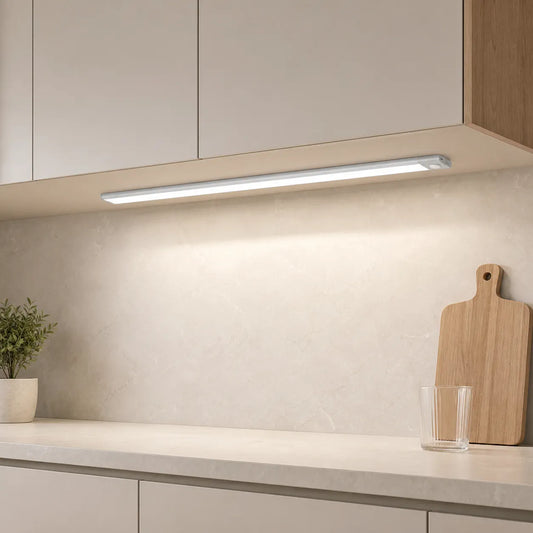
Recommended setup: match one 30cm, 40cm, or 50cm Lumaz light bar to each uninterrupted cabinet underside. Select a multi-light kit for the number of straight sections, then keep the powered bars as separate luminous segments while routing their cables out of view. Place the hand-sweep sensor where one deliberate gesture can control the intended group.
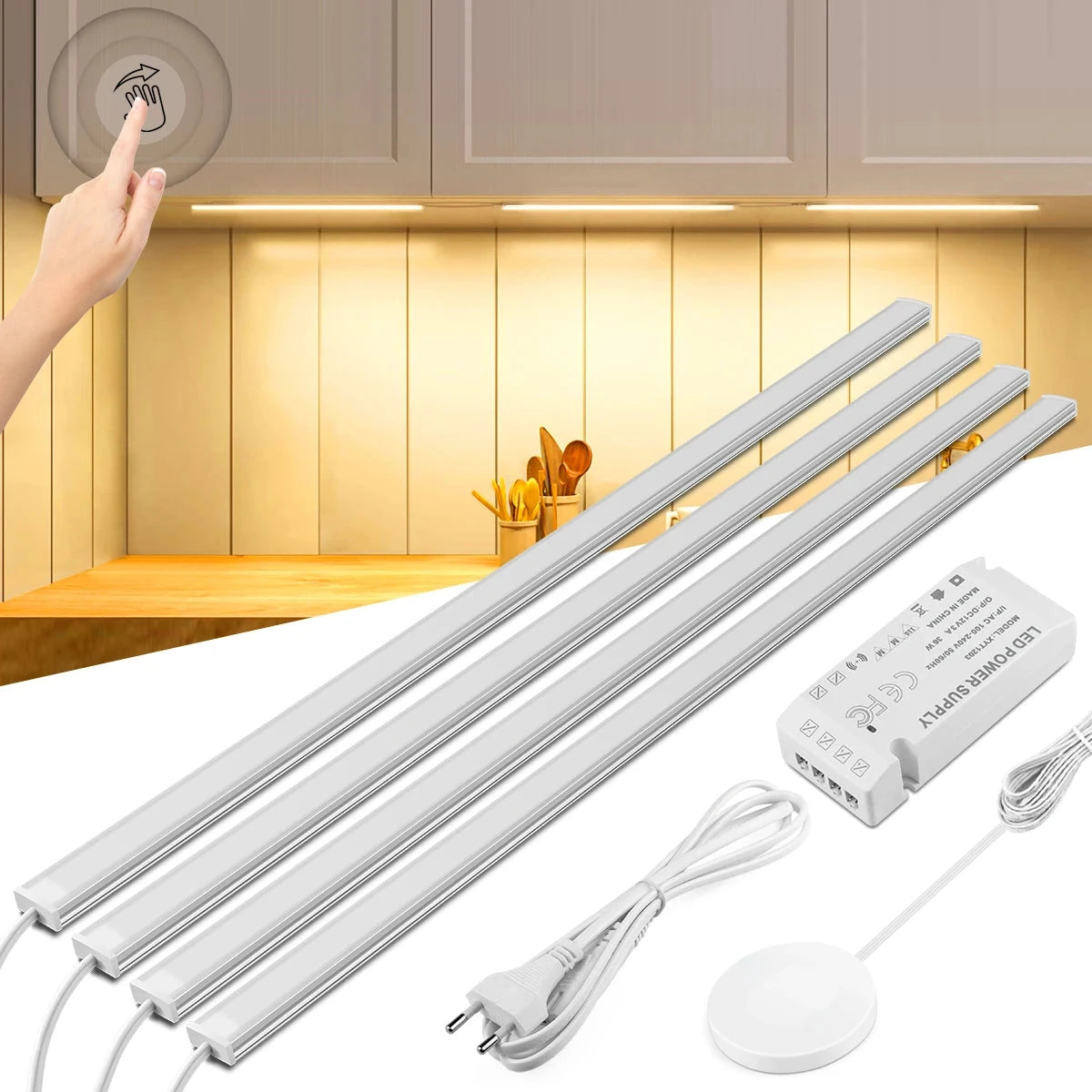
- Best fit: two to six straight cabinet sections whose cables can be concealed within one powered plan.
- Fixture facts: 7mm aluminum body, 30cm/40cm/50cm lengths, 1- to 6-light kits, and US or EU adapters.
- Why this model: the rigid lengths simplify alignment on straight runs, while hand-sweep control and stepless dimming suit frequent kitchen tasks without battery maintenance.
Best fit
A sink-side cabinet, prep section, and coffee-station cabinet with accessible voids or trim channels that let the non-luminous cable cross short interruptions without entering the user's view.
Not ideal when
The available cabinet lengths do not match the 30cm, 40cm, or 50cm bars, or the route requires a fixture to bend around the inside corner. Use the cuttable Lumaz COB kit for exact lengths and separate corner runs.
Do not confuse a multi-light kit with unlimited linkability: select a kit size that matches the planned sections, but verify the supplied cable layout against the actual cabinet distances before ordering. Do not assume that an unlisted extension or connector will fit.
Configuration 3 · Sections that cannot share a hidden cable route
Make the Cabinet Beyond the Gap an Independent Rechargeable Zone
Recommended setup: install one Lumaz rechargeable light bar on each isolated cabinet section and treat it as a separate operating group. Match the 10cm to 50cm length to the usable underside, use always-on mode for meal preparation, and reserve motion modes for brief access. This is usually cleaner than running a visible cable across a sink window, range hood, doorway, or tall appliance.

- Best fit: a short cabinet beyond a hood, window, sink, tall cabinet, or other gap with no acceptable cable crossing.
- Fit facts: 10cm/20cm/30cm/40cm/50cm lengths, black or silver finish, and magnetic installation.
- Why this model: rechargeable power removes the crossover wire, while 3000K/4000K/6000K light, stepless dimming, always-on, and two motion modes let the isolated section retain useful task control.
Best fit
A rental or completed kitchen where one distant cabinet serves a coffee machine, landing area, or short preparation zone and preserving clean sightlines matters more than synchronized control.
Not ideal when
Several isolated sections remain on for long cooking sessions every day. Multiple charging routines become the main burden; plan new concealed power or divide the kitchen into a small number of powered groups instead.
Manage independent groups
- Count each section beyond an uncrossable gap as a separate fixture, not as part of the length total for the previous cabinet.
- Keep the magnetic removal direction accessible after appliances return to the counter.
- Use the same color-temperature setting across neighboring groups when visual continuity matters.
- Create one charging location and label bars by cabinet section if several identical fixtures are installed.
Configuration 4 · Installer-planned custom 12V route
Use a Two-Pin COB Strip When the Power and Connections Are Specified Separately
Recommended setup: divide the custom layout into straight measured runs, select the appropriate IP30 or IP68 Lumaz strip for the actual environment, and have the compatible 12V power supply, wire, dimmer, and any corner or gap connectors specified as one electrical system. The strip is the light source; it is not a complete plug-and-play kit.
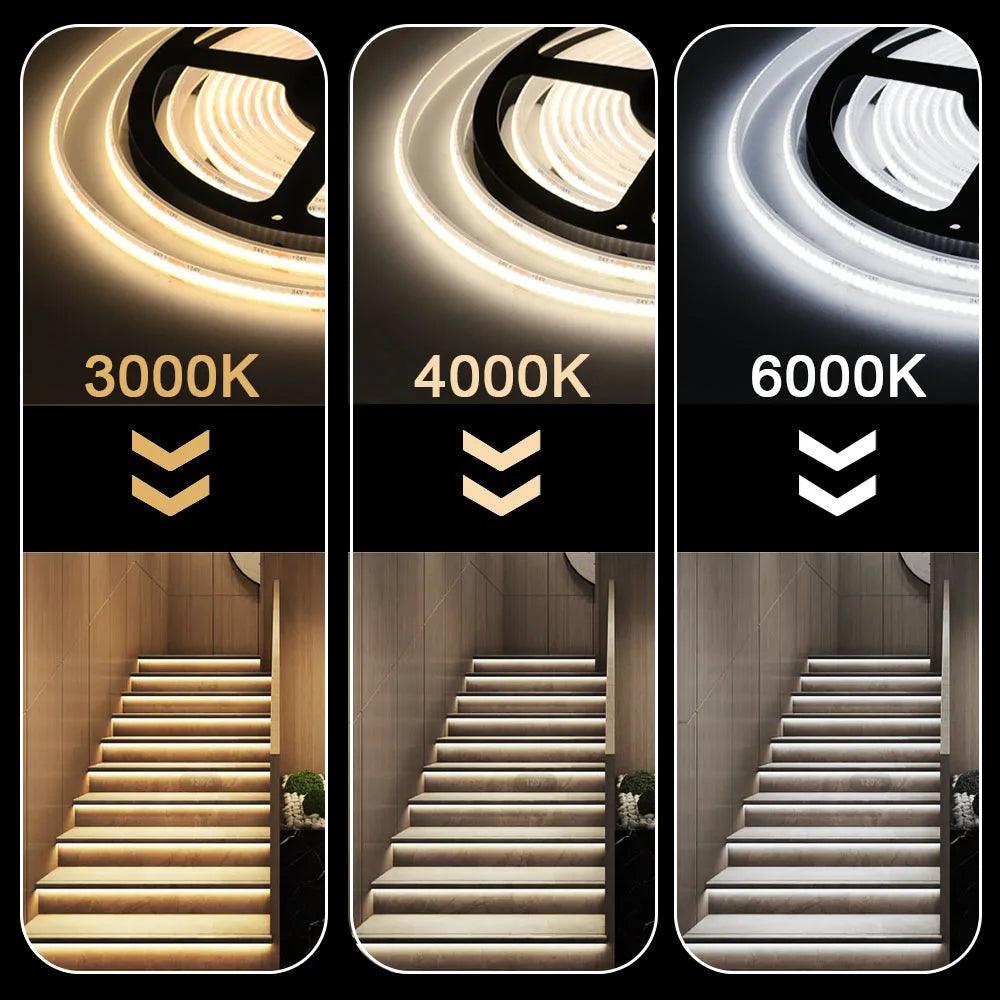
- Best fit: an installer-planned kitchen where power capacity, wire routes, dimming, and connections are selected separately.
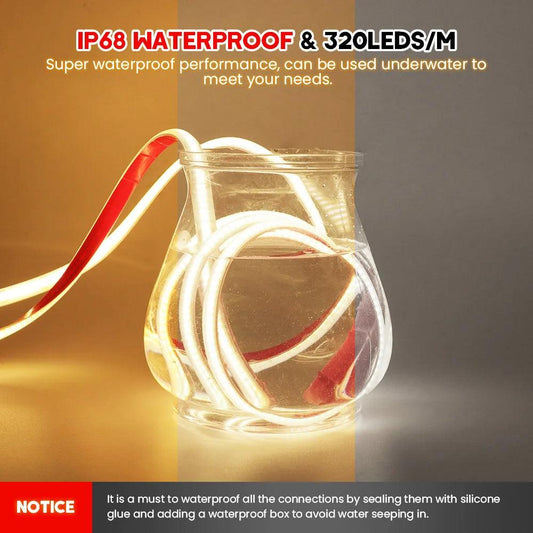
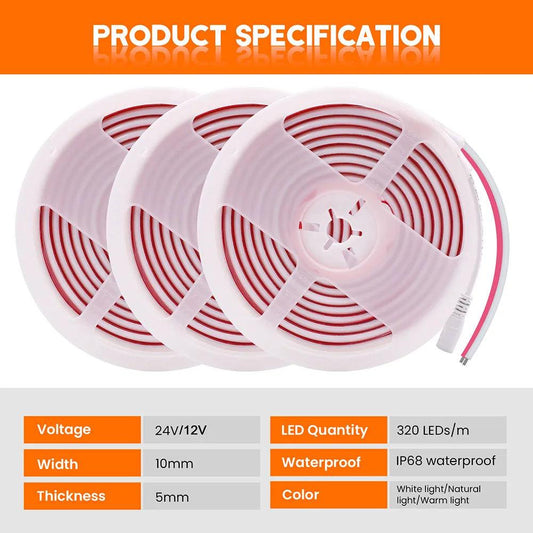
- Strip facts: 12V two-pin construction, 1m–20m lengths, 9–10mm width, 320 LEDs/m, and warm/natural/cool white choices.
- Why this model: a flexible, cuttable strip supports precisely measured straight runs, while the IP30/IP68 choice allows the light source to be matched to the actual exposure condition.
Best fit
A new kitchen, cabinet refit, or electrician-assisted project where several corners and gaps require a purpose-built low-voltage wiring plan rather than a packaged consumer kit.
Not ideal when
The user expects the power supply, dimmer, splitters, extension wires, and corner connectors to be included. Choose the Lumaz Through-Wood Touch Sensor COB Kit for a more complete multi-run package.
Connector check: before using any separately sold corner or gap connector, verify 12V compatibility, two-pin polarity, the strip's 9–10mm width, connector current capacity, and fit with the selected IP30 or sealed IP68 construction. Similar-looking connectors are not automatically interchangeable.
Map the Runs Before Choosing Lengths or Kit Size
1. Draw only the cabinet undersides
Sketch each upper-cabinet section as a separate line. Mark inside corners, outside corners, hoods, sink windows, tall cabinets, open shelves, and every place where the fixture or cable cannot continue normally.
2. Assign a run ID at every decision point
- Keep the same run: the underside remains straight and continuous, and the selected fixture can fit the measured length.
- Start a new luminous run: the cabinet turns sharply, a hood or gap interrupts the underside, or the next section needs a different fixture length.
- Start a new power group: no concealed compatible cable route reaches the next section, or independent control is more practical.
3. Plan the non-luminous path separately
A gap does not need a glowing bridge. If two sections share power, measure the hidden cable path around or behind the interruption—not the straight-line distance across the countertop. Keep connections accessible for service and out of wet, hot, pinched, or moving areas.
4. Count products by run, not by wall
For planning, expect one rigid light bar per uninterrupted straight section. For a cuttable strip system, expect one strip segment per straight run and enough kit outputs or independently specified wiring for every segment. Confirm the actual kit contents and cable reach before ordering.
5. Dry-fit the whole system
Temporarily position lights, hub, controls, adapters, and every crossover cable. Open cabinet doors, operate the hood, return countertop appliances, and view the corner from normal standing positions before cutting or adhering anything.
Questions That Change the Connection Plan
Should an LED strip bend around a 90-degree cabinet corner?
For a sharp inside corner, plan two straight strip runs and stop each at an approved cut point. This avoids twisting, overlapping, or stressing the strip. Use a corner connector only when its voltage, pin layout, width, load rating, and protection style are confirmed compatible with the selected strip.
How should lighting cross a range hood or sink-window gap?
Do not continue the illuminated strip through open air. End the light at the last cabinet, begin a new run under the next cabinet, and either connect the two through a concealed compatible low-voltage route or make the second section an independent powered or rechargeable group.
Do all separate cabinet runs need their own power adapter?
No. Runs can share one powered kit when the hub supports the required number of outputs and every cable can reach through a concealed, serviceable route. Use a separate adapter or rechargeable bar when a cabinet section cannot join that group cleanly.
Is a cuttable strip always better than several light bars?
No. Choose a cuttable strip when exact lengths, corners, or several coordinated runs drive the plan. Choose Lumaz light bars when the cabinets are straight, the available bar lengths fit, and independent fixtures make installation and future replacement simpler.
Continue with the Right Lumaz Path
- Browse Lumaz Under Cabinet Lighting — compare current strip, light-bar, puck, power, and control variants after mapping the cabinet runs.
- How to Fix Dark Kitchen Countertops with Under Cabinet Task Lighting — use this when the run layout is known but front-to-back placement and task-surface shadows still determine the result.
- No-Wiring Under Cabinet Lighting Solutions — use this when one or more separated cabinet runs cannot accept a concealed power or crossover cable.