Under Cabinet Lights With a Wall Dimmer
Can Your Wall Dimmer Control Under Cabinet Lights?
Yes, if the under-cabinet fixture or its LED driver is designed for the exact wall dimmer and the installed load. A purpose-built dimmable direct-wire LED bar can be the simplest replacement for an existing hardwired run. For a 12V or 24V strip, the wall dimmer controls a compatible dimmable driver, which then supplies the strip at its required low voltage. A plug-in kit with touch or remote dimming is a different system: its “dimmable” label does not mean its adapter can be plugged into a wall-dimmer-controlled outlet.
Before buying, collect the model numbers for the wall dimmer, light and driver. Check the dimming method and supported load as a set, then confirm how the light behaves when power is switched off and restored. If those details are unavailable, choose a matched fixture-and-control system rather than hoping that any three “dimmable” parts will work together.
Choose the Control Path Before the Fixture
| Setup | How brightness changes | Best fit | Deciding check |
|---|---|---|---|
| Dimmable direct-wire LED fixture | Compatible wall dimmer controls the fixture's built-in electronics | Existing hardwired bar or a new permanent kitchen run | Fixture and wall-dimmer model compatibility, cable entry, and combined load |
| Low-voltage LED strip with dimmable driver | Compatible wall dimmer controls the driver; driver supplies the strip at its specified DC voltage | Continuous light shaped to several cabinets | Driver input/control type, strip voltage and load, dimmer compatibility, serviceable driver location |
| Plug-in kit with its own touch or remote dimmer | Kit's included controller changes brightness; a regular wall switch may only cut power to its outlet | Finished kitchen with an accessible outlet and no requirement to dim from the wall | Outlet arrangement and what the controller does when power returns |
Want to slide the wall control from bright task light to a softer evening level? Choose the first or second route as a complete compatible system. Only want one wall button to turn the lights on and off? A switched outlet with a plug-in kit may work, but the kit's own control sets brightness and its power-return behavior must be tested. A wall dimmer is not interchangeable with a plain wall switch.
If you are replacing fluorescent or halogen fixtures, first identify the existing feed and transformer, then settle the wall-dimming combination. The LED driver and transformer guide explains why the old power components may not suit the new light.
Match the Wall Dimmer, Driver and Light as One System
Start with the wall control you actually have
Find its exact model number and instructions, not just the brand or the shape of its knob. An older dimmer intended for incandescent or halogen lamps may behave poorly with a small LED load. Wall controls also use different dimming methods, commonly called forward phase and reverse phase; these describe how the control changes the household AC supply. The new LED fixture or driver must explicitly accept the chosen control method. A 0–10V control is another system and should not be assumed to work on the same two wires as an ordinary wall dimmer. Lutron's LED control guide explains why the control method must match the driver or fixture.
If the model number is hidden behind the wallplate, ask the electrician or installer to identify it safely. Do not open the box or infer a neutral wire, phase type, or compatibility from the wallplate alone.
Then read the LED fixture or driver specification
A direct-wire LED bar needs documentation that names compatible wall-control types or models. A bare 24V strip needs a compatible 24V supply; for wall dimming, that supply must be a dimmable driver designed for the wall control. A non-dimmable plug-in adapter cannot be made wall-dimmable merely because the strip or its separate touch controller can dim.
Ask the seller or installer for one written system answer: “This dimmer model controls this fixture or driver model with this number and length of lights.” Include every cabinet section on the same dimmer in that count. A manufacturer compatibility list or a matched system is stronger evidence than a broad “LED compatible” claim on one box.
Check the load without relying on a universal watt threshold
Some wall dimmers need a minimum LED load to start and remain stable, while all have an upper limit. The relevant limits depend on the exact dimmer and LED driver or fixture, not simply the old incandescent rating printed on a dimmer. Lutron's minimum and maximum load note explains that the same LED lamp can behave differently on different controls. Have the installer check the complete planned load and the manufacturer's compatibility information; adding an unrelated lamp just to make a dimmer behave is not a sound design plan.
What a Good Low Setting Should Look Like
“Dimmable” does not promise the same lowest brightness from every combination. For a kitchen, choose a bright level that makes food preparation clear and a lower setting that feels comfortable from the room. The low setting should still be steady, with no repeated flashing, sudden shutoff, loud buzzing, or persistent glow after the dimmer is off.
- At full output: every run should turn on reliably and the counter should be evenly usable.
- Halfway down: brightness should change predictably without one cabinet section lagging far behind another.
- Near the lowest usable level: look for flicker, stepping, dropout or an unexpectedly bright minimum. A compatible dimmer may allow low-end adjustment, but that does not make an incompatible driver suitable.
- Off: check for faint glowing or periodic flashes. Some dimmer/load combinations can produce these symptoms; Lutron's troubleshooting guidance describes this behavior.
Try the actual number of fixtures and driver arrangement before the installer closes access to the wiring. A showroom sample with one short light may not reveal how several cabinet runs behave together. If the finished lights already flicker, the flickering guide helps separate a control mismatch from other symptoms; switch the system off and call the installer for heat, smell, damaged wiring, or breaker trips.
Will the Lights Return to the Same Setting After the Wall Switch Is Used?
This matters when a wall device cuts power to a plug-in adapter or a separate electronic controller. Some products resume the last brightness, others return to a default, and some stay off until their touch sensor or remote is used again. Do not assume that “memory” on a product page includes a full loss of mains power; it may only remember a setting after the product's own button is pressed.
- With the exact light, adapter and controller connected according to their instructions, set a comfortable mid-level brightness.
- Turn power off using the ordinary wall switch or the intended switched outlet. Wait, then restore power.
- Record whether the light turns on, whether it recalls brightness and color, and whether a touch, remote or app action is required.
- Repeat at a low setting and after the controller has been left off. The desired behavior may differ between a morning task light and a late-night glow.
This is a functional check of a plug-in or already installed system, not a reason to place a plug-in adapter on an unapproved wall dimmer. For a true wall-dimming system, ask how the chosen dimmer and driver behave after power interruption as part of the system demonstration.
A Lumaz Strip for a Planned Wall-Dimming System
If you and your installer are building a low-voltage system around a compatible wall dimmer and 24V dimmable driver, the Lumaz strip below is a possible light source. Its published “dimmable” attribute refers to the strip as a component; it does not verify compatibility with a specific wall dimmer or supply a driver.
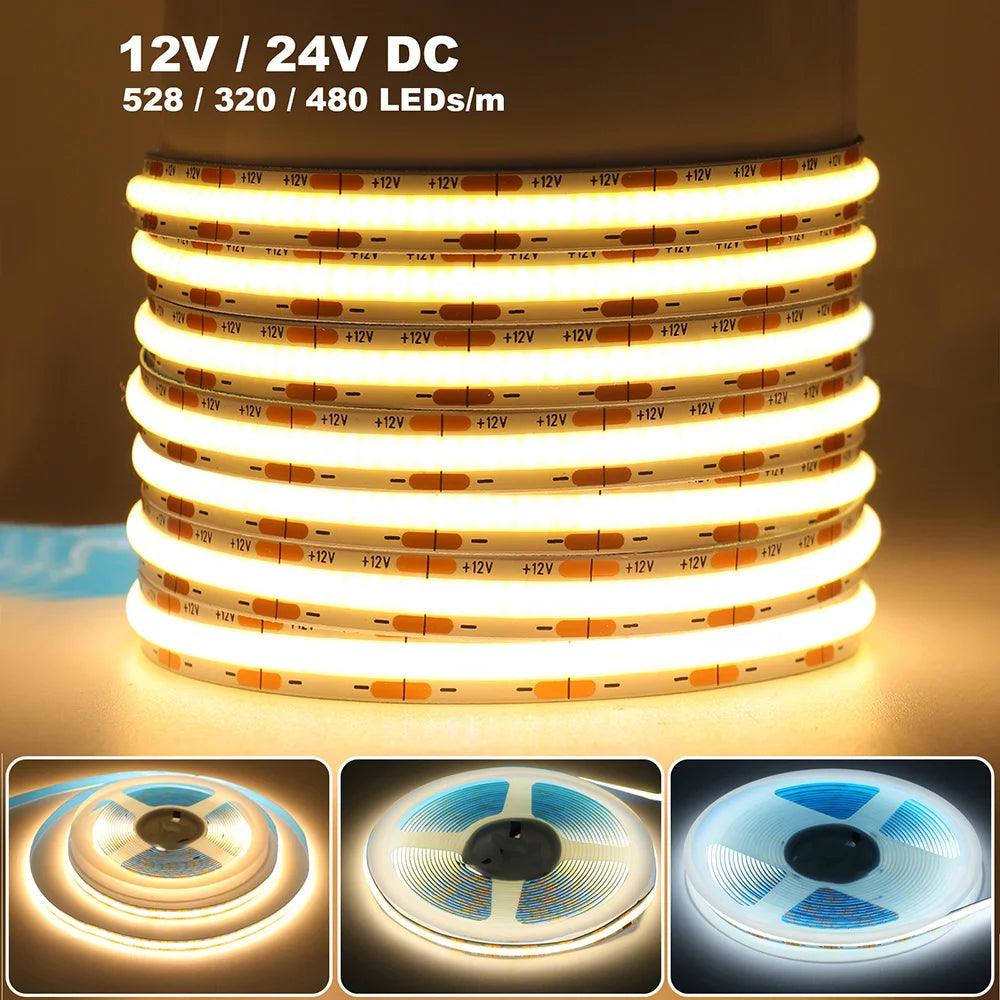
- Multiple lengths and warm, natural or cool-white variants support a measured linear layout.
- The 8mm COB strip can provide a continuous light line across a planned cabinet run.
- Before buying: match the selected variant's 24V load to the driver, then confirm that driver and the wall dimmer work together. The strip cannot connect to household voltage.
If you do not need brightness at the wall, Lumaz's Hidden Touch Sensor COB LED Strip Light Kit includes its own adapter and touch dimming control. It can be simpler for a suitable outlet, but its supplied product facts do not establish wall-dimmer compatibility or power-return memory. Keep the wall control as an ordinary on/off choice only if the exact kit's instructions and a power-cycle check support that use.
Bring This Short List to the Installer or Seller
- Wall control: model number, whether it is a switch or dimmer, supported LED control method, and any manufacturer compatibility list.
- Light: exact fixture or strip model, selected length and voltage, the number of cabinet runs, and whether it includes a driver.
- Driver, if used: input/control method, output voltage and capacity, supported dimmer models, and an accessible location for later replacement.
- Performance: full, medium and low brightness; reliable turn-on; complete off; no objectionable flicker or buzz.
- Power return: what happens after an ordinary wall off/on cycle and after a longer power outage, including brightness and color settings.
If the existing dimmer does not match the desired LED system, the sensible choice may be a compatible new wall control or a different lighting architecture, not a guess at the old dimmer's capacity. Any changes to in-wall devices, wiring or drivers should follow the product instructions and local requirements through a qualified installer. For the wider permanent-installation sequence, see the hardwired lighting guide.
Common Wall-Dimmer Questions
Can I put a plug-in under-cabinet LED kit on a dimmer-controlled outlet?
Only when the exact kit and adapter explicitly allow that wall-dimmer method. A kit's touch dimming does not establish that permission. Otherwise, use an ordinary suitable outlet and the kit's own controller, or select a fixture and driver built for wall dimming.
Can my old halogen wall dimmer control a new 24V strip?
Not the strip directly. A 24V strip needs a matching LED supply, and wall dimming additionally requires a driver compatible with that exact dimmer and the planned LED load. An older halogen dimmer may need replacement; verify the combination before the kitchen work begins.
Why do the lights flicker only at the lowest setting?
A dimmer, driver and LED combination may have an unstable low end or a load outside its supported range. Check the manufacturers' compatibility information and have the installer demonstrate the full range. Do not assume that adding random extra lights or hiding a buzzing driver fixes the cause.
Can one wall dimmer control several cabinet sections?
Yes when the chosen dimmer and all fixtures or drivers support the same control method and their combined load is within the approved range. Different drivers can reach different low levels, so test all sections together before closing the installation.
Will a wall switch remember my last touch-dimmer setting?
The wall switch itself does not determine the kit's memory. The controller may resume the last level, turn on at a default, or remain off after power returns. Verify the exact product's instructions and test an ordinary off/on cycle before relying on that behavior.
Continue With the Right Next Step
Broader hub
Explore Under Cabinet Lighting
Compare strip and bar forms after choosing the control method your kitchen can support.
Practical next step
Understand LED Drivers and Supplies
Check what a 12V or 24V strip needs between the wall supply and the light.
Related alternative
Choose a No-Wiring Setup
Consider a plug-in or rechargeable route when changing the wall control is not part of the project.