

Top Benefits of Using LED Light Bars for Under Cabinet Task Lighting
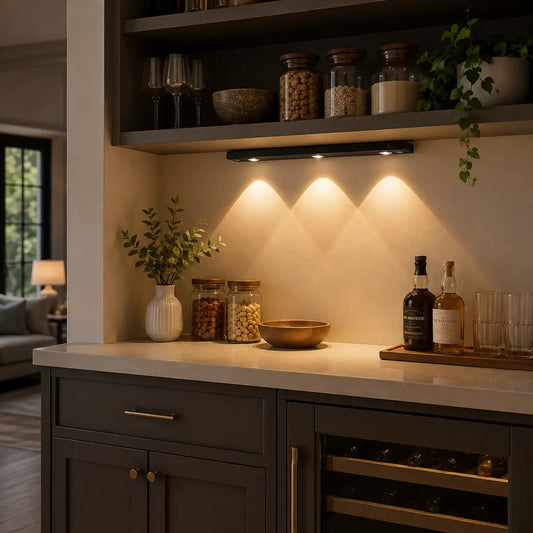
Under-cabinet lighting is one of the most effective ways to make kitchen work surfaces safer and easier to use. LED light bars are especially popular because they deliver uniform, controllable light in a clean, linear form factor.
This article takes a standards-informed approach: how to think in terms of illuminance on the countertop, how to reduce glare and shadows, and what safety and performance markers (e.g., UL, IEEE, ENERGY STAR) to look for when selecting and installing LED light bars.
Table of Contents
- What Under-Cabinet Task Lighting Means
- Benefit 1: Better Task Visibility With Measurable Targets
- Benefit 2: More Uniform Light, Fewer Shadows
- Benefit 3: Efficiency Without Sacrificing Performance
- Benefit 4: Safety and Compliance Signals to Look For
- Benefit 5: Better Light Quality for Food and Finishes
- Benefit 6: Precise Control and Lower Flicker Risk
- How to Choose an LED Light Bar (Checklist)
- Installation Tips for Optimal Task Lighting
- FAQs
- References
What Under-Cabinet Task Lighting Means
Under-cabinet luminaires are installed below an upper cabinet to direct light down to a countertop work surface. That matches the definition used in ENERGY STAR’s luminaires specification (ENERGY STAR Luminaires specification).
Task lighting is not just “more brightness.” A good under-cabinet plan delivers:
- Enough light on the counter for cutting, reading labels, and cleaning.
- Uniform distribution to avoid dark zones and hard shadows.
- Controlled glare so the light feels clear rather than harsh.
- Electrical safety appropriate for kitchens and permanent installation.
Benefit 1: Better Task Visibility With Measurable Targets
The most useful way to evaluate under-cabinet lighting is by the illuminance (lux or footcandles) on the countertop, not just “watts” or even total lumens.
Many lighting guides reference IES-recommended ranges when translating tasks into maintained light levels. For example, residential charts based on IES guidance commonly cite approximately 30–40 footcandles for general kitchen lighting and 70–80 footcandles in high-task areas like the sink and stove (IES-based residential footcandle chart).
Why LED bars help: a continuous linear source can be placed where it best supports the work plane, then dimmed to fine-tune measured illuminance without changing fixture layout.
Practical tip: after installation, spot-check the counter with a lux meter (or a calibrated phone app) and adjust brightness/diffusion until prep zones are bright without glare.
Benefit 2: More Uniform Light, Fewer Shadows
LED bars usually outperform spot-like under-cabinet fixtures when the goal is consistent task light. With a long luminous surface and a diffuser, bars:
- Reduce scalloping and “hot spots” on the backsplash.
- Lower the chance of shadow bands across the cutting area.
- Make it easier to link multiple cabinets into one continuous run.
This uniformity also supports better perceived brightness at lower output, which helps comfort and energy use.
Benefit 3: Efficiency Without Sacrificing Performance
LED technology can deliver strong task illumination with relatively low power draw, and programs like ENERGY STAR set performance and test requirements for qualifying luminaires (including under-cabinet types) (ENERGY STAR Luminaires V2.2).
In practice, efficiency is easiest to protect when you can use the right amount of light (and no more). A dimmable LED bar paired with a compatible driver/control lets you run bright for prep, then lower for evening scenes.
Benefit 4: Safety and Compliance Signals to Look For
Under-cabinet lighting combines electricity, cabinetry, and kitchen use—so safety indicators matter. When selecting light bars and power supplies, look for:
- Third-party safety certification (e.g., UL Listed, ETL Listed) for the luminaire and/or system.
- Appropriately evaluated LED equipment/drivers. ANSI/UL 8750 is a key safety standard for LED equipment used in lighting products (UL on ANSI/UL 8750).
- Correct installation method for your space (plug-in vs. hardwired vs. low-voltage). For hardwiring, follow applicable electrical codes and consider a licensed electrician.
These checks reduce the risk of overheating, shock hazards, and compatibility problems—especially when multiple bars are linked on one driver.
Benefit 5: Better Light Quality for Food and Finishes
In kitchens, light quality affects how you see:
- Food (freshness cues, doneness, and color).
- Surfaces (glossy stone, backsplash tile, stainless steel).
- Cleanliness (crumbs and spills).
When comparing LED bars, prioritize diffused optics and consistent color across fixtures. Many homeowners prefer warm-to-neutral whites (roughly 2700K–3500K) for kitchens, but the “best” choice depends on finishes and personal preference.
Benefit 6: Precise Control and Lower Flicker Risk
Dimming is a major advantage of LED bars, but it’s also where poor driver/control pairing can introduce flicker. IEEE has a recommended practice (IEEE Std 1789-2015) addressing modulation in LED lighting to mitigate potential health risks (IEEE 1789-2015), and the U.S. Department of Energy discusses flicker metrics and measurement considerations in its SSL resources (DOE: Characterizing Photometric Flicker).
To reduce risk:
- Choose a bar/driver designed for your dimming method (e.g., TRIAC, 0–10V).
- Test at low dim levels (where problems often appear first).
- Avoid mixing unmatched drivers, controls, and light bars.
How to Choose an LED Light Bar (Checklist)
| Decision | What to check | Why it matters |
|---|---|---|
| Brightness | Target illuminance on the counter; dimming range | Meets task needs without glare or over-lighting |
| Optics | Frosted/opal lens; wide distribution | Improves uniformity; reduces LED point sparkle |
| Color | CCT consistency across bars; stable white appearance | Avoids mismatched “two-tone” whites across cabinets |
| Controls | Dimmer compatibility; low-end stability | Prevents flicker and nuisance behavior at night scenes |
| Safety | UL/ETL listing; driver evaluation (e.g., UL 8750 context) | Reduces electrical and thermal hazards |
| System design | Linkability, maximum run length, driver headroom | Prevents dim runs, voltage drop, and overload issues |
If you want under-cabinet lighting that adapts to real daily routines—like late-night kitchen trips or hands-free prep—choosing a rechargeable LED light bar with motion sensing can make a noticeable difference. A Type-C rechargeable under-cabinet LED light bar with a smart motion sensor and adjustable color modes offers flexible placement, automatic activation when you need light, and the ability to switch between warm, neutral, or cool tones based on the task at hand.

Installation Tips for Optimal Task Lighting
1) Place the bar for the work plane, not the backsplash
- Mount the bar slightly behind the cabinet front edge so the beam reaches the primary prep zone.
- Use a diffuser to reduce glare reflections on glossy counters.
2) Build a continuous run where possible
- Link bars end-to-end to avoid dark gaps between cabinets.
- Keep wiring tidy and protected from heat and moisture sources.
3) Size the power supply and wiring correctly
- Check total system wattage and ensure adequate driver capacity.
- For permanent wiring, follow applicable codes and use a qualified installer when needed.
4) Verify dimming performance before finishing
- Test minimum brightness, ramp smoothness, and whether flicker appears at low levels.
- Confirm any smart controls or motion sensors behave predictably in your kitchen’s ambient light.
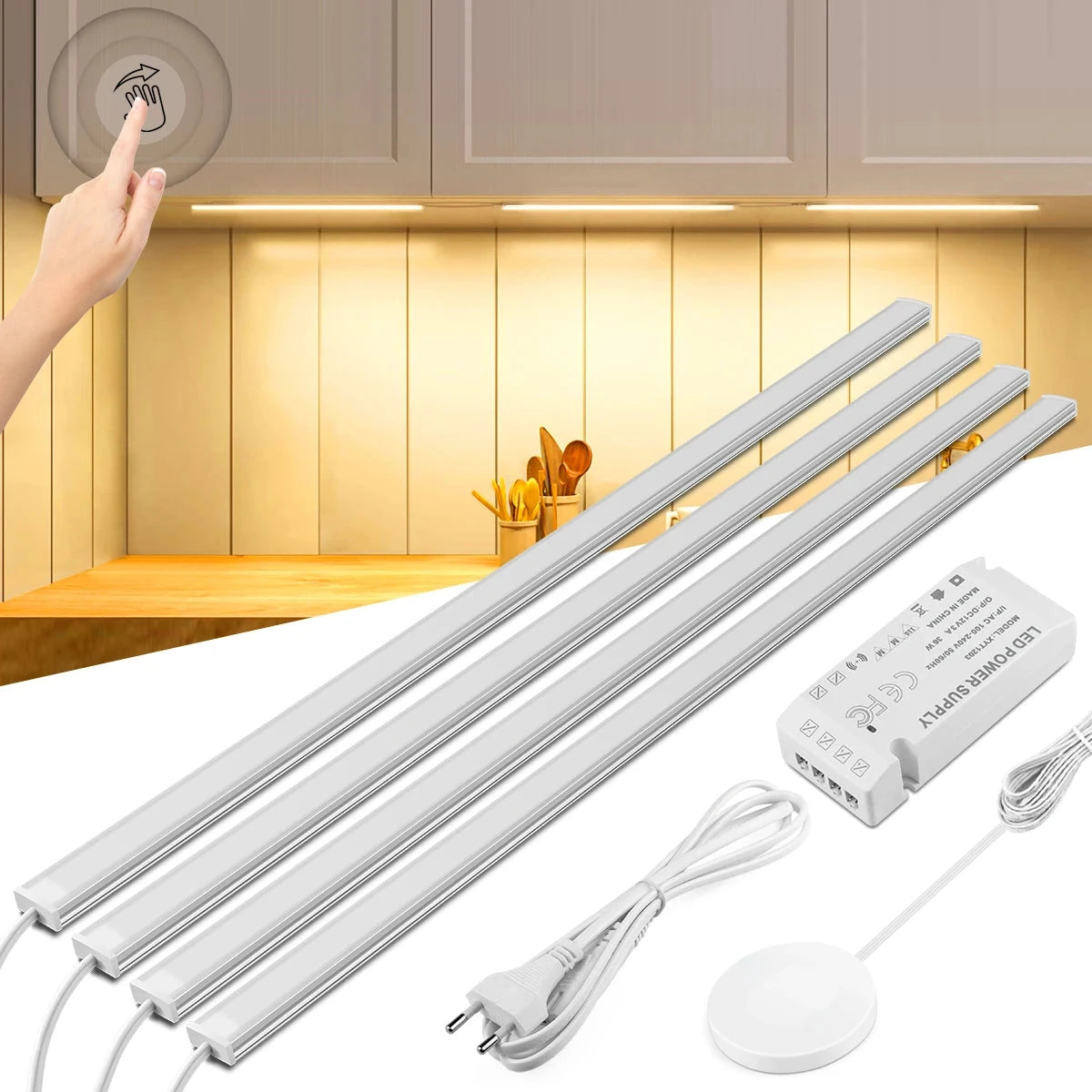
For installations where drilling isn’t practical—such as rental kitchens, glass shelves, or finished cabinetry—an ultra-thin, no-drill light bar can simplify both setup and adjustments. A touch and hand-sweep sensor under-cabinet LED light bar allows quick, precise control right at the workspace, while its slim profile keeps the lighting discreet and focused exactly where tasks happen.
FAQs
Are LED light bars better than LED strips for under-cabinet lighting?
They can be, especially when you want a clean, rigid fixture with integrated diffusion and easy linking. LED strips are highly flexible for custom lengths but often require an added channel/lens to match bar-like comfort and uniformity.
How bright should under-cabinet task lighting be?
Use countertop illuminance as the decision point. Residential guides based on IES recommendations commonly cite around 30–40 footcandles for general kitchen lighting and 70–80 footcandles at the stove/sink (reference chart). Measure at the counter and adjust with dimming and diffusion.
What certifications should I look for?
Look for third-party safety certification (e.g., UL or ETL). For LED equipment used in lighting products, ANSI/UL 8750 is a foundational safety standard referenced by UL (UL overview).
Conclusion
LED light bars are a strong choice for under-cabinet task lighting because they make it easier to hit measurable countertop light targets, reduce shadows, and deliver comfortable, controllable illumination. When you choose products with credible safety markings, pair drivers and controls correctly, and install for the work plane, you get a kitchen that feels clearer and more confident for daily tasks.
Further Reading
Explore the full guide for this topic: How to Choose Under Cabinet Lighting: A Complete Decision Guide














 />
/>
 />
/>
 />
/>
 />
/>
 />
/>