

Minimalist and Invisible Bedroom Lighting: Recessed and Integrated LED Solutions
Share
Table of Contents
- 1. What “Invisible Lighting” Really Means
- 2. The Three Design Goals: Comfort, Clarity, Quiet
- 3. Choose Your Toolkit: Downlights, Wall Wash, Cove, Joinery
- 4. A Professional Layout Method (Start From the Bed)
- 5. Specs That Actually Matter in a Bedroom
- 6. Controls and Scenes That Make It Feel Effortless
- 7. Common Failures (and the Fixes Designers Use)
- 8. FAQs: Minimalist & Invisible Bedroom Lighting
- 9. Conclusion
1. What “Invisible Lighting” Really Means
Minimalist and invisible bedroom lighting is not “no fixtures.” It is lighting that reads as architecture. When you walk into the room, you notice the bed, the wall texture, and the calm atmosphere—not a grid of bright points overhead.
Professionally, “invisible” means three things:
- Hidden source: the light-emitting surface is shielded, recessed, or diffused.
- Controlled brightness hierarchy: the brightest area is where your eyes work (book, closet, mirror), not the ceiling.
- Quiet distribution: fewer, better-placed luminaires that create even, comfortable light.
It also happens to be efficient: the U.S. Department of Energy notes LEDs use substantially less energy and last much longer than incandescent lighting (energy.gov).
2. The Three Design Goals: Comfort, Clarity, Quiet
Most “minimalist lighting” articles talk about products. Designers start with outcomes. In a bedroom, the outcomes are very specific.
Comfort: no glare from the pillow
If you can see a bare LED point from bed, it will feel harsher than its brightness number suggests. Comfort comes from shielding (deep regress, baffle, or lens), and from indirect light (cove, wall wash, headboard glow).
Clarity: light the verticals, not just the floor
A bedroom feels “dim” when walls are dark. Minimalist rooms often have fewer visual elements, so vertical illumination matters more. Wall washing and grazing create brightness on walls without turning the ceiling into a spotlight field.
Quiet: fewer fixtures, more control
Quiet is achieved by reducing visual clutter and reducing decision fatigue. A good plan has a default scene you use every night, plus one clear reading scene and one navigation scene.
3. Choose Your Toolkit: Downlights, Wall Wash, Cove, Joinery
Invisible bedrooms usually use a mix of recessed and integrated sources. The trick is choosing each tool for what it does best.
| Tool | What it does best | Bedroom note |
|---|---|---|
| Recessed downlights | Controlled task light on the floor, closet, or walkway | Use fewer units; avoid placing any in direct bed sightlines |
| Recessed wall wash | Makes walls bright and the room feel larger | Best “minimalist” upgrade because it reduces contrast and harshness |
| Cove / perimeter linear | Soft ambient glow, ceiling “lift,” no hotspots | Excellent for wind-down scenes and night ambience |
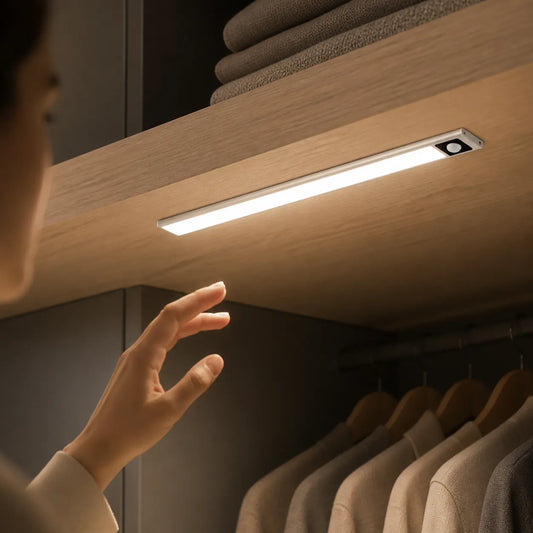
| Joinery-integrated linear | Headboard backlight, shelf wash, wardrobe visibility | Use diffusers to avoid dotting; keep the source hidden from bed |
| Low-level guidance | Safe navigation without waking you up | Toe-kick, under-bed, or low wall grazing beats bright ceiling lighting |
4. A Professional Layout Method (Start From the Bed)
The biggest reason invisible-lighting projects feel “generic” is that they start with a fixture list. A more professional method starts with how the bedroom is used.
Step 1: map sightlines and “no-glare zones”
Lie on the bed (or mark the pillow area on plan). Any recessed source you can see directly from that zone is a glare risk. In minimalist rooms, you should be able to look up and see as few bright apertures as possible.
Step 2: decide what should be bright
In most bedrooms, the priority order is:
- Closet/wardrobe face (color accuracy and clarity)
- Reading zone (focused beam, not whole-room brightness)
- Walk path (low-level guidance at night)
- Walls (soft ambient that makes the room feel calm)
Step 3: build layers, then hide them
Minimalist layered lighting still uses ambient + task + accent. The difference is that the “accent” is often an architectural wash (wall/cove) rather than decorative fixtures.
Step 4: test with two scenes before you commit
If your plan cannot create a comfortable Wind Down scene and a functional Read scene, adjust the layout before adding more fixtures.
5. Specs That Actually Matter in a Bedroom
For invisible lighting, performance details matter more than “how many fixtures.” These are the specifications that change how the room feels.
Shielding and cut-off: the anti-glare foundation
Look for recessed optics that hide the LED source (deep regress, baffle, or well-designed lens). In bed, this is the difference between “calm glow” and “ceiling sparkle.”
Beam distribution: wide vs. narrow changes the mood
Narrow beams create hot spots and scallops—great for art, often uncomfortable as bedroom ambient. Wider distributions are usually better for general bedroom comfort, while dedicated reading lights can stay tighter and directional.
Color quality: CRI is not the whole story
Use high color rendering for wardrobes and mirrors. If clothing and skin tones look “flat,” the room will feel cheap even if it is bright.
Flicker and dimming behavior: the hidden quality marker
Choose a dimming system that is stable at low levels. “Invisible” bedrooms rely on very low evening settings; if the light drops out, flickers, or changes color poorly when dimmed, the design will never feel premium.
Evening light hygiene: warm, dim, and indirect wins
Light exposure influences circadian timing; NIGMS summarizes the role of light in regulating circadian rhythms (nigms.nih.gov). Practically, that translates to: keep pre-sleep scenes warmer, dimmer, and more indirect than your daytime settings.
6. Controls and Scenes That Make It Feel Effortless
Minimalist lighting should be easy to use. The most “luxury” feature is not an app—it is predictability.
Build your system around a small set of scenes:
- Day / Clean: brighter, neutral-to-warm, full visibility.
- Evening: wall wash/cove prioritized, downlights reduced.
- Read: bedside task light on, room kept comparatively low.
- Night Path: only low-level guidance (toe-kick or under-bed), no ceiling glare.
- Off: truly off (avoid indicator LEDs in the sightline if they bother you).
Design rule: if you need more than 5 scenes to feel “done,” the layout is usually doing too much. Fix the distribution before adding complexity.
7. Common Failures (and the Fixes Designers Use)
Failure: a “checkerboard ceiling” of downlights
Fix: remove fixtures, add a wall wash or cove layer. A calmer bedroom typically benefits more from vertical/indirect light than from extra ceiling apertures.
Failure: bright points visible from bed
Fix: change placement (move away from bed sightlines) and use shielded optics. If the bed is under the brightest sources, the room will never feel restful.
Failure: the room feels flat or gloomy at night
Fix: add a soft vertical component (wall wash, headboard glow, curtain wash). Walls are your “ambient reflector” in minimalist spaces.
Failure: dimming flicker, buzzing, or poor low-end control
Fix: match dimmer + driver + fixture. Invisible lighting depends on low-level dimming; treat compatibility as a core spec, not an accessory.
Failure: closet is bright but bedroom mood is harsh
Fix: separate circuits/zones. Wardrobe clarity and bedtime comfort require different light distributions and settings.
8. FAQs: Minimalist & Invisible Bedroom Lighting
Is invisible lighting only for modern interiors?
No. The concept is about light quality and concealment, not style. Traditional, Scandinavian, Japandi, and contemporary bedrooms can all use recessed and integrated layers as long as the distribution supports comfort.
Do I still need bedside lamps?
Not always, but you do need a dedicated task source for reading. That can be a recessed reading light, a headboard-integrated linear, or a discreet sconce—what matters is that it lights the page without raising the whole room.
What is the fastest upgrade that makes the biggest difference?
Add dimming and shift your evening scene toward indirect/vertical light (cove or wall wash). If your only layer is downlights, the room tends to feel harsher from bed.
Are integrated LED systems a risk because you can’t change bulbs?
Integrated systems are clean and efficient, but the design should still consider driver access and serviceability. Favor solutions where key components are replaceable without demolishing finishes.
9. Conclusion
A minimalist bedroom lighting plan becomes “invisible” when you treat light like part of the architecture: control glare from bed, brighten vertical surfaces, and keep scenes simple. Use recessed downlights sparingly for clarity, rely on wall wash and cove layers for comfort, and prioritize stable low-level dimming for evenings.
Further Reading
Explore the full guide for this topic: Bedroom Lighting Design Guide: Style, Mood, and Atmosphere Explained
Related Articles
- Bedroom Lighting Ideas: Layered Lighting Plans for Different Bedroom Sizes
- Sculptural Floor Lamps and Oversized Pendants: Top Lighting Ideas for Bedrooms
- Using Colorful and Patterned Table Lamps to Add Personality to Your Bedroom Lighting
- Mood Lighting in Bedrooms: How Color and Temperature Control Improve Sleep and Relaxation
- How to Create a Cozy Bedroom Atmosphere with Warm White vs. Cool White LEDs
















 />
/>
 />
/>
 />
/>
 />
/>
 />
/>