

Powering Your LED Puck Lights with Batteries
Powering your LED puck lights with batteries is all about balancing convenience, brightness, and maintenance. This guide explains which batteries work best, how to estimate runtime, and how to design an install that stays easy to live with.
Table of Contents
- Battery Power Basics for LED Puck Lights
- What Batteries Do LED Puck Lights Use?
- Choosing Between Alkaline, NiMH, Lithium, and Rechargeable Packs
- How to Estimate Battery Life for Puck Lights
- How to Make Battery-Powered Puck Lights Last Longer
- Charging and Safety for Rechargeable Puck Lights
- Changing Batteries and Planning for Easy Maintenance
- When Battery Power Is the Wrong Choice
- Frequently Asked Questions About Battery-Powered LED Puck Lights
- Final Thoughts: Powering LED Puck Lights with Batteries
Battery Power Basics for LED Puck Lights
Battery-powered puck lights turn LED efficiency into a “no-wiring” lighting upgrade. The trade-off is simple: you avoid cords and drivers, but you commit to battery changes or charging.
LEDs draw far less power than older bulbs, which is why compact battery lighting is practical at all. The U.S. Department of Energy explains why LEDs are efficient and long-lasting compared with incandescent lighting (energy.gov).
What Batteries Do LED Puck Lights Use?
Most battery puck lights use common formats like AA or AAA, while some use built-in rechargeable packs. The best option depends on how often you use the lights and how easy the batteries are to access.
| Battery Type | Common In | Best For | Main Trade-Off |
|---|---|---|---|
| AA / AAA alkaline | Tap lights, remote puck kits | Occasional use, quick replacements | Recurring battery purchases and waste |
| AA / AAA NiMH rechargeable | Frequent-use installs | Lower long-term cost, less waste | Needs charging routine; slightly lower peak voltage |
| AA lithium (primary) | Cold spaces, emergency kits | Better shelf life and cold performance | Higher upfront battery cost |
| Built-in Li-ion pack (USB) | Rechargeable puck bars/pucks | Clean look, easy top-up charging | Charging downtime; eventual pack aging |
Choosing Between Alkaline, NiMH, Lithium, and Rechargeable Packs
The “best” battery is the one that matches your usage pattern. Choose based on how often the lights run, how easy it is to swap batteries, and whether you’d rather charge than replace.
- Pick alkaline if you use the lights rarely and want grab-and-go convenience.
- Pick NiMH rechargeable if you use them weekly or daily and want lower long-term cost.
- Pick lithium primary if the install is in a cold area or you need long shelf life.
- Pick a built-in rechargeable pack if you want the cleanest look and can tolerate charging cycles.
💡 Lumaz tip: If you’re installing more than 3–4 battery puck lights in a daily-use area, plan the “battery workflow” first—same batteries, same tool-free access, and one place to store spares or a charger.
How to Estimate Battery Life for Puck Lights
Battery life is driven by output level and usage time, not just “battery type.” A simple estimate helps you avoid installs that become a constant maintenance chore.
Use this rule of thumb: higher brightness + longer daily runtime = frequent changes. Many puck lights have multiple brightness levels, and running on “high” can cut runtime dramatically.
Quick estimate method
- Count your lights and note whether you’ll run them on high or low.
- Decide a typical daily runtime (for example, 10 minutes in a closet vs 2 hours in a kitchen).
- Plan for variability: battery output drops over time, so the last third of battery life may look dimmer.
If you want consistent brightness for long sessions, battery power may not be the right fit. In that case, plug-in or hardwired systems are usually better.
How to Make Battery-Powered Puck Lights Last Longer
You usually get the biggest gains from reducing time-on and avoiding max brightness. Small design choices can multiply runtime without making the lighting feel “weak.”
- Use “low” for ambient and reserve “high” for short tasks.
- Choose wider coverage (better placement) instead of overdriving brightness to fix shadows.
- Use auto-off or motion for closets, pantries, and hallways.
- Mount for airflow so heat doesn’t accelerate battery drain and component aging.
Charging and Safety for Rechargeable Puck Lights
Rechargeable puck lights reduce replacement waste, but only if charging is easy in your routine. If charging is inconvenient, you’ll end up with dead lights when you need them most.
Simple charging practices
- Charge on a schedule (weekly or monthly) instead of waiting for full depletion.
- Keep a dedicated cable near the install location, or choose removable/portable pucks.
- Avoid heat traps during charging: don’t charge inside sealed cabinets without airflow.
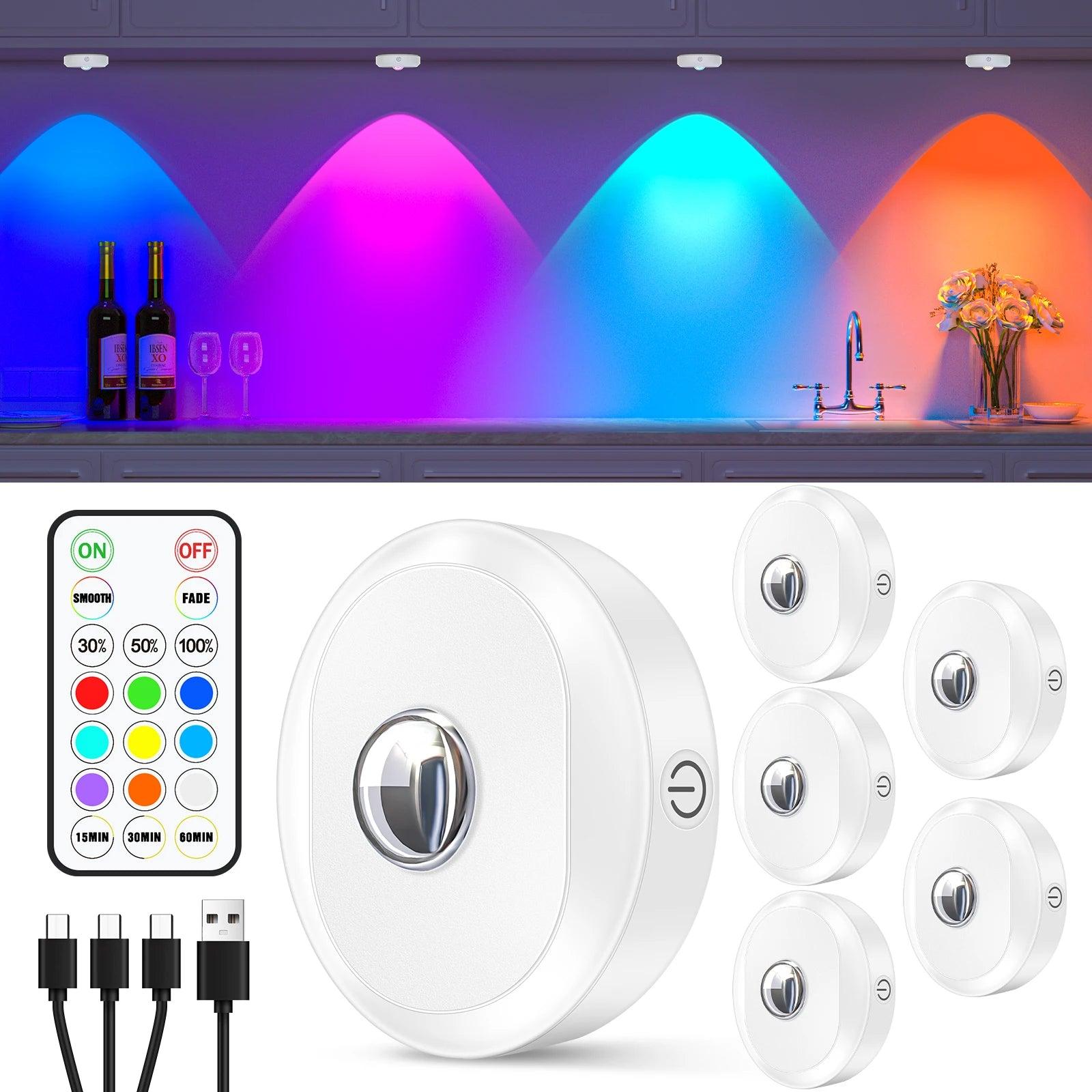
For users who want hassle-free maintenance and consistent lighting, easy-to-recharge puck lights make a big difference. A 6-pack of rechargeable RGB under cabinet LED puck lights with remote and touch control lets you keep cabinets and shelves bright while managing charging conveniently without disrupting daily use.
Changing Batteries and Planning for Easy Maintenance
Battery changes are only “easy” if you design access into the install. Plan for future you: quick removal, clear polarity markings, and a consistent battery type across the system.
Fast battery swap checklist
- Mount for access: avoid placing pucks behind trim where you can’t open the battery door.
- Use consistent batteries: one battery type across the whole run simplifies spares.
- Check polarity: incorrect orientation is a common cause of “dead” puck lights.
- Keep surfaces clean: grease and dust reduce output, causing you to run the lights brighter than needed.
💬 “Battery pucks were perfect for my closet—until I installed them where I couldn’t reach the battery door easily. Repositioning them made maintenance a non-issue.”
When Battery Power Is the Wrong Choice
Battery power is a great tool for no-wiring installs, but it’s not the best default for every space. Use this section to avoid the most common “regret installs.”
- Daily task lighting where lights run for hours (maintenance becomes frequent).
- Large multi-light runs where replacing batteries across many pucks becomes a chore.
- Hard-to-reach locations where swaps require ladders or disassembly.
Frequently Asked Questions About Battery-Powered LED Puck Lights
These FAQs cover the edge cases people run into when powering LED puck lights with batteries.
Which batteries last the longest in puck lights?
For removable batteries, lithium AA often performs well for shelf life and cold conditions, while NiMH rechargeable can be the best value for frequent use. Actual runtime depends on brightness level and how long the lights run each day.
Do battery puck lights get dim as batteries drain?
Many do. Some designs regulate output better than others, but it’s common for brightness to drop as voltage decreases, especially near end of life.
Are rechargeable puck lights better than replaceable-battery models?
They can be, if charging is convenient. If you can’t charge easily, replaceable batteries may be less frustrating.
How should I dispose of used batteries?
Follow local guidance for recycling and disposal. The EPA provides a practical overview for used household batteries (epa.gov).
How many battery puck lights should I install?
Start by spacing for coverage (to avoid hot spots), then size the system to your willingness to maintain it. If you need many lights and long runtimes, consider plug-in or hardwired power instead.
Final Thoughts: Powering LED Puck Lights with Batteries
Battery power is the fastest way to add light where wiring is difficult. The best results come from choosing the right battery type for your usage, planning easy access for maintenance, and using placement to reduce wasted brightness.
Further Reading
Explore the full guide for this topic: How to Install Puck Lights: Placement, Wiring, and Layout Guide
Related Articles
- Hardwired vs Plug-In vs Battery Puck Lights: Which Installation Option Is Right?
- Best Places to Install Puck Lights
- Low-Voltage vs Line-Voltage Puck Lights: Which to Choose
- How to Wire Multiple Puck Lights: Transformer & Wire Gauge Guide
- Puck Light Color Temperature Guide: Kitchens, Closets & Displays
















 />
/>
 />
/>
 />
/>
 />
/>
 />
/>