

How Brightness Affects Your Under Cabinet Lighting: Choosing the Right Light Intensity
Table of Contents
- Introduction: The Importance of Brightness in Under Cabinet Lighting
- Understanding Brightness: What It Means for Under Cabinet Lighting
- How Much Brightness Do You Need? Factors to Consider
- Brightness for Task Lighting vs. Ambient Lighting
- The Right Brightness for Different Areas: Kitchen, Living Room, Office, etc.
- Adjusting Brightness: Dimmable Lighting Solutions
- The Impact of Overly Bright or Dim Lighting
- Choosing the Right Light Bulbs and Fixtures for Optimal Brightness
- FAQs
- Conclusion: Balancing Brightness and Comfort in Under Cabinet Lighting
Introduction: The Importance of Brightness in Under Cabinet Lighting
Brightness determines how safely and comfortably you use counters. Pick output that reaches the work surface without glare so cooking, reading, and cleanup feel clear and calm.
Under cabinet runs are close to tasks, so sizing output and dimming matters. Balanced brightness improves clarity and reduces eye strain, especially at night.
Understanding Brightness: What It Means for Under Cabinet Lighting
Brightness describes total light and on‑counter illuminance. Lumens quantify output; footcandles (or lux) tell you how bright the surface actually is.
Key definitions
- Lumen (lm): total light emitted by a fixture or lamp.
- Footcandle (fc): illuminance on a surface; 1 fc ≈ 10.76 lux.
- Lumen density: lumens per foot of fixture run; useful for linear bars/strips.
How Much Brightness Do You Need? Factors to Consider
Choose brightness by task demand, counter material, and run length. Most kitchens feel clear at 30–50 fc on the counter with 300–500 lm/ft along the front.
Decision factors
- Task intensity: chopping and reading need higher fc than simple plating.
- Counter reflectance: glossy stone amplifies glare; add diffusion and dimming.
- Run length and spacing: continuous coverage reduces bright/dark stripes.
- Time of day: daytime favors higher output; evenings prefer lower, warmer scenes.
Sizing method
- Measure each cabinet run; multiply length by target lumen density (lm/ft).
- Set on‑counter targets around 30–50 fc for tasks; verify with a phone lux app.
- Add 10–20% driver headroom to maintain uniformity and dimming range.
Brightness for Task Lighting vs. Ambient Lighting
Task lighting prioritizes clarity and edge detection; ambient lighting prioritizes comfort. Use higher fc for prep and lower fc for evenings and navigation.
Targets and ratios
- Task layer: ~30–50 fc on counters; 300–500 lm/ft in linear fixtures.
- Ambient layer: ~5–15 fc for mood; 150–250 lm/ft along the front lip.
- Layer ratio: keep task to ambient near 2:1 to 3:1 to avoid harsh contrast.
Comfort rules
- Place fixtures 1–2 inches behind the front lip for forward throw.
- Use frosted or opal lenses to hide LED points and soften sparkle.
- Match one color temperature per layer to avoid “two‑tone” whites.
🙂 “We run brighter neutral light for prep and dim gently at night. With diffusion and front placement, the counters stay clear without glare—even on polished stone.”
The Right Brightness for Different Areas: Kitchen, Living Room, Office, etc.
Brightness needs vary by space and use. Kitchens need higher fc at work zones; living areas benefit from low, calm levels; desks and offices track task clarity.
Brightness targets by area
| Area | Primary Use | Recommended Counter/Surface Illuminance | Typical Lumen Density (linear runs) | Notes |
|---|---|---|---|---|
| Kitchen counters | Food prep, reading labels | 30–50 fc (≈ 325–540 lux) | 300–500 lm/ft | Prefer front placement and diffusion; add dimming for evenings |
| Living room shelves | Ambient, display accents | 5–15 fc (≈ 54–162 lux) | 100–200 lm/ft | Keep low output for comfort; avoid direct view of LEDs |
| Home office desks | Reading, typing, precision | 30–50 fc (≈ 325–540 lux) | 250–400 lm/ft | Favor neutral white and diffused optics for text clarity |
| Pantry/utility | Navigation, quick tasks | 10–20 fc (≈ 108–215 lux) | 150–300 lm/ft | Motion sensors and battery bars suit utility runs |
Adjusting Brightness: Dimmable Lighting Solutions
Dimming adapts output to time and activity while reducing eye strain. Aim for smooth low‑end control without flicker, and set presets for day, evening, and night.
Control options
- Wall dimmers: unify layers and set scene ratios quickly.
- Inline/touch sensors: simple local control at the cabinet run.
- Smart routines: schedule day/evening/night levels for consistent comfort.
Implementation details
- Match dimmer and driver types (TRIAC, ELV, 0–10V) to prevent flicker.
- Test minimum levels; raise low‑end if color shifts or strobing appears.
- Group fixtures by scene to maintain balanced layer ratios.
💡 Brightness should flex with life. Lumaz scenes make prep crisp and evenings gentle—so your counters feel bright when you need them and soothing when you don’t.
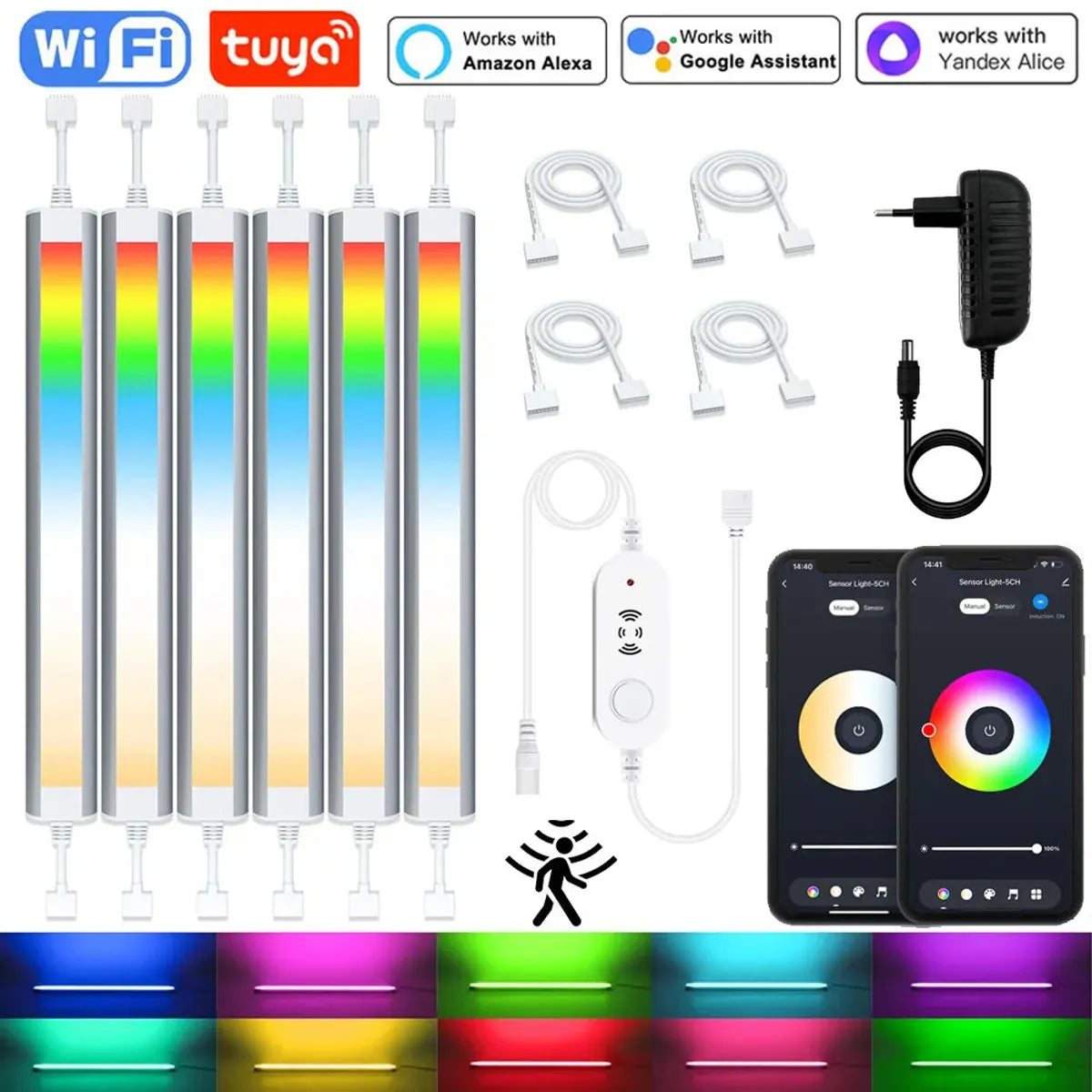
For optimal brightness control, the 12V Tuya WiFi Under Cabinet LED Light Bar allows you to easily adjust light intensity with its dimmable RGBCCT feature and motion sensor. Whether you're cooking in the kitchen or relaxing in the evening, you can create the perfect lighting environment with a simple app or voice command, reducing glare and ensuring comfort throughout the day.
The Impact of Overly Bright or Dim Lighting
Too bright creates glare and harsh contrast; too dim hides edges and labels. Both increase effort and reduce comfort, especially on glossy materials.
Common issues
- Backsplash streaks from rear‑mounted fixtures at high output.
- Visible LED points reflecting on polished stone; sparkle distracts.
- Under‑lit corners and sink gaps causing shadow pockets.
Fixes
- Set fixtures near the front; add frosted/opal lenses to soften optics.
- Bridge gaps with short segments; keep coverage continuous.
- Use presets; task near 30–50 fc and ambient near 5–15 fc.
Choosing the Right Light Bulbs and Fixtures for Optimal Brightness
Pick fixtures that deliver uniform spread and stable dimming. Linear bars and strips in diffused channels produce reliable fc on the counter with minimal glare.
Type comparison
| Type | Spread | Brightness Control | Typical Output | Best Use |
|---|---|---|---|---|
| Linear bars | Wide, uniform | Good dimming; stable low‑end | 300–500 lm/ft | Main kitchen runs |
| LED strips + channel | Configurable, wide | Good with quality drivers | 300–600 lm/ft | Custom lengths, hidden optics |
| Puck lights | Narrow spots | Limited uniformity at low output | 150–300 lm per puck | Accent zones and niches |
| Battery bars | Moderate, localized | Basic touch/motion control | Lower total output | Pantries, rentals, quick navigation |
Selection checklist
- Target fc by use: task 30–50; ambient 5–15.
- Prefer diffused optics and front placement for comfort.
- Verify dimmer/driver compatibility and low‑end stability.
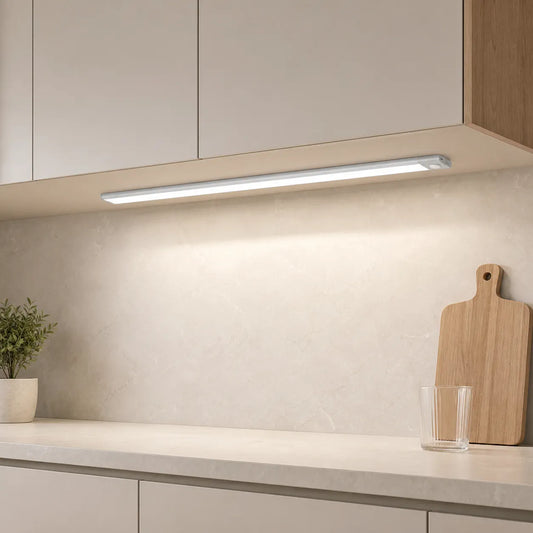
For a seamless, energy-efficient solution, the Type-C Rechargeable Under Cabinet LED Light Bar offers smart motion sensing and three color temperature options. Whether you need bright light for tasks or a softer glow for ambiance, this LED light bar provides flexible, reliable lighting with minimal glare, perfect for your kitchen or workspace.

FAQs
How do I measure brightness without a light meter?
Use a phone lux app as a proxy. Aim for ~325–540 lux on counters for tasks and ~50–160 lux for ambient scenes.
Why does my counter look too shiny at higher brightness?
Glossy stone reflects point sources. Add frosted/opal lenses, move fixtures toward the front, and reduce output slightly.
Do I need different brightness for night navigation?
Yes. Keep ambient near 5–10 fc with motion sensors in sink or path zones for low, safe guidance.
Can I set one brightness level for the whole kitchen?
Use scenes. Keep task near 30–50 fc and ambient far lower. Matching layer ratios avoids harsh contrast.
Will dimming save energy meaningfully?
Yes. Lower output reduces power draw, heat, and glare while extending driver and LED life. See ENERGY STAR — Lighting for program context.
Conclusion: Balancing Brightness and Comfort in Under Cabinet Lighting
Balance task clarity with evening comfort. Set fc targets for prep, add diffusion, and use dimming presets so light intensity matches time, activity, and material.
With measured output, consistent placement, and smooth control, counters feel brighter, safer, and more relaxing—without glare.
References
- Illuminating Engineering Society. (n.d.). Lighting for Kitchens. Retrieved from ies.org
- U.S. Department of Energy. (n.d.). Energy-Efficient Lighting. Retrieved from energy.gov
- Consumer Reports. (2020). Best Under Cabinet Lights. Retrieved from consumerreports.org
- Lighting Research Center. (n.d.). Lighting and Reflectance. Retrieved from lrc.rpi.edu
Further Reading
Explore the full guide for this topic: Light Quality for Under Cabinet Lighting: Color, Brightness & Comfort














 />
/>
 />
/>
 />
/>
 />
/>
 />
/>