

How Much Does Under Cabinet Lighting Cost?
How Much Does Under Cabinet Lighting Cost? The Short Answer
There is no useful single “average price” until you decide whether you mean one light, a complete DIY kit, or a professionally installed kitchen. A rechargeable bar for one dark spot and a hardwired system across several cabinet runs have different costs because they solve different-sized problems.
For a U.S. reference point, Angi’s under-cabinet lighting cost guide, updated in May 2026, reports a typical $200–$800 for professional installation, averaging about $400. It also gives $50–$300 for a basic plug-in or battery-operated DIY project. These are broad project benchmarks, not Lumaz product prices or quotes for your home. Your total depends on how much counter you light, which parts are included, and whether new wiring is needed.
If you already have a usable outlet and want continuous task light, compare a complete plug-in kit before paying for electrical work. If you need a permanent built-in result with a new switch or concealed wiring, price the whole installation—not just the visible fixtures. If one short area needs light and there is no acceptable outlet, a rechargeable light may have the lowest installation cost, but it adds a charging routine.
What the Total Price Actually Includes
The price on a product page might be for one light, one strip, a multi-strip kit, or a complete package. Before comparing prices, make each option answer the same question: What would it cost to light my chosen cabinet runs and use the lights the way I want?
| Budget line | What to count | Easy-to-miss detail |
|---|---|---|
| Lights | Number of bars or pucks, or the length and number of strip runs | A low price may cover only one short fixture or one strip. |
| Power | Included or separate adapter, driver, batteries, or charging equipment | A low-voltage strip needs the correct power supply; a plug-in fixture still needs a reachable outlet. |
| Controls | Switch, touch sensor, dimmer, motion sensor, remote, or smart controller | Check whether the control is included and compatible with the light and power supply. |
| Finish and connections | Connectors, cable, diffuser or channel, mounting pieces, and any valance | Cabinet gaps, corners, and exposed cords can turn a simple-looking plan into a parts list. |
| Installation | Your DIY materials and time, or a professional quote for new electrical work | Ask whether the quote includes a switch, wall repair, permits if required, and cleanup. |
Total project cost = lights + required power + controls + connection/finish parts + installation. Keep the fixture-only subtotal separate from the installed total. That one habit makes two quotes much easier to compare.
How Lighting Type Changes the Budget
The cheapest individual light is not always the cheapest finished kitchen. A row of inexpensive pucks may need several fixtures and connecting leads; a strip may need channels or careful routing; a bar may cost more per piece but simplify a straight run. Compare the completed layout, not the unit price.
| Approach | Why people choose it | What can raise the total | Best value when... |
|---|---|---|---|
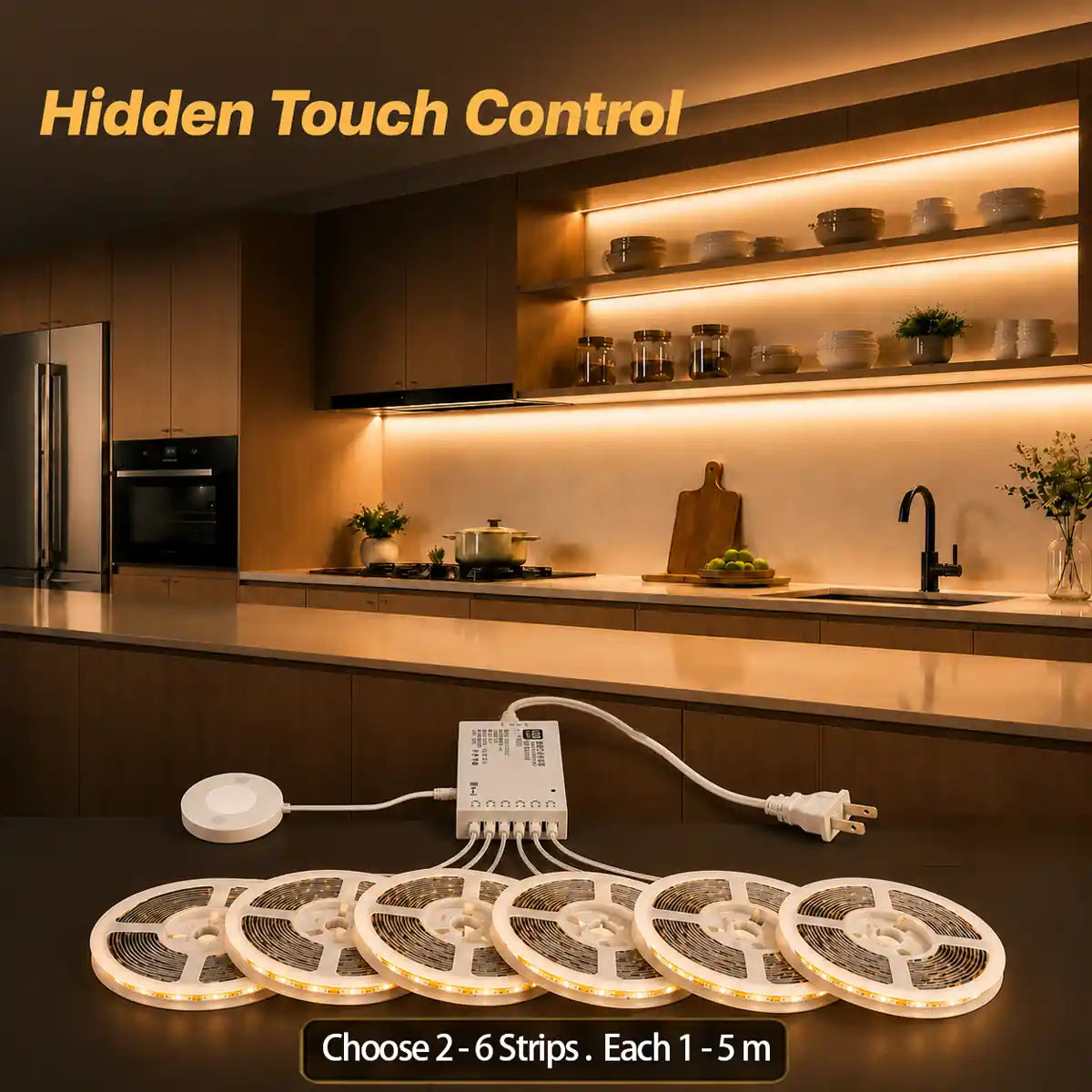
| Plug-in LED strip or COB kit | Continuous light around a straight run or several planned sections | Extra runs, connectors, channels, and an outlet or adapter location | The kit covers the required lengths and includes the needed power and control parts. |
| Plug-in light bars | Neat linear fixtures for distinct cabinet sections | Multiple bars, interconnecting cables, controls, and cord concealment | Standard lengths fit the cabinet layout without many extra pieces. |
| Rechargeable bars | Light in a rental or an isolated spot without new wiring | More fixtures for a long run and the time spent removing and charging them | Use is brief or occasional and the fixture is easy to reach. |
| Puck lights | Individual pools of light for shelves or short accent areas | More pucks, leads, and spacing work if you try to cover a whole prep counter | You want separated highlights rather than one continuous work surface. |
| Hardwired linear system | A permanent, integrated result for a remodeled kitchen | New wiring, switches, access work, labor, and any required permits | Electrical work is already planned or a clean built-in finish is worth the investment. |
A smart controller is an optional budget line, not a default upgrade. Pay for app control, scenes, or sensors only if the household will use them, and confirm compatibility before buying. For the separate choice between fixture shapes, see the strip, bar, and puck layout comparison.
DIY vs. Electrician: Where the Big Price Difference Comes From
DIY usually saves the most when an existing outlet or a rechargeable fixture lets you avoid new electrical work. You still need to check the full kit, safe cable route, mounting surface, and access to the adapter or charging point. A low-priced light is poor value if the cord crosses a hot appliance area or if a long worktop needs several separately charged fixtures.
Professional work becomes the major variable when you want a new hardwired circuit, concealed wiring, or a wall switch. Labor depends on local rates and on what the installer has to open, route, connect, and restore. A fixture-only listing cannot predict those charges. Ask for an itemized local quote and confirm what is included; do not substitute a national electrician wage statistic for an installer’s billed project price.
New line-voltage wiring is not the place to save money through guesswork. Use a qualified electrician for work that requires one under local rules, and choose fixtures and drivers compatible with the proposed installation. If the budget is tight, a well-planned plug-in route can be a legitimate finished choice—not merely a temporary compromise. For the broader everyday trade-offs, read hardwired vs. plug-in vs. rechargeable lighting.
Build a Budget for Your Own Cabinet Runs
- Mark only the areas that need light. Measure each separate cabinet run and note the prep, sink, coffee, display, or pantry zones. Lighting one useful counter may cost much less than circling the entire kitchen.
- Choose the power route. Mark an existing outlet, possible plug-in cable path, or the location where a rechargeable light can be removed. If the desired result requires new wiring, get an electrician’s scope before setting a final budget.
- Count complete systems, not just lights. For each option, list the number and length of fixtures plus the required adapter or driver, controls, connectors, channels, and mounting parts. Check package contents and variants.
- Add installation and finish. Include any authorized electrical work, cabinet or wall repair, and cable concealment. Separate must-haves from optional smart features.
- Compare the result and ongoing effort. A rechargeable solution may avoid installation labor but be inconvenient for hours of daily cooking. A hardwired quote may cost more today but remove visible cords from a permanent kitchen.
| Example project | What belongs in the estimate | What to compare before choosing |
|---|---|---|
| One short dark counter, no new wiring | One suitable rechargeable bar or a complete plug-in light; mounting and charging/cord plan | Upfront price versus the convenience of continuous power |
| Several daily-use prep zones with an outlet | Enough strips or bars for each run; included or extra adapter, control, leads, and cable hiding | Coverage and a tidy power path, not the cheapest single-fixture price |
| Full permanent kitchen during a remodel | Fixtures, compatible power and controls, electrician’s itemized labor, and finish work | Total installed quote and what can be serviced later |
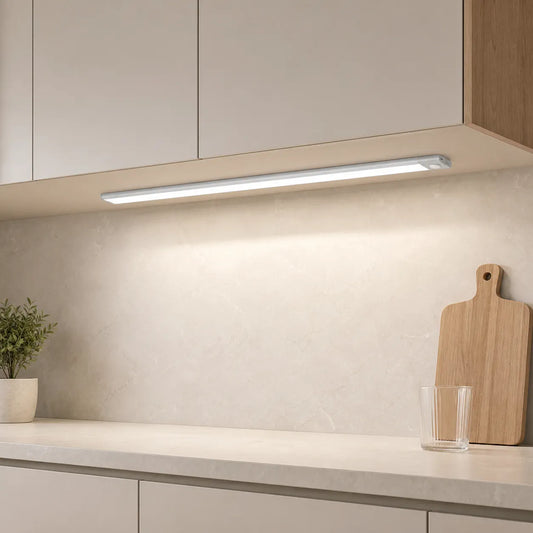
For an existing-room, no-wiring example, the Type-C Rechargeable Under Cabinet LED Light Bar - Smart Motion Sensor, 3 Color comes in several lengths and has magnetic mounting, selectable color temperatures, and motion modes. It avoids a new lighting wire at the cabinet, but budget for enough bars to cover the actual area and for a practical charging routine. It is not our default recommendation for a long counter used continuously.

Where to Spend—and Where to Save
Spend where the difference will be visible or used every day: enough coverage on the actual work surface, a sensible control location, comfortable diffusion when LEDs would be in view, and compatible power and dimming parts. Check the product’s stated safety markings and installation instructions for the exact model; do not assume every option in a category has the same certification.
Save by reducing unnecessary scope: light the prep run first, use an existing outlet when the route is safe and acceptable, choose a complete kit when its contents match your plan, and skip app features you do not need. Do not save by using an undersized or mismatched power supply, burying serviceable parts, or treating line-voltage work as a casual DIY step.
The common budget surprises are extra adapters, dimmer incompatibility, too-short connecting leads, channels or valances needed to hide glare, and wall repair after wiring. Check those before comparing the final totals. If you are still choosing the overall lighting approach, the under-cabinet lighting buying guide helps narrow the fixture and power choices first.
Common Under Cabinet Lighting Cost Questions
What is the cheapest way to add under-cabinet lighting?
For one small area, a rechargeable or existing-outlet plug-in light usually avoids the largest installation expense. For a long daily-use counter, compare the total for enough fixtures and the ongoing charging effort before assuming the cheapest single light is the best value.
Why do “average cost” figures vary so much?
Some refer to one fixture, some to DIY materials, and others to a whole professionally installed project. Kitchen size, wiring, local labor, switches, and finish work also differ. Use a published range only when you know what it measures, then replace it with your own parts list or local quote.
Does a more expensive fixture automatically make better task lighting?
No. Placement and coverage matter as much as the fixture itself. Spending more for a feature you will not use may add little value, while buying too few lights can leave the prep area dark. Compare how each complete option lights the same cabinet run.
Should I price a hardwired system by the number of lights?
Count the fixtures, but ask the electrician to price the whole job: power source, wire route, controls, connections, access, and any surface repair. “Price per light” may leave out the work that changes the bill most.
Bottom line: use a national cost range for orientation, then budget your own project by complete system and installation route. The best-value choice is the one that lights the right areas comfortably, fits your power access, and has no surprise parts or labor after checkout.
Related articles
- How to Choose Under Cabinet Lighting — decide which type and power route fit your home.
- Hardwired vs. Plug-In vs. Rechargeable — compare installation effort and everyday use.
- Strip vs. Bar vs. Puck Lights — match the fixture shape to your cabinet layout.
















 />
/>
 />
/>
 />
/>
 />
/>
 />
/>