

Best Under Cabinet Lighting Brands and Models
Best Under Cabinet Lighting Brands and Models at a Glance
There is no single best under-cabinet light for every kitchen. The best model is the one that fits the available power, cabinet layout, required light pattern, control preference, and willingness to maintain batteries or conceal cables. For most permanent kitchens, begin with a dimmable linear strip or bar. Choose rechargeable lighting when avoiding new wiring matters more than all-evening runtime, and choose a smart color system only when scenes or grouped app control will actually be used.
| Best for | Brand and representative model | Why it fits | Main trade-off |
|---|---|---|---|
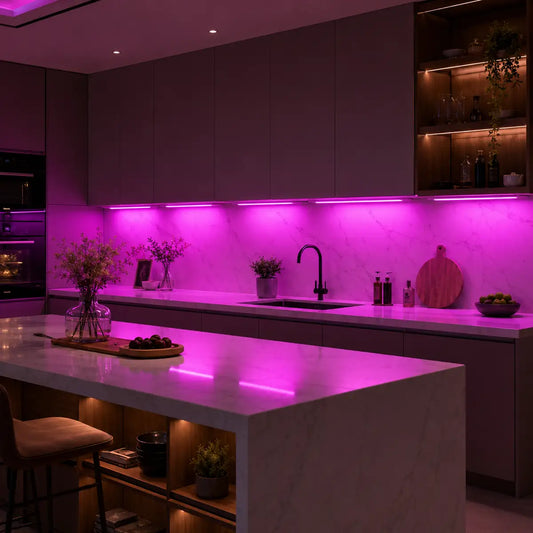
| Custom connected cabinet runs | Lumaz Hidden Touch Sensor COB LED Strip Light Kit | Cut-to-fit COB strips, one centralized hub, concealed through-panel control, and a smooth light line. | Needs a planned cable, hub, and adapter route. |
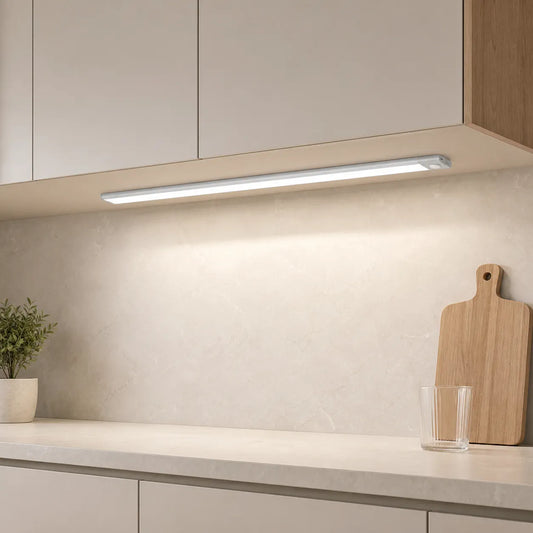
| Straight cabinet-width task zones | Lumaz Touch & Hand Sweep Sensor LED Light Bar | 7mm rigid profile, multi-light kits, stepless dimming, and hands-free switching. | Fixed bar lengths are less adaptable to corners and irregular runs. |
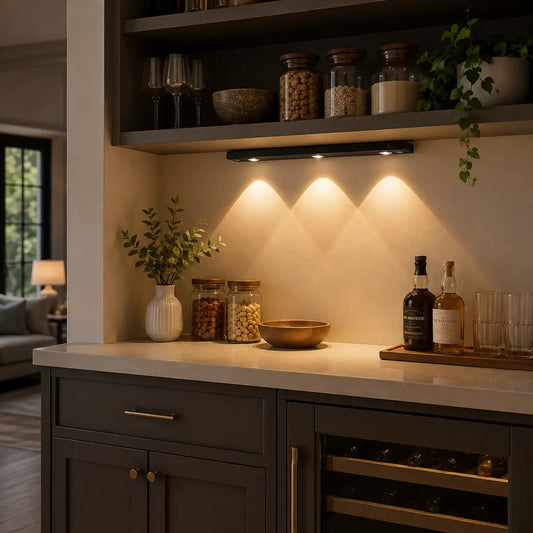
| No-wiring kitchens, rentals, and isolated cabinets | Lumaz Type-C Rechargeable Motion-Sensor Light Bar | Magnetic mounting, five length choices, three white-light settings, and motion or always-on modes. | Must remain reachable for charging and is better for targeted use than long continuous sessions. |
| App-controlled color and grouped automation | Lumaz Tuya WiFi RGBCCT Light Bar System | App control, adjustable white and color light, motion sensing, and multi-bar kits. | More setup and controller hardware than a simple dimmable white system. |
| Permanent 120V hardwired light bar | Kichler 4U Series 4U30K30WHT | A representative 30-inch, 3000K hardwired fixture with published CRI and output specifications. | Electrical work and fixed sizing make it a remodel-oriented choice. |
| Accessible plug-in adjustable-white bar | Feit Electric OneSync UCL18/5CCT | Plug-in power, selectable white settings, fixture dimming, and retail availability. | The cord must be hidden, and its published CRI is lower than some color-critical alternatives. |
| Smart color scenes and ecosystem control | Philips Hue indoor lightstrips | Strong app, scene, voice, Bluetooth, and Hue Bridge ecosystem options. | Best treated as a smart accent or flexible scene layer unless the selected model and placement meet the task-light requirement. |
| Specification-led professional tape-light project | WAC Lighting InvisiLED system | A broad 24V tape-light ecosystem for projects designed around compatible channels, drivers, connectors, and controls. | Component selection and installation planning are more involved than an all-in-one kit. |
Best starting point for most permanent kitchens
Choose a dimmable linear strip or bar with a serviceable power route. Start with the COB strip kit when connected counters need a continuous custom line, or the ultra-thin bar when the run breaks naturally into cabinet-width sections.
Do not choose by brand name alone
A strong brand cannot solve the wrong power source, exposed cable route, unsuitable fixture length, inaccessible battery, or control system the household will not use.
How We Compared Under Cabinet Lighting Brands and Models
This is a fit-based editorial comparison built from current manufacturer specifications, Lumaz product facts, and the practical consequences of each system design. It is not a claim that every model was laboratory-tested or installed side by side. The shortlist uses the same questions for every option:
- What job must the light perform? Continuous kitchen task light, a short appliance station, a display zone, smart ambience, or brief automatic cabinet access are different jobs.
- What power is actually available? A hardwired fixture, plug-in adapter, centralized low-voltage driver, and rechargeable battery create different installation and ownership demands.
- Does the form match the layout? Flexible strips suit custom runs, rigid bars suit straight measured zones, and pucks suit separated focal areas.
- Can the source and hardware be concealed? Fixture thickness, cabinet lip depth, cable exits, adapters, hubs, and controllers matter as much as the light itself.
- Will the controls improve daily use? Dimming, hand-sweep, motion, app, timer, and voice controls are valuable only when their placement and behavior match the household routine.
- What maintenance remains? Battery charging, adhesive replacement, inaccessible drivers, discontinued accessories, and proprietary ecosystems can outweigh a low purchase price.
The result is not an absolute first-to-eighth ranking. It is a set of best-fit winners. That makes the comparison more useful than declaring one smart strip, hardwired bar, or rechargeable puck the “best overall” for homes with completely different constraints.
Best Lumaz Models by Household Need
Lumaz offers several under-cabinet formats, so the useful question is not “Which Lumaz light has the most features?” It is “Which system removes the biggest constraint in this room without creating a worse maintenance or installation problem?”
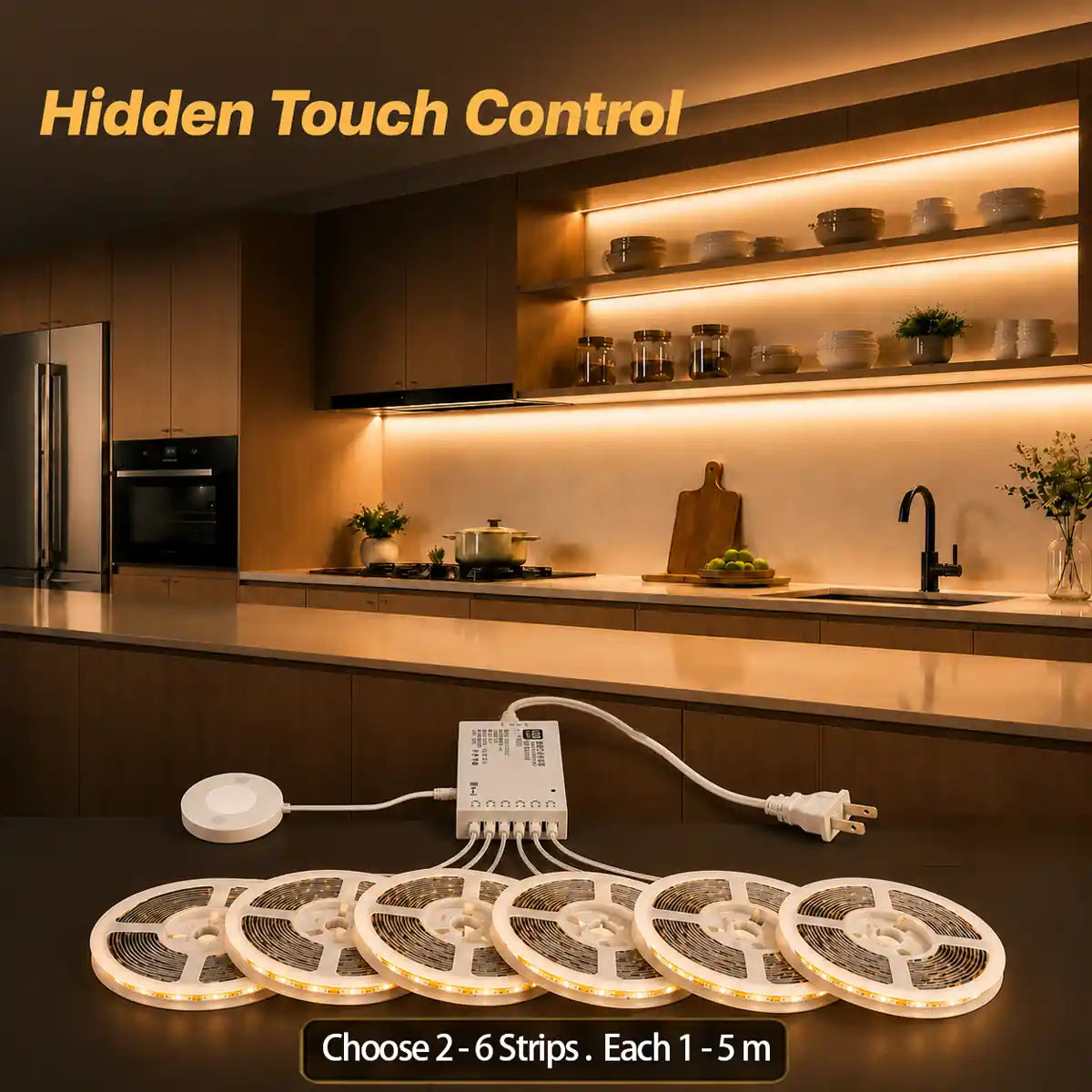
- Choose it when: several cabinet sections can return to one concealed hub and plug-in power source.
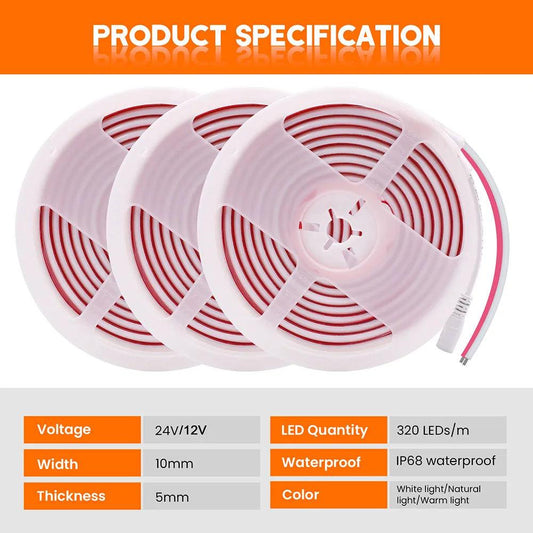
- Useful facts: 1m, 2m, 3m, or 5m strips; up to six strip runs; 2.5cm cut intervals; warm, neutral, or white light.
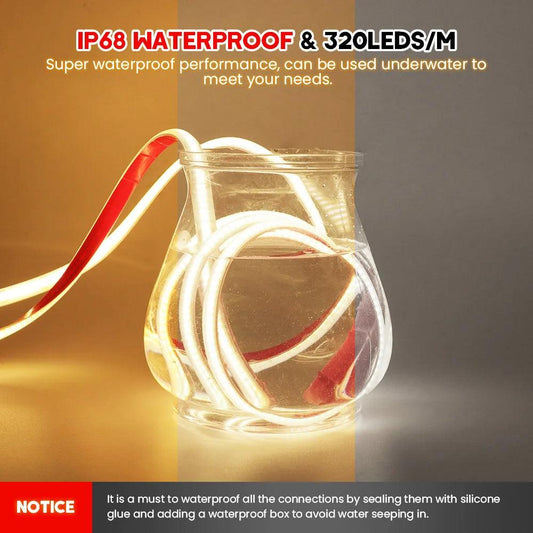
- Why it stands out: 320 LEDs/m COB construction creates a smoother-looking line, while through-panel touch control avoids a visible switch cutout.
- Skip it when: the installation must be removable or there is no practical route for the hub, adapter, and connecting cables.
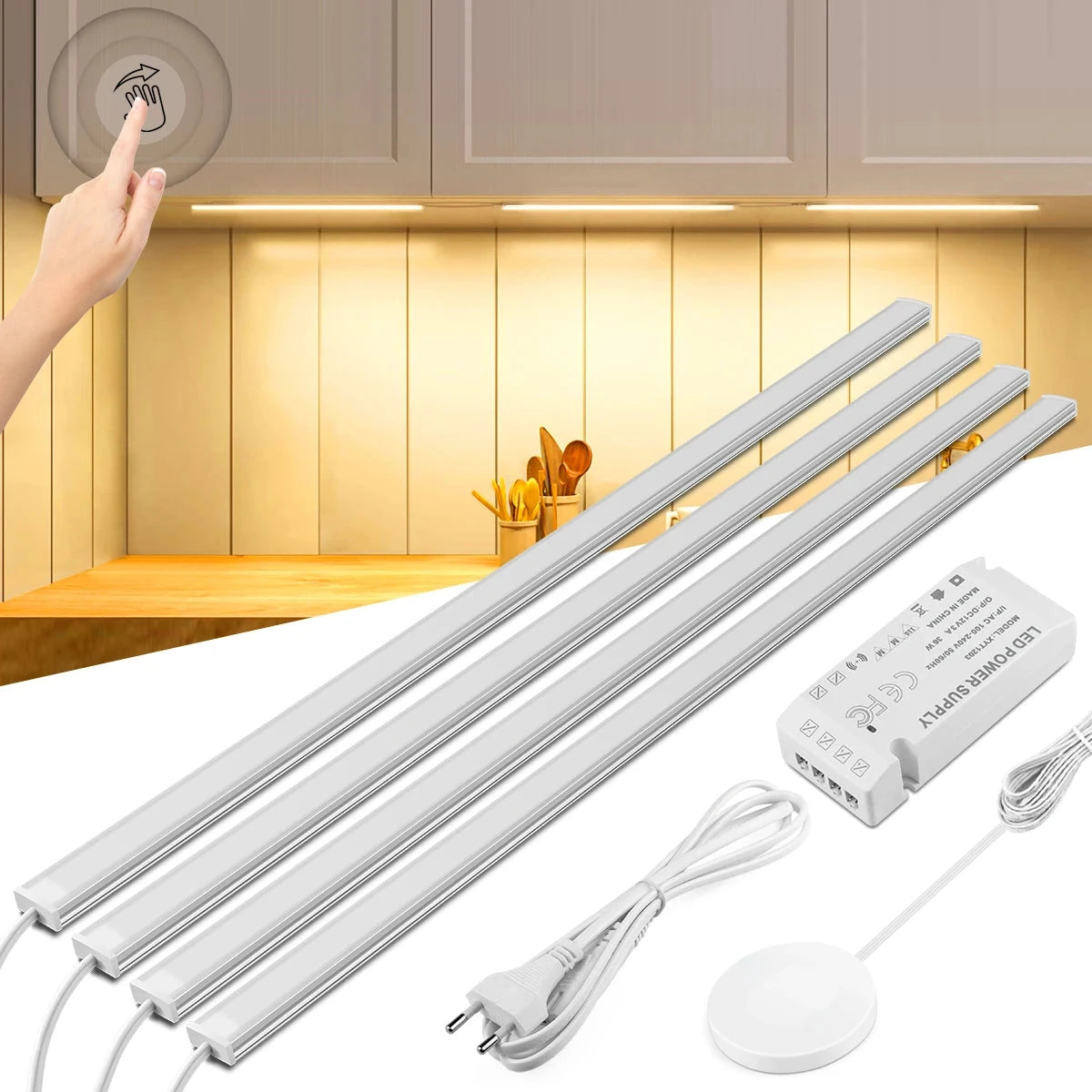
- Choose it when: cabinets form straight 30cm, 40cm, or 50cm zones and a nearby outlet can serve the kit.
- Useful facts: one- to six-light kits, 7mm aluminum body, stepless dimming, hand-sweep switching, and warm or cool white choices.
- Why it stands out: the slim rigid body simplifies alignment, while hands-free switching suits a frequently used prep or cleanup area.
- Skip it when: the route turns corners or needs custom lengths between cabinet breaks.

- Choose it when: wiring is unavailable and the light can be removed from its magnetic mount for charging.
- Useful facts: 10cm to 50cm lengths, black or silver finish, 3000K/4000K/6000K selection, stepless dimming, and motion or always-on modes.
- Why it stands out: the length range helps fit isolated counters, closets, and cabinet bays without a permanent electrical project.
- Skip it when: several lights must remain on together for long cooking or all-evening sessions.
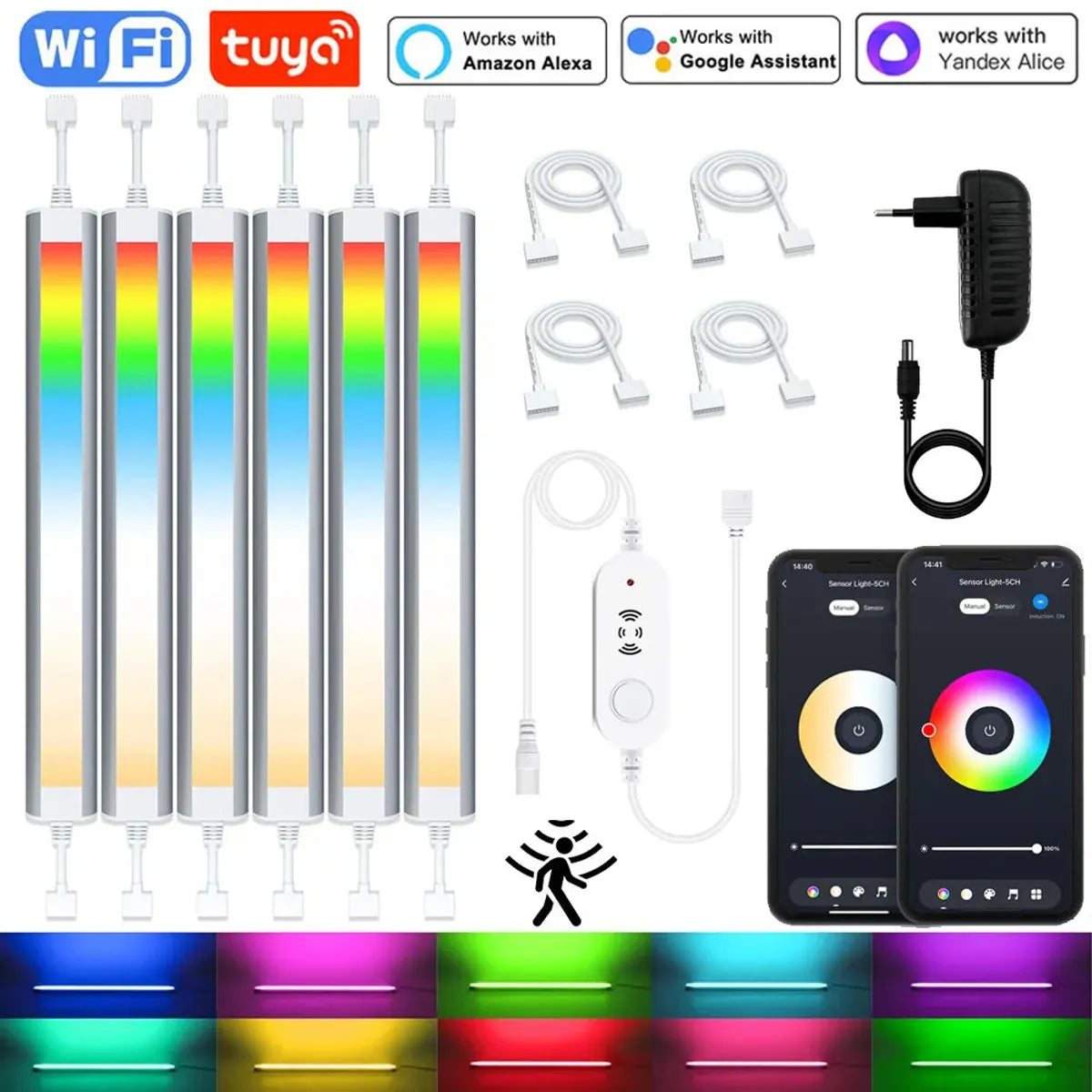
- Choose it when: the household will use app control, grouped scenes, adjustable white/color light, or automated motion behavior.
- Useful facts: 300mm bars, multi-light kits, DC12V system, RGBCCT light, Tuya/Smart Life app support, dimming, and adjustable sensing distance.
- Why it stands out: one system combines everyday white light, color scenes, app control, and hands-free activation.
- Skip it when: a simple dimmable white task layer would meet the need with less setup and hardware.
Representative Systems from Other Under Cabinet Lighting Brands
These brands illustrate different purchasing routes. They are not interchangeable: a hardwired Kichler bar, a plug-in Feit bar, a Philips Hue smart strip, and a WAC tape-light system solve different problems.
Kichler 4U Series: best representative hardwired light bar
The Kichler 4U30K30WHT is a useful reference for a permanent 120V linear fixture. Kichler publishes 3000K, CRI 94, 733 delivered lumens, a 30-inch length, and dimming for this model. It suits a remodel or new installation where a fixed light bar and electrical work are acceptable. Its trade-off is commitment: cabinet dimensions, junction locations, dimmer compatibility, and service access must be resolved before installation.
Feit Electric OneSync UCL18/5CCT: best representative plug-in retail bar
The Feit UCL18/5CCT represents the plug-in bar route. Feit publishes 900 lumens, five selectable white settings from 2700K to 5000K, dimming, a six-foot AC cable, and OneSync pairing. It is easier to add to a finished kitchen than a hardwired model, but the visible cord route still needs a plan, and its published CRI 80 may not be the first choice when accurate color rendering is a priority.
Philips Hue indoor lightstrips: best representative smart ecosystem
Philips Hue lightstrips are strongest when the household already values Hue scenes, app and voice control, Bluetooth, or Bridge-based automation. Current Hue lines vary in length, output, cut/extension behavior, and whether the light is intended for direct or indirect viewing, so choose the exact strip only after checking those details. For a kitchen, treat color capability as an extra layer; it does not automatically prove that a concealed strip will provide comfortable, even work-surface light.
WAC InvisiLED: best representative professional tape-light ecosystem
WAC InvisiLED is better understood as a system than a single ready-to-install lamp. Its 24V tape-light family, drivers, channels, connectors, and control options suit a specification-led project where a designer, installer, or careful DIY planner will coordinate components. This flexibility is valuable for integrated cabinetry, but it also creates more compatibility decisions than an all-in-one Lumaz strip kit.
Brands such as Barrina, LE, Govee, TORCHSTAR, and portable USB-strip makers may also fit a particular budget or channel. Compare the exact current model against the same power, light pattern, control, size, and service questions above; do not transfer one model's specifications or reviews to an entire brand.
Technical Specifications Buyers Must Compare
Specifications are useful only when they change the result in the real cabinet. Use this order so a large lumen number or a long feature list does not distract from a basic fit problem.
| Specification | What it changes at home | What to verify |
|---|---|---|
| Power source and voltage | Determines whether the job is hardwired, plug-in, centralized low-voltage, USB, or rechargeable. | Outlet/junction location, adapter or driver, plug region, cable length, and service access. |
| Fixture form and physical size | Controls whether the light creates a continuous line, defined bar, or separated pools. | Usable underside length, cabinet lip depth, corners, gaps, mounting surface, and visibility from normal sightlines. |
| Light color and CRI | Affects how food, counters, cabinet finishes, and the room atmosphere appear. | Available CCT choices and a published CRI when color accuracy matters; do not assume every variant shares the same value. |
| Output and distribution | Determines whether the work surface is evenly visible or broken into bright spots and dark gaps. | Published output, beam/distribution information, diffuser or COB construction, mounting height, and a temporary mock-up on the actual counter. |
| Dimming and controls | Changes comfort, task-to-evening flexibility, and daily interaction. | Whether the dimmer, driver, controller, sensor, app, and chosen model are designed to work together. |
| Kit and extension limits | Controls how many cabinet sections can share power and control. | Maximum supported runs, cut points, connector availability, extension rules, and what happens to unused cut pieces. |
| Environmental rating | Matters near moisture, heat, and unusual cabinet locations. | The exact product's stated rating and installation limits; a brand or LED type alone does not establish suitability. |
For an exact strip, bar, or puck layout after the fixture form is selected, use How to Space Under Cabinet Lighting. It separates continuous-strip coverage, rigid-bar assembly, and equal-pitch puck planning instead of applying one spacing number to every product.
Choose the Power and Installation Route Before the Brand
A model cannot be the best choice if its power route is unrealistic. Decide which of these four installation commitments the household will accept before comparing detailed features.
Permanent
Hardwired 120V fixture
Best for a remodel or finished built-in look. Coordinate junctions, switching, dimming, cabinet dimensions, and code-compliant electrical work before buying. Kichler's 4U bar is the representative option in this comparison.
Flexible permanent system
Plug-in or low-voltage strip/bar kit
Best when an outlet exists and the cabinet can conceal an adapter, hub, and cables. Lumaz COB strips and ultra-thin bars fit this route; WAC InvisiLED represents a more component-driven professional system.
Fast retrofit
Plug-in retail light bar
Best for one or several straight sections in a finished kitchen. Feit's selectable-white bar is a representative choice, but cable concealment and fixture length remain part of the design.
Reversible
Rechargeable magnetic light
Best for rentals, isolated cabinets, and short automatic use. The fixture must be reachable for charging, and several units create several batteries to maintain.
- Mark the active prep, cleanup, appliance, display, and short-visit zones.
- Measure each uninterrupted cabinet underside rather than the room's total wall length.
- Draw the source, cable, adapter/driver/hub, and control locations.
- Temporarily test source position with the counter loaded and the ceiling light both on and off.
- Confirm that every power component remains accessible and that rechargeable models can be removed without unloading the counter.
- Only then choose the brand and exact kit size that fits the drawing.
If the room has no acceptable outlet or cable route, compare the practical configurations in No-Wiring Under Cabinet Lighting Solutions before buying several rechargeable lights. For new branch-circuit work, junction boxes, or uncertain hardwiring, use a qualified electrician rather than treating a product review as installation instructions.
When Smart Under Cabinet Lighting Is Worth Buying
Smart control earns its cost when the household will use grouped zones, schedules, scenes, remote access, or voice control. It is not automatically better for a person who wants dependable white task light from one switch.
Choose smart lighting when
- several cabinet zones should change together;
- task white, evening ambience, and color scenes are all intentional uses;
- scheduled or motion-triggered behavior removes a recurring inconvenience;
- the household already maintains the selected app or lighting ecosystem.
Choose simpler controls when
- the light serves one counter and normally uses one brightness;
- guests or household members need an obvious physical control;
- network setup, controller placement, or ecosystem dependence adds more work than value;
- accurate, even white task light is the only goal.
The Lumaz Tuya RGBCCT bar system is the stronger fit when app control, adjustable color, and motion sensing should work together. Philips Hue is the stronger fit when the home already uses the Hue ecosystem and the strip is serving a smart scene or accent role. In either case, verify the exact controller, app, hub requirement, light distribution, and offline control behavior for the selected model.
Compare Ownership Cost and Maintenance, Not Only Purchase Price
LEDs generally use less energy and last longer than older incandescent lighting, as summarized by the U.S. Department of Energy. But when comparing one modern LED under-cabinet system with another, the larger household difference may come from installation, controls, batteries, replacement parts, and whether the system is comfortable enough to keep using.
| Cost or maintenance item | Question before purchase | Typical consequence |
|---|---|---|
| Electrical installation | Does the model require a new junction, wall control, or branch-circuit change? | A lower fixture price can be outweighed by professional electrical work. |
| Drivers, hubs, and controllers | Are they included, compatible, accessible, and replaceable? | An inaccessible or proprietary component can make a simple repair difficult. |
| Rechargeable batteries | How many lights need charging, and can each one be removed easily? | Cordless convenience becomes a recurring task when many fixtures serve long sessions. |
| Adhesive and mounting | Can the selected mount hold on the real cabinet finish and still permit service? | Heat, dust, surface coatings, and repeated removal can shorten adhesive life. |
| Smart ecosystem | Will the household use the app, bridge, voice, or scene features? | Unused smart hardware adds cost and setup without improving the daily task. |
| Expansion parts | Can the system add a cabinet section later with matching light and controls? | A component ecosystem may be valuable in a staged remodel, but only if the needed parts remain compatible. |
Final Recommendations and Buying Checklist
Use the shortlist only after completing these checks. A model that fails one non-negotiable condition should leave the shortlist even if it wins on features or brand recognition.
- Name the primary job: kitchen task light, short automatic access, display accent, evening ambience, or a mix with one clear priority.
- Choose the power commitment: hardwired, plug-in/low-voltage, or rechargeable.
- Match the form: continuous strip for custom runs, rigid bar for straight zones, or puck for separated focal areas.
- Measure the real installation: usable length, cabinet lip, fixture thickness, cable exits, corners, gaps, and mounting surface.
- Choose light quality: select color temperature and verify published CRI when food, wood, stone, or merchandise color matters.
- Choose only useful controls: dimming first; add hand-sweep, motion, app, scenes, timers, or voice only when they solve a routine.
- Plan service: keep the driver, hub, adapter, controller, battery, and connections accessible.
- Mock up one section: check counter coverage, glare, reflections, fixture visibility, and control behavior before scaling the system.
Short recommendation: choose the Lumaz Hidden Touch Sensor COB kit for connected custom runs, the Lumaz ultra-thin hand-sweep bar for measured straight zones, the Lumaz Type-C rechargeable bar when wiring is the main obstacle, Kichler 4U for a permanent hardwired bar, Feit OneSync for a simple plug-in selectable-white bar, Philips Hue for a Hue-centered smart scene layer, and WAC InvisiLED for a component-designed professional tape system.
Questions About the Best Under Cabinet Lighting Brands and Models
What is the best overall under cabinet lighting brand?
No brand is best for every installation. Lumaz is a strong fit for direct-to-consumer strip, bar, rechargeable, and smart options; Kichler represents fixed hardwired bars; Feit offers accessible plug-in fixtures; Philips Hue is strongest as a smart ecosystem; and WAC suits specification-led tape-light projects. Choose the system role first.
What is the best hardwired under cabinet light?
A hardwired bar such as the Kichler 4U Series is a useful benchmark when a permanent 120V fixture, published light-quality specifications, and a remodel-ready installation are priorities. Confirm the exact length, color temperature, output, dimmer, finish, and junction plan for the selected model.
What is the best wireless under cabinet lighting?
For a targeted zone without wiring, the Lumaz Type-C rechargeable motion-sensor bar offers multiple lengths, three white-light settings, magnetic mounting, dimming, and motion or always-on modes. It is best when the light remains easy to remove for charging; wired power is usually better for several fixtures used for long sessions.
Are strips, bars, or puck lights best?
Strips are best for custom continuous runs, bars for straight measured zones, and pucks for separated focal areas. The cabinet geometry and desired light pattern should decide the form. If spacing is the remaining question, use the dedicated strip, bar, and puck spacing methods.
Is smart under cabinet lighting worth it?
It is worth it when the household will use grouped scenes, schedules, remote access, adjustable color, or voice control. A simple dimmable white system is normally the better value when one counter needs dependable task light from an obvious control.
Should I buy by lumens, watts, or CRI?
Start with the real coverage and fixture form, then use published output to compare candidates designed for that same job. Watts describe energy use rather than visible result. CRI matters when accurate color appearance is important, but it does not replace proper placement, distribution, and glare control.
Can I trust a “best” list without laboratory testing?
A useful list should state how the products were compared, use current manufacturer specifications, distinguish facts from editorial judgment, and explain best-fit users and trade-offs. It should not claim hands-on testing, measured performance, or customer results that did not occur. This page uses a fit-based comparison rather than a simulated laboratory ranking.
Choose the System First, Then the Brand and Model
The best under-cabinet lighting purchase starts with five decisions: the job, power source, fixture form, control method, and service plan. Once those are fixed, the brand comparison becomes much simpler. A permanent kitchen may need a Lumaz COB kit, Kichler bar, Feit plug-in fixture, or WAC tape system; a rental or isolated cabinet may be better served by a rechargeable Lumaz bar; and a household already invested in smart scenes may prefer Lumaz Tuya or Philips Hue.
Do not solve uncertainty by buying the longest feature list. Draw the route, verify the exact model, mock up one section, and choose the option whose trade-offs are acceptable in daily use.
Continue with the right next step
- Compare current Lumaz under cabinet lighting after choosing the power source and fixture form.
- Use the complete under cabinet lighting decision guide if the fixture type and specifications are still unclear.
- Plan kitchen counter and work-zone lighting when dark preparation surfaces are the main problem.
- Compare battery-operated under cabinet lighting pros and cons before choosing several cordless fixtures.














 />
/>
 />
/>
 />
/>
 />
/>
 />
/>