

Smart Bedroom Lighting Guide: Systems, Controls, and Real-Life Benefits
Table of Contents
- Introduction: Why Smart Lighting Is Changing the Bedroom Experience
- What Makes Bedroom Lighting “Smart”? Core Concepts Explained
- Smart Bedroom Lighting Systems: Ecosystems and Architectures
- Control Methods Compared: Apps, Voice, Sensors, and Physical Switches
- Smart Bulbs, Smart Fixtures, or Smart Switches? Choosing the Right Control Layer
- Automation in the Bedroom: Scenes, Schedules, and Circadian Support
- Real-Life Benefits of Smart Bedroom Lighting
- Energy Efficiency and Long-Term Cost Considerations
- Privacy, Reliability, and Common Concerns About Smart Lighting
- Planning a Smart Bedroom Lighting Setup: Start Small or Go All-In?
- Integrating Smart Lighting with Non-Smart Bedroom Fixtures
- Future Trends in Smart Bedroom Lighting
- Common Mistakes to Avoid When Upgrading to Smart Bedroom Lighting
- FAQs About Smart Bedroom Lighting
- Conclusion: Is Smart Bedroom Lighting Right for You?
Introduction: Why Smart Lighting Is Changing the Bedroom Experience
Smart bedroom lighting is worth considering when it reduces nightly friction: easier wind-down, safer night navigation, and more consistent “default comfort” without thinking about switches.
People often test smart lighting in living rooms first because it feels social and visible. Bedrooms are different: they are private, routine-driven, and sensitive to how light affects relaxation. If you only judge smart lights by color effects, you miss the real reason they shine in a bedroom—repeatable control of brightness, warmth, and placement across the moments that actually matter: getting ready, reading, winding down, and waking up.
This guide explains smart lighting as a system, not a product pile. You will learn how control methods behave in real bedroom situations, where “smart” should live (bulb, fixture, or switch), how to automate without annoyance, and how to plan upgrades without replacing everything you already own.
What Makes Bedroom Lighting “Smart”? Core Concepts Explained
Bedroom lighting is “smart” when it improves control and consistency: you can reliably set the same comfort level every night with less effort than traditional switches.
In a bedroom, smart lighting has a boundary. It is not about showing off features. It is about three practical capabilities that change daily use:
- Controllability: you can set brightness and warmth precisely (not just “on/off”). The system holds a comfortable low level for wind-down and night use.
- Automation: the room can shift modes with time or triggers (bedtime, wake time, motion at night) so you do fewer manual steps.
- Context awareness: the system responds to real bedroom needs (quiet, low glare, minimal stimulation, shared-sleeper constraints).
Smart lighting should also respect what bedrooms are for. If you are trying to improve general bedroom comfort, you care more about low-glare placement and stable dimming than about a thousand colors. If you are trying to support circadian routines, you care about evening light behavior and morning ramps more than about a single “perfect bulb.” The National Institute of General Medical Sciences describes how light helps regulate circadian rhythms and the timing of melatonin (nigms.nih.gov).
Smart Bedroom Lighting Systems: Ecosystems and Architectures
The best smart bedroom setups are designed as architectures: a dependable “control backbone” plus lights that behave predictably at low levels.
Most smart lighting confusion comes from mixing layers: a cloud app controls one lamp, a sensor controls another, and the wall switch disables half the room. A system-level view prevents that.
In practical terms, bedroom smart lighting usually fits one of three architectures. The right choice depends on how much you value interoperability versus simplicity:
- Platform-first (ecosystem) architecture: you pick a primary platform and keep most devices inside it. This is best when you want consistent scenes, shared controls, and fewer “which app controls this?” moments.
- Device-first (standalone) architecture: you buy a self-contained product that works well on its own (a smart lamp, a light panel, a plug-in night light). This is best for minimal setup and a small number of lights.
- Hybrid architecture: you keep a platform for the “core” bedroom lights and use standalone devices for accents or niche needs (a rechargeable reading lamp, a closet puck light). This is often the most realistic long-term approach.
A decision rule that works: if you want your bedroom to behave consistently every day, choose a platform-first or hybrid architecture. If you want one “smart moment” (like a bedside lamp you can dim from bed), standalone can be enough.
Control Methods Compared: Apps, Voice, Sensors, and Physical Switches
Bedroom control is “good” when it works half-asleep: it is fast, quiet, predictable, and doesn’t force you to look at a screen.
Users often ask, “How will I actually use this every day?” Here is the cleanest way to compare control methods specifically for bedroom routines.
| Control method | Best for | Weak spot in bedrooms | Decision rule |
|---|---|---|---|
| App | Setup, fine-tuning scenes, occasional adjustments | Screen light at night; too many taps when sleepy | Use apps to configure, not as your main nightly control |
| Voice | Hands-free changes from bed; quick scene activation | Wakes a partner; mishears commands; relies on network/cloud | Use voice for “Evening/Read/Night Path,” keep a physical fallback |
| Sensors | Night path lighting; closet lighting; hands-free safety | False triggers; lights too bright at night | Only automate what you want to happen every time, at the right brightness |
| Physical switch / button | Reliable daily use; shared rooms; guests; outages | Bad placement means you forget to use scenes | Keep at least one “bedtime” control you can reach without thinking |
A practical bedroom standard: you should be able to trigger your default nighttime scene in one action at the door and also from bed. If it takes more than one action, you will eventually stop using it.
Smart Bulbs, Smart Fixtures, or Smart Switches? Choosing the Right Control Layer
Choose the smart control layer based on what you want to preserve: bulb-level is flexible, switch-level is simple for the whole room, and fixture-level is cleanest when you are already changing hardware.
This is a high-intent decision because it determines daily usability, upgrade cost, and how “future-proof” your setup feels. Think of it as choosing where the intelligence lives.
- Smart bulbs: best when you want tunable white or warm-dim behavior in lamps, and you want room-by-room customization. Watch-out: turning off the wall switch cuts power and breaks the “smart.”
- Smart fixtures: best when you want an integrated look (built-in LED, hidden sources, clean diffusers) and you are willing to commit to that fixture’s ecosystem and repair path.
- Smart switches/dimmers: best when you want “anyone can use it” behavior and you want the entire circuit to be controllable without apps. Watch-out: you may lose color temperature control unless the system supports it at the fixture level.
Decision rules that prevent regret:
- If your bedroom lighting is mostly lamps, start with smart bulbs or smart plugs plus a scene button.
- If you rely on ceiling fixtures for most light, consider a smart dimmer for reliability first, then add tunable lamps for comfort.
- If you share the bedroom, prioritize controls that a sleepy partner can use without explaining “don’t touch that switch.”
- If you are renting, prefer non-permanent upgrades: smart bulbs, smart plugs, and portable lights.
- If you hate maintenance, reduce app dependence: physical controls and simple scenes beat complex automations.
Automation in the Bedroom: Scenes, Schedules, and Circadian Support
Bedroom automation works when it reinforces routine: it makes the right light happen at the right time without surprises or bright interruptions.
Automation sounds technical, but in a bedroom it is mostly behavioral. Your automations should map to four repeatable moments, not a long list of “if this then that” rules.
- Wake: a gentle ramp up that prevents the “ceiling light shock.” A gradual increase in brightness can feel calmer and more consistent than an alarm-driven blast.
- Wind-down: a predictable shift to warmer, dimmer light 1–2 hours before sleep, so the bedroom stops feeling like daytime.
- Night activity: a low, warm, floor-level path light triggered by motion so you can move safely without fully waking up.
- Leave/return: optional, but useful if you want lights to go to a default scene when you arrive home late.
Two constraints matter for circadian support: timing and intensity. A well-known study found that exposure to ordinary room light before bedtime suppressed melatonin onset and shortened melatonin duration compared with dim light (pmc.ncbi.nlm.nih.gov). You do not need a perfect plan; you need a consistent “evening mode” that is dimmer, warmer, and lower-glare than your daytime lighting.
When automation becomes harmful: if motion sensors trigger a bright light in the middle of the night, the automation fights the very goal of a bedroom. Set night automations to the lowest practical brightness, and place them near the floor.
Bedroom automation is all about creating routines that enhance your comfort without the need for constant adjustments. The USB-powered RGBIC Smart Corner Floor Lamp is perfect for this, offering music sync and dimmable features that allow you to set the mood based on your daily rhythm. Whether you want a relaxing wind-down or a vibrant start to your day, this smart lamp can be programmed to match your preferred lighting moments effortlessly.

Real-Life Benefits of Smart Bedroom Lighting
The biggest benefit of smart bedroom lighting is consistent comfort: you reduce the small frictions that keep you too alert at night and make mornings harsher than they need to be.
Instead of promising “better sleep” as a slogan, it is more honest to describe what improves daily life. When smart lighting is done well, it typically helps in these ways:
- Faster wind-down: one scene reduces brightness, shifts warm, and removes glare without you thinking about it.
- Better partner compatibility: a reading light can be bright on one side without lighting the whole room.
- Safer night navigation: path lighting can reduce stumbles without pushing you into full wakefulness.
- More consistent “default mood”: the bedroom feels intentionally calm on most nights, not only when you remember to adjust lamps.
- Less decision fatigue: you stop choosing between “too bright” and “too dark” because you have a usable middle mode.
- Easier living with constraints: shift work, early alarms, and dark winters are easier when light is responsive.
🙂 “The best part wasn’t the colors. It was having an Evening button that always lands at the same calm level. I stopped doing the ‘turn on, squint, adjust, turn off’ routine every night.”
💡 Lumaz tip: In bedrooms, smart lighting earns its place when it reduces steps. Start by making one calm scene effortless, then add only automations you want every single day.
Energy Efficiency and Long-Term Cost Considerations
Smart lighting can reduce energy use when it changes behavior: lights run at lower levels, turn off when not needed, and avoid “whole room” lighting for small tasks.
LEDs are already the baseline for efficiency. The U.S. Department of Energy notes that LEDs use far less energy and last much longer than incandescent lighting (energy.gov). Smart features can add savings, but only if you actually use them.
Think of cost in three layers:
- Upfront: smart bulbs, switches, sensors, and any platform components.
- Operational: energy consumption driven by brightness and time-on; this often improves when scenes reduce “over-lighting.”
- Lifecycle: replacement and compatibility over years (especially for integrated smart fixtures).
A practical budget rule: if you are price-sensitive, avoid replacing every bulb at once. Start with the lights you use daily at night (bedside, path, main dimmable source). That is where comfort and behavior benefits appear first.
Privacy, Reliability, and Common Concerns About Smart Lighting
A smart bedroom should still work when Wi‑Fi fails and should not create a new anxiety loop around privacy or control.
This is the section many “smart light” guides skip, but it is essential for trust. Bedrooms are sensitive spaces; if your lighting depends on cloud services or microphones, you should understand trade-offs clearly.
- Privacy: voice assistants and cloud-controlled systems may transmit data. If that feels uncomfortable, use smart switches, local buttons, or app-only setups and keep microphones out of the bedroom.
- Reliability: network outages happen. A bedroom needs a local fallback: physical switch control, local scenes, or manual lamp controls that keep working.
- Security: treat smart lighting like any home network device. Keep firmware updated and avoid reusing weak passwords on accounts that control home devices.
- Learning curve: over-complex setups fail because people stop using them. If someone else uses the room (partner, guest, kids), keep controls obvious.
- Vendor lock-in: integrated fixtures can be harder to replace if the ecosystem changes. Bulb-and-switch approaches are often easier to swap over time.
Decision rule: if “bedroom control must always work” is your top priority, bias toward physical controls and local behavior. Use cloud features as convenience, not as the only way your lights operate.
Planning a Smart Bedroom Lighting Setup: Start Small or Go All-In?
Planning works best as a decision path: start with a minimal setup that solves your biggest nightly pain point, then expand only if the routine becomes genuinely easier.
Here are three upgrade paths that match common user goals. Choose the smallest one that solves your real problem.
- Minimum viable smart bedroom (1–2 upgrades): add a dimmable bedside lamp (smart bulb or smart plug) plus a night-path light. Create one Evening scene and stop there until it becomes habit.
- Balanced smart bedroom (routine-first): add a physical scene button at the door and bedside, plus a smart dimmer for the main light. Keep three scenes: Evening, Read, Night Path.
- Full system (if you love consistency): add gentle wake ramps, sensors for closets and night paths, and tune scenes by time. Prioritize reliability and keep a “manual mode” that still works.
A planning checklist that keeps you honest:
- Behavior: what do you do in bed (read, scroll, meditate, work)? Your scenes should map to those behaviors.
- Glare: can you see any bulbs directly from the pillow? If yes, fix placement or shading before buying more tech.
- Control points: can you trigger your default scene from the door and from bed in one action?
- Shared use: will a partner understand controls without instructions?
- Fallback: what happens if Wi‑Fi fails at 2 a.m.?
Integrating Smart Lighting with Non-Smart Bedroom Fixtures
You can integrate smart lighting without replacing everything by choosing a smart “control layer” that respects your existing fixtures and habits.
This is the most common real-world situation: you already have a ceiling fixture, maybe one lamp, and you want smarter behavior without a remodel.
- Keep existing lamps: add smart bulbs (tunable white or warm-dim) or use smart plugs for simple on/off schedules.
- Keep existing ceiling fixtures: add a compatible smart dimmer so the room stays usable for anyone. Then use smart lamps for warmer night comfort.
- Add hidden comfort light: a concealed strip behind a headboard or under-bed glow can create calm ambience without turning the room bright. If you like this approach, you may also find value in LED Strip Lights vs. Fairy Lights for Bedroom Decoration.
- Use non-smart as task, smart as mood (or vice versa): you do not need every light to be smart. Make the lights that define your nightly mood the ones you can control easily.
A common integration mistake is leaving a “dumb switch” that cuts power to smart bulbs. If you choose smart bulbs, keep them powered and use a smart button, smart dimmer, or a lamp switch for everyday use.
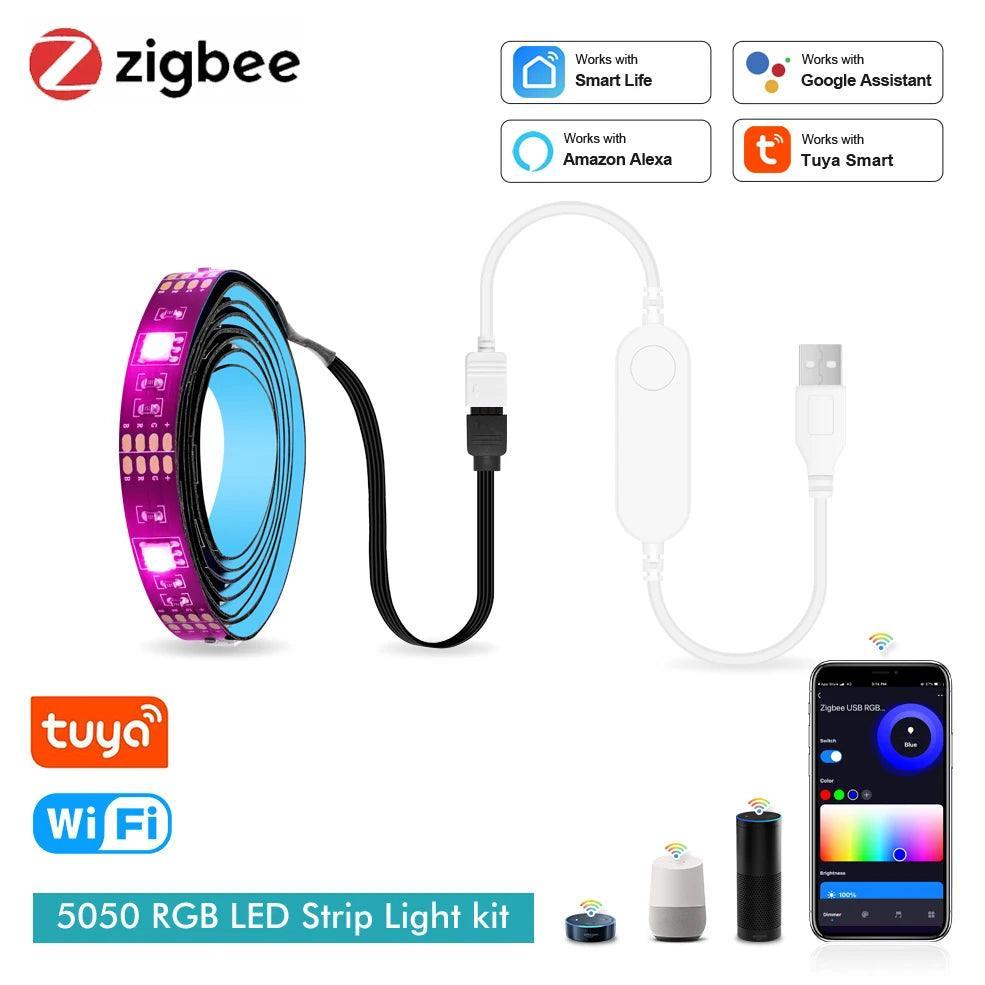
You can enhance your bedroom with smart lighting without replacing existing fixtures. The Tuya Zigbee & WiFi RGB LED Strip Light lets you add a concealed, calming glow behind the headboard or under the bed, integrating seamlessly with your current setup.
Future Trends in Smart Bedroom Lighting
The most meaningful future trends in smart bedroom lighting are about better interaction and calmer automation, not louder effects or more colors.
Expect improvements in these directions:
- More natural control surfaces: quieter physical controls, better bedside buttons, and fewer reasons to open an app.
- Smarter automation logic: routines that adapt to season and bedtime drift without over-triggering in the middle of the night.
- Better sensing with less intrusion: occupancy and ambient-light sensing that supports comfort without requiring microphones in bedrooms.
- Lighting that respects sleep: more products designed around warm dimming, low glare, and gentle ramps rather than maximum brightness.
Trend decision rule: choose systems that stay useful even if “smart features” change. Physical usability, stable dimming, and sensible scenes do not go out of style.
Detailed Insight:
Common Mistakes to Avoid When Upgrading to Smart Bedroom Lighting
Most smart bedroom lighting failures come from over-complexity and poor control placement, not from choosing the “wrong brand.”
These are the mistakes that repeatedly destroy daily usability:
- Building a system you can’t use half-asleep: if control requires an app and multiple taps, you will stop using it at night.
- Automating the wrong thing: avoid automation that triggers unpredictably (especially bright lights at night).
- Ignoring glare: visible bulbs and mirror reflections can keep you alert even when light is warm.
- Mixing incompatible layers: smart bulbs on a dimmer, or a wall switch that kills power to smart lamps.
- Too many scenes: if you create ten scenes, you will use one. Three core scenes usually win.
- No fallback: bedrooms need a reliable “always works” option when Wi‑Fi, apps, or services fail.
Fix pattern: simplify. Pick one control backbone, make your default Evening scene one action, and make the lights comfortable from the bed.
FAQs About Smart Bedroom Lighting
These FAQs cover real bedroom edge cases and decisions that do not always fit neatly into the main sections.
Do smart lights actually help sleep, or is it just a vibe?
Smart lighting helps when it changes your evening environment consistently: dimmer, warmer, lower glare, and easier to repeat. It is not a substitute for medical care, but it can support better sleep routines.
What is the simplest smart bedroom setup that feels “worth it”?
One dimmable warm bedside lamp you can control from bed plus a low-level night path light. Add a single Evening scene button if you want the habit to stick.
Is a smart switch better than smart bulbs for a shared bedroom?
Often yes for reliability and usability, especially for the main light. You can still add smart bulbs to lamps for warmth and comfort without making the whole room dependent on apps.
Will motion sensors wake me up at night?
They can if the light is too bright or placed too high. Keep night sensors low, set brightness to a minimal level, and use warm light so the trigger supports safety without pushing alertness.
Can I keep my existing ceiling fixture and still get good smart lighting?
Yes. Use a compatible smart dimmer for that circuit, then add a warm, low-glare bedside lamp for wind-down comfort. This combination is often more usable than trying to make everything a smart bulb.
What if I do not want microphones in my bedroom?
You can build an excellent smart bedroom with physical scene buttons, smart switches, and app-based setup. Voice control is optional; it should never be the only way the room works.
Conclusion: Is Smart Bedroom Lighting Right for You?
Smart bedroom lighting is right for you if it makes nightly routines simpler: a calmer default in the evening, safer movement at night, and gentler wake-ups with less effort.
If you love control and consistency, a small smart system can feel like an everyday quality-of-life upgrade. If you dislike maintenance, focus on simple scenes, physical controls, and local fallback behavior so the bedroom stays dependable. The best outcome is not a “smart home.” It is a bedroom that feels predictably comfortable most nights—without you thinking about it.
After considering all the factors mentioned, you can explore more product options and detailed buying guides on our Indoor Lighting Hub Page to find the best solution for your needs.

















 />
/>
 />
/>
 />
/>
 />
/>
 />
/>